

What to Expect in a Monthly Marketing Report: The 2026 Business Owner’s Guide
Nearly 30% of marketers reported decreased search traffic this year as consumers shift toward AI tools for answers. If your agency is still bragging about “impressions” while your phone isn’t ringing, you’re looking at the wrong data. Knowing exactly what to expect in a monthly marketing report is the difference between a wasted budget and a scalable engine for growth. You shouldn’t have to guess if your spend is driving leads or if your agency is actually being proactive.
It’s frustrating to receive a 20-page PDF that lacks a single clear action item. You need a report that acts as a strategic roadmap, not a history lesson. This guide will help you decode your data and identify the specific KPIs that translate to real revenue growth for your business. We’ll explore how 2026 privacy laws in states like Indiana and Kentucky affect your tracking; why first-party data is now your most valuable asset; and how to ensure your marketing system is built for ROI. With customer trust in AI falling to 42%, your reports must show more than just automated charts. They must prove your agency is protecting your data and your bottom line.
Key Takeaways
- Learn how to transform raw data into business intelligence that links your marketing investment to tangible revenue growth.
- Understand what to expect in a monthly marketing report, including a concise executive summary and clear goal tracking.
- Identify critical 2026 performance indicators such as ADA compliance health checks and AI chatbot lead capture rates.
- Master the ability to spot vanity metrics that look good on paper but fail to drive actual leads or sales.
- Gain the clarity needed to ensure your agency is providing proactive strategic recommendations for the month ahead.
What is a Monthly Marketing Report and Why Does It Matter?
A monthly marketing report is a recurring document that translates raw marketing data into business intelligence. It isn’t just a list of numbers; it’s the vital bridge between your marketing investment and your company’s revenue goals. When you understand what to expect in a monthly marketing report, you stop viewing marketing as a mysterious expense and start seeing it as a predictable engine for growth. This document takes the systematic computational analysis of data and turns it into a clear narrative about where your business is headed and how to get there faster.
Consistency is key for any growing brand. A 30-day cadence represents the “sweet spot” for modern marketing analysis. It’s long enough to spot significant trends and gather statistically relevant data, yet short enough to prevent you from wasting budget on underperforming campaigns for months on end. This timeframe allows your agency to make informed adjustments without the knee-jerk reactions that often plague daily or weekly monitoring. You need a strategic performance review, not a “data dump” that leaves you more confused than when you started.
A strategic review focuses on the “so what?” behind the numbers. If your impressions went up by 20% but your sales stayed flat, a simple data dump would just celebrate the 20% increase. A strategic report, however, would investigate why those impressions didn’t convert and outline a specific plan to fix the funnel. This level of insight is exactly what to expect in a monthly marketing report from a partner who’s truly invested in your success. It moves the conversation from “look at these charts” to “here is how we’ll increase your profit next month.”
The Purpose of Regular Reporting in 2026
Reporting ensures absolute accountability for your SEO services Orange County. It validates your budget allocation across PPC, social media, and content by showing exactly which dollars are returning a profit. A high-quality report helps you identify which channels are over-performing and which require a pivot. It’s about transparency. You shouldn’t have to guess if your marketing is working; the report should prove it through clear, verifiable outcomes that align with your specific business objectives.
Reporting vs. Real-Time Dashboards
Real-time dashboards are great for monitoring daily fluctuations, but they lack the depth needed for high-level decision making. Dashboards show you what’s happening now; reports explain why it’s happening and what to do next. The true value lies in human expert commentary over automated software exports. Experts filter out the noise and focus on long-term growth, preventing the “metric obsession” that leads to short-term thinking. A report provides the context and proactive strategy that a raw dashboard simply can’t offer.
The 7 Essential Components of a High-Impact Marketing Report
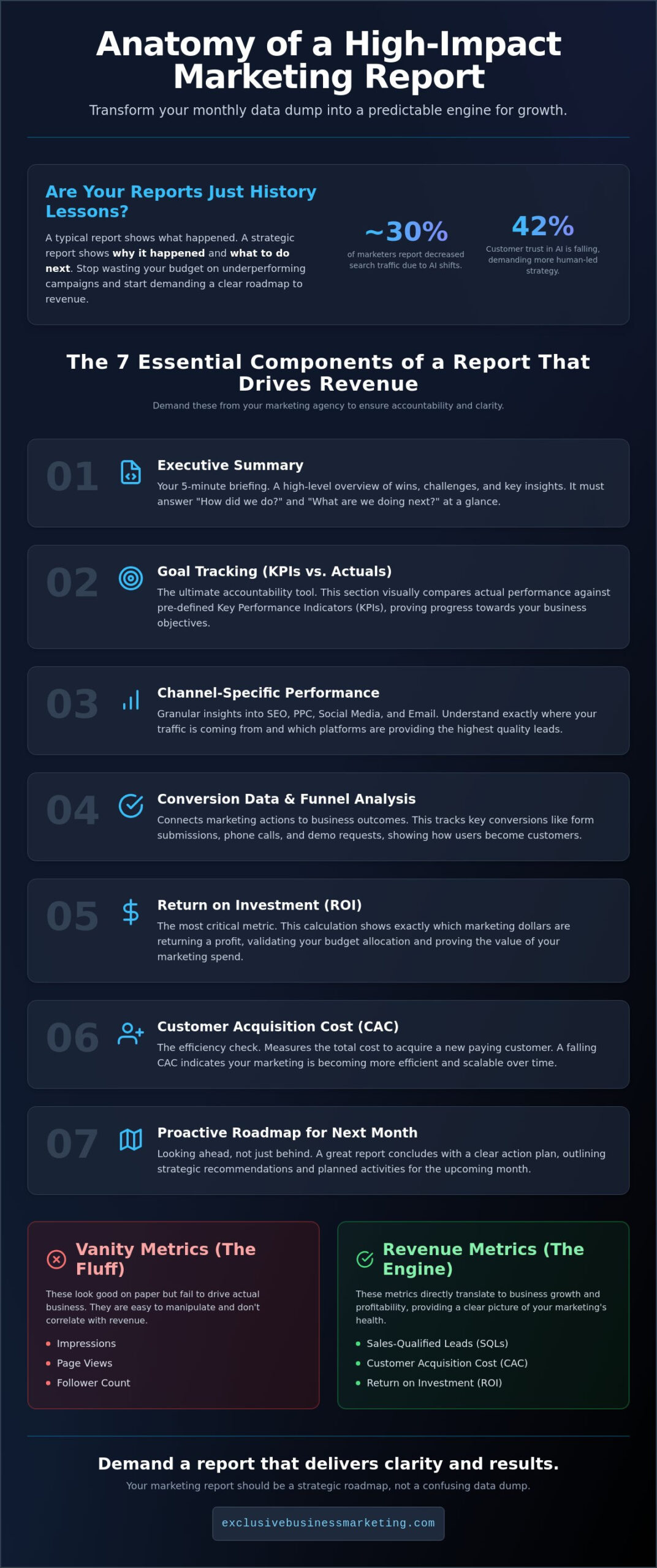
A high-impact report is lean, focused, and avoids the “fluff” of unnecessary cover pages. It prioritizes data-driven marketing strategies that move the needle for your specific business. When considering what to expect in a monthly marketing report, look for these seven essential building blocks: an executive summary, goal tracking, channel-specific performance, conversion data, ROI analysis, Customer Acquisition Cost (CAC), and a proactive roadmap for the coming month.
Each of these components serves a distinct purpose. Goal tracking provides a clear comparison of actual results versus your predefined KPIs. It’s the ultimate accountability tool. Channel performance then breaks this down further, providing granular insights into SEO, PPC, and social media. This clarity allows you to see exactly where your traffic is coming from and which platforms are earning their keep. If your report doesn’t clearly link these activities to your bottom line, it isn’t doing its job.
The Executive Summary: Your 5-Minute Briefing
The Executive Summary should be the first page of every report. It acts as a “TL;DR” for busy owners, summarizing the biggest wins and acknowledging any challenges faced during the month. A great summary doesn’t just look backward; it must include a “Next Month Roadmap.” This ensures you know exactly what your agency is doing to improve performance. It’s about transparency and proactive leadership, giving you the confidence that your marketing is in capable hands.
Deep Dive: SEO and PPC Metrics
Your report must analyze keyword ranking movements and organic traffic quality. High rankings are useless if they don’t bring in the right visitors. For paid media, we look at CTR, Quality Score, and Cost Per Conversion. These metrics are vital for validating your investment in pay per click management services. You need to know if your ads are producing a profit or simply burning through your budget. We focus on the numbers that lead to growth.
Conversion and Revenue Attribution
Conversion data is where marketing meets reality. We track the entire path from a Google search to a phone call or form fill. This allows us to attribute revenue to specific campaigns with high precision. If a conversion rate trend line dips, the report should explain why and offer a fix. Understanding what to expect in a monthly marketing report means demanding this level of detail. If you want to see how your data can drive real growth, consider how professional marketing management can clarify your path to success.
Next-Gen Metrics: Accessibility, AI, and Compliance
Marketing in 2026 has evolved beyond simple traffic and clicks. As technology integrates deeper into the customer journey, your reporting must adapt to include technical health and automated performance. Understanding what to expect in a monthly marketing report today means looking for data on ADA compliance, AI chatbot efficiency, and video engagement. These aren’t just “extra” stats; they are core indicators of your brand’s stability and its ability to scale in a digital-first economy.
When you Make a marketing plan, you have to account for the tools that work while you sleep. If your agency isn’t reporting on how your AI chatbot handles after-hours inquiries or how your video content influences brand sentiment, you’re missing half the story. High-impact reports now include view-through rates for video marketing and granular engagement metrics for custom mobile applications. These insights prove that your connected systems are working together to move prospects through the funnel.
ADA Compliance Monitoring
Accessibility is no longer optional. Monthly audits are essential to protect your business from website accessibility lawsuits. Your report should feature a WCAG compliance health check that tracks your accessibility score improvements over time. This isn’t just a legal shield. A compliant site reaches a wider audience and improves your overall SEO performance. When you know what to expect in a monthly marketing report, you look for this proactive monitoring to ensure your digital presence remains inclusive and legally sound.
AI Chatbot and Automation Insights
Your AI assistant is often the first point of contact for a lead. Your monthly report should quantify its impact. How many leads did it capture while your office was closed? What are the customer satisfaction scores (CSAT) for these automated interactions? By identifying common customer questions through chatbot data, we can inform your future content strategy and refine your sales process. This level of detail turns a simple bot into a 24/7 sales powerhouse. We analyze these interactions to ensure your automation feels human and delivers results.
Finally, for brands utilizing video or mobile apps, view-through rates and app retention are non-negotiable metrics. Video view-through rates tell us if your message is resonating or if viewers are dropping off early. Mobile app metrics reveal how often users return to your platform. Both are critical for understanding long-term brand loyalty. Your report should synthesize all these next-gen data points into a single, cohesive narrative of business growth.
How to Interpret Your Report to Drive Business Decisions
Receiving your report is only the first step. The real value lies in how you use that data to steer your company toward higher profitability. When you know what to expect in a monthly marketing report, you can quickly separate “vanity metrics” from “value metrics.” Vanity metrics, like total impressions or social media likes, might boost your ego, but they don’t pay the bills. Value metrics, such as your cost per lead and conversion rate, tell you the truth about your business health. Focus on the numbers that represent actual money entering your bank account.
Distinguishing between seasonal trends and genuine performance issues is another critical skill. If you’re in a B2B industry, a dip in leads during late December is often just a seasonal trend. However, a steady decline in organic traffic over three consecutive months is a performance issue that requires a pivot. We recommend the “Three-Month Rule” for any new strategy. Marketing systems need time to calibrate. Evaluating a campaign after only thirty days often leads to premature changes that sabotage long-term results. Be patient, but stay vigilant.
Spotting Growth Opportunities
Your report should act as a treasure map for future profits. Look for high-converting keywords that currently have low search volume; these are often untapped goldmines. If you notice specific blog posts are driving significant engagement, that’s a content gap telling you what your audience wants more of. You should also analyze orange county web design data to see how users interact with your landing pages. If people are clicking but not converting, a simple layout adjustment could double your revenue without increasing your ad spend.
Red Flags to Watch For
Aggressive growth sometimes hides underlying problems. One major red flag is increasing traffic paired with decreasing conversion rates. This usually means your marketing is attracting the wrong audience. Stagnant keyword rankings in a growing market suggest your competitors are outworking you on technical SEO. High bounce rates on your primary service pages are another warning sign. They indicate that your website isn’t meeting the expectations of your visitors. If you see these patterns, it’s time to ask your agency for a specific correction plan.
Don’t be afraid to challenge the data. Ask your agency: “Why did this specific metric drop?” or “What is our plan to scale this success?” A great partner welcomes these questions because they prove you’re engaged. If you feel your current reporting lacks this level of actionable insight, it might be time to partner with a results-oriented marketing agency that prioritizes your ROI. Knowing exactly what to expect in a monthly marketing report gives you the power to demand excellence and drive your business forward with confidence.
The Exclusive Business Marketing Difference: Clarity and Results
We believe you deserve a partner who values your time as much as your budget. Many agencies hide behind technical noise and complicated spreadsheets to mask a lack of progress. At Exclusive Business Marketing, we’ve redefined what to expect in a monthly marketing report by prioritizing absolute clarity and jargon-free communication. Our reports don’t just list data; they provide a narrative of your growth. We translate complex digital signals into clear business outcomes so you can make informed decisions without needing a degree in data science.
Our approach is rooted in the specific needs of high-growth companies. When you work with a specialized business to business marketing agency, you gain access to strategies that are built for long sales cycles and high-value conversions. We integrate these niche insights into every report we deliver. You’ll work with a dedicated account manager who acts as your strategic interpreter. They filter out the noise and highlight the metrics that actually impact your bottom line. This personalized touch ensures your reporting is always tailored to your specific business goals, not a generic template.
Our Proactive Strategy Sessions
We don’t just email you a PDF and disappear. Every month, we host proactive strategy sessions to walk you through your results. These meetings are where we turn monthly data into quarterly pivots. If a specific campaign is outperforming expectations, we discuss how to scale it. If a channel is struggling, we present a fix before you even have to ask. This constant alignment ensures your marketing spend always supports your latest business objectives. We keep your strategy agile, responsive, and focused on the future.
Get a Marketing Audit That Actually Makes Sense
Are you tired of the “automated junk” other agencies send? Most free reports are just surface-level exports from software that don’t account for your unique market position or 2026 compliance needs. We invite you to receive a comprehensive SEO and compliance audit that offers genuine depth. We’ll analyze your current visibility, your ADA status, and your conversion bottlenecks. It’s time to move beyond vanity metrics and start demanding real business intelligence. Contact Exclusive Business Marketing for a results-driven partnership today!
Knowing what to expect in a monthly marketing report is your right as a business owner. Don’t settle for reports that leave you with more questions than answers. Demand transparency, demand accountability, and demand a roadmap that leads to revenue. We’re ready to show you the difference that expert, hands-on marketing management can make for your brand’s trajectory.
Take Control of Your Marketing Growth
Your marketing data should never be a source of frustration. By moving away from vanity metrics and focusing on high-impact KPIs like ROI and customer acquisition costs, you’re positioning your business for long-term stability. You now know exactly what to expect in a monthly marketing report, from executive summaries that outline clear roadmaps to technical audits covering the latest WCAG 2.1 and 2.2 standards. These insights are the fuel for smarter business decisions and proactive pivots.
As Orange County’s leading agency for SEO and ADA compliance, we’re committed to providing the clarity you need to scale. Our team offers 24/7 responsiveness and a hands-on, proactive strategy that ensures your marketing always aligns with your revenue goals. Don’t let your data go to waste or your compliance slip through the cracks. It’s time to demand more from your agency and your reporting.
You have the tools and the knowledge to turn every report into a strategic win. We’re ready to help you execute that vision with precision and confidence.
Frequently Asked Questions
What are the most important KPIs in a marketing report?
The most critical KPIs focus on your bottom line. You should prioritize Return on Investment (ROI), Customer Acquisition Cost (CAC), and overall conversion rates. While metrics like impressions or reach provide context, they don’t reflect revenue. A high-quality report connects marketing activities directly to lead generation and sales growth. This ensures your budget is always working to expand your market share.
How long should a monthly marketing report be?
A monthly report should be as long as necessary to provide clarity, but as short as possible to remain actionable. Most effective reports range from five to ten pages. This includes a high-level executive summary followed by granular data for each channel. Avoid agencies that send fifty-page documents filled with automated charts. You need strategic insights that you can read and understand in under ten minutes.
Why is my traffic up but my leads are down?
This discrepancy usually indicates a mismatch between your traffic source and your offer. You might be ranking for broad keywords that bring in “window shoppers” rather than buyers. It could also suggest friction on your landing pages that prevents visitors from converting. We analyze user behavior to identify where the disconnect happens. This allows us to pivot your strategy toward high-intent audiences who are ready to purchase.
Should I see results in the very first monthly report?
You should expect to see a baseline and initial progress, but major shifts often take time. SEO typically requires three to six months to show significant ranking improvements. However, paid campaigns like PPC can deliver immediate traffic and lead data. The first report is vital for setting benchmarks. It allows us to measure all future growth against your starting point and refine our tactics accordingly.
How do I know if my agency is “padding” the report with useless data?
Look for an over-reliance on vanity metrics like “total reach” or “engagement rate” without any connection to sales. If the report lacks a proactive strategy for next month, it’s likely just a data dump. Knowing what to expect in a monthly marketing report helps you spot these red flags. Every chart should serve a purpose. If a metric doesn’t help you make a business decision, it’s probably padding.
What is the difference between MQLs and SQLs in a report?
Marketing Qualified Leads (MQLs) are prospects who have engaged with your content but aren’t ready to buy. Sales Qualified Leads (SQLs) have been vetted and show a clear intent to purchase. Distinguishing between the two is essential for understanding your sales funnel. Your report should track how effectively marketing is moving MQLs into the SQL category. This ensures your sales team spends their time on the most promising opportunities.
How often should we have a meeting to discuss the monthly report?
You should meet once a month for a formal review of the results. This allows you to discuss the data and align on the strategy for the following thirty days. While your agency should be responsive to daily questions, the monthly deep dive is where the big strategic pivots happen. These sessions ensure that your marketing partner remains proactive and fully integrated with your company’s evolving goals.
Can I request custom metrics in my monthly report?
Absolutely. Your report should be customized to track the specific goals that matter to your business. Whether you want to monitor AI chatbot lead capture or specific product sales, your agency should accommodate these requests. Knowing what to expect in a monthly marketing report means demanding a document that reflects your unique KPIs. We tailor our reporting to ensure every metric provides value to your specific operational needs.