

What Is a Website Accessibility Audit? A Complete Guide
Is the threat of a costly ADA lawsuit looming over your business? If you find yourself confused by technical terms like WCAG and Section 508, you’re not alone. Many business owners worry about compliance, unsure if automated checkers are enough to protect them from legal action. The answer is a professional accessibility audit-your single most effective tool for securing your website and driving growth. It’s the definitive way to move from uncertainty to confident action and ensure your digital doors are open to everyone.
This complete guide provides a clear path forward. We will walk you through the entire audit process, from understanding the legal standards to identifying and fixing critical issues. You will gain a step-by-step plan to make your site compliant, avoid expensive legal fees, and welcome millions of new customers with disabilities. Stop worrying about potential lawsuits and start building a more successful, inclusive business today.
Key Takeaways
- Understand why a website accessibility audit is a non-negotiable step to protect your business from legal risks and welcome more customers.
- Learn how key standards like WCAG and the ADA provide a clear, manageable framework for making your website accessible to everyone.
- Discover why free online checkers are not enough and how a combination of automated and manual testing is essential for true compliance.
- See how a professional accessibility audit moves beyond compliance to unlock tangible business growth by improving SEO and enhancing user experience.
What Is a Website Accessibility Audit? (And Why It’s Non-Negotiable)
In simple terms, a website accessibility audit is a comprehensive evaluation of your website to identify and fix barriers that prevent people with disabilities from using it effectively. It’s a top-to-bottom inspection where your site’s code, design, and content are measured against established technical standards. The primary framework for this is the Web Content Accessibility Guidelines (WCAG), which provides a clear, internationally recognized roadmap for digital inclusion.
This audit is the critical first step to mitigate legal risk and unlock your website’s full potential. The ultimate goal is to create a seamless, effective online experience for every single visitor, protecting your business and expanding your customer base.
The Rising Tide of Website Accessibility Lawsuits
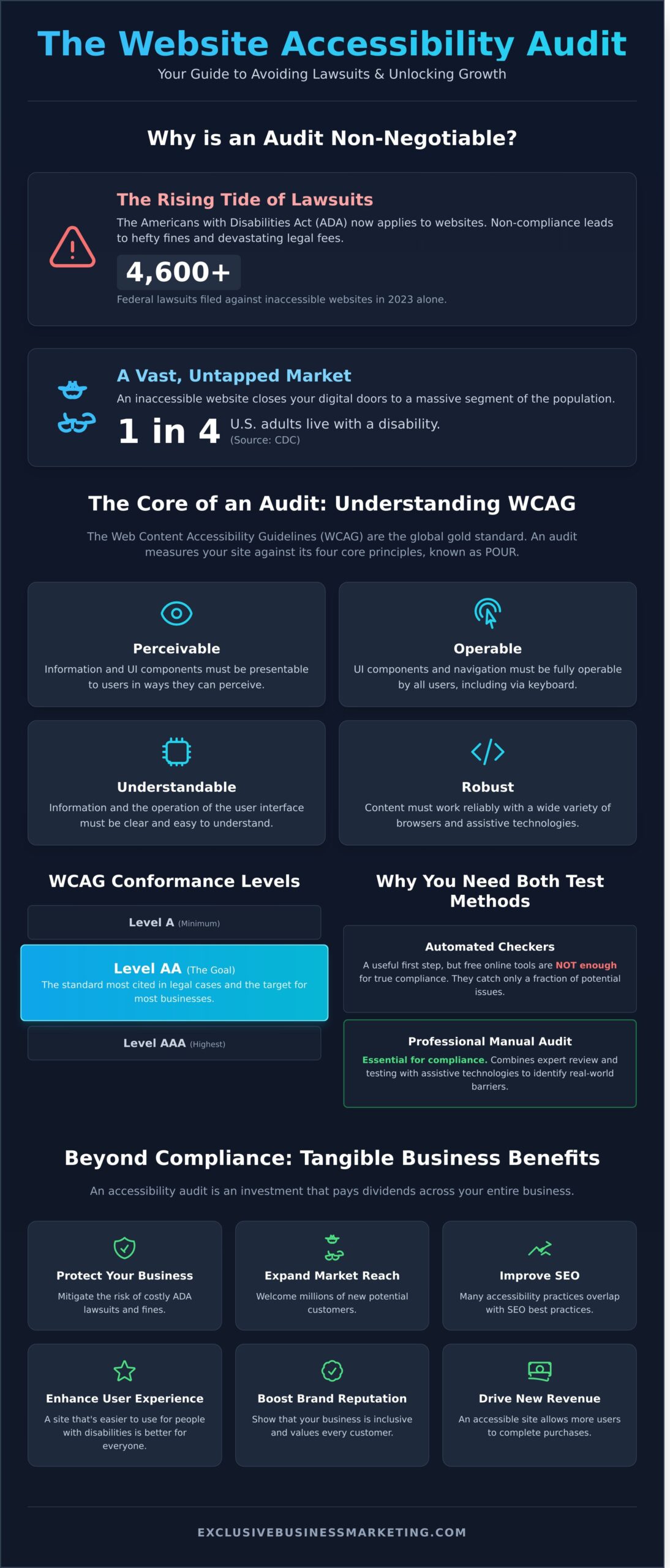
The digital landscape is a legal minefield for non-compliant businesses. In 2023 alone, over 4,600 federal lawsuits were filed against companies with inaccessible websites. The legal foundation is the Americans with Disabilities Act (ADA) Title III, which courts consistently rule applies to websites as “places of public accommodation.” States like California add another layer of risk with strict regulations like the Unruh Civil Rights Act. Non-compliance leads directly to hefty fines, devastating legal fees, and court-mandated remediation.
More Than a Legal Checklist: The Ethical and Business Case
Beyond legal threats, a commitment to accessibility is simply smart business. According to the CDC, one in four adults in the U.S. lives with a disability. An inaccessible website effectively closes your digital doors to 25% of your potential market. Digital inclusion is a modern business responsibility and a core tenet of excellent customer service. By ensuring everyone can navigate your site—whether they want to discover Seafood and Crawfish or browse a menu—you enhance your brand reputation, drive new revenue, and prove you value every potential customer.
The Core of an Audit: Understanding WCAG, ADA, and Section 508
A successful accessibility audit isn’t a guessing game. It’s a methodical evaluation of your website against clear, internationally recognized standards. Instead of viewing these guidelines as obstacles, see them for what they are: a proven roadmap to building a better, more inclusive website that serves every potential customer. These standards provide the technical framework that most accessibility laws rely on to define compliance, making them the foundation of any effective audit.
WCAG: The Global Gold Standard
The Web Content Accessibility Guidelines (WCAG) are the undisputed rulebook for digital accessibility. Developed by the World Wide Web Consortium (W3C), WCAG provides a single, shared standard that is technology-neutral. Its success criteria are organized under four core principles, known as POUR:
- Perceivable: Information and user interface components must be presentable to users in ways they can perceive.
- Operable: User interface components and navigation must be operable, meaning users can interact with them successfully.
- Understandable: Information and the operation of the user interface must be easy to understand.
- Robust: Content must be robust enough that it can be interpreted reliably by a wide variety of user agents, including assistive technologies.
WCAG defines three levels of conformance: Level A (the minimum), Level AA (the common target), and Level AAA (the highest). For the vast majority of businesses, achieving Level AA compliance is the goal. It delivers a high degree of accessibility and is the standard most frequently cited in legal cases and regulations worldwide.
ADA and Section 508: The Legal Connection
In the United States, laws provide the “why” for accessibility, while WCAG provides the “how.” The Americans with Disabilities Act (ADA) prohibits discrimination but doesn’t include its own technical rules for websites. However, U.S. courts and the Department of Justice (DOJ) consistently reference WCAG as the benchmark for compliance. Similarly, Section 508 requires federal agencies to make their technology accessible, and it directly incorporates WCAG standards. For your business, this simplifies the path forward: focusing your accessibility audit on achieving WCAG 2.1/2.2 Level AA is the most effective strategy to ensure legal compliance and strengthen the business case for digital accessibility by reaching the widest possible audience.
The Accessibility Audit Process: What to Expect Step-by-Step
An accessibility audit might sound intimidating, but with a capable partner, it’s a straightforward and structured process designed to deliver clear results. We demystify the technical complexities, providing you with a transparent, step-by-step plan to improve your website’s usability for everyone. The goal is not just to find problems, but to provide a clear roadmap to a more inclusive and compliant digital presence. We manage the process so you can focus on the outcome: a better website that serves more customers.
Phase 1: Scoping and Defining Goals
The first step is a strategic kickoff to align on goals. We work with you to define the scope of the accessibility audit, ensuring we focus on what matters most to your users and your business. This initial planning, as emphasized by official resources like the GOV.UK guide on getting an expert audit, is crucial for success. Together, we will:
- Identify your website’s key user journeys, like completing a purchase or filling out a contact form.
- Select a representative sample of pages that covers all unique templates and critical functionalities.
- Define the target conformance level, typically the industry standard of WCAG 2.1 Level AA.
- Establish clear communication channels and project timelines.
Phase 2: Testing and Issue Identification
This is where our certified professionals get to work. We use a powerful combination of automated scanning tools and in-depth manual testing to uncover every potential barrier. Unlike simple automated checkers, our hands-on approach simulates the real-world experience of users with disabilities. We meticulously document every issue found with screenshots, code references, and clear explanations, then categorize each one by severity (critical, serious, or moderate) to guide prioritization.
Phase 3: Reporting and Remediation Guidance
You won’t receive a confusing spreadsheet of technical jargon. Our final deliverable is a comprehensive report that is built for action. Each identified issue is explained in plain English, detailing its impact on users and its violation of WCAG standards. Most importantly, the report provides your development team with clear, actionable recommendations and code examples to fix the problems efficiently. We give you a prioritized plan to tackle the most critical issues first, generating the biggest impact with the least amount of friction. See what a professional audit can uncover for you.
Automated vs. Manual Audits: Why You Absolutely Need Both
One of the most common and costly misconceptions in web accessibility is believing that a free online checker is a complete audit. It isn’t. Relying solely on these tools leaves your business exposed to legal risks and alienates customers with disabilities. To achieve genuine compliance and usability, you need a two-pronged strategy.
Think of it this way: an automated scan is like running a spell-check on a document. It’s great for catching obvious, technical mistakes quickly. A manual audit, however, is like hiring a professional editor who reviews the document for clarity, tone, and logical flow. One without the other is an incomplete job. A comprehensive accessibility audit leverages the strengths of both.
What Automated Tools Can (and Can’t) Do
Automated accessibility checkers are powerful first-pass tools. They rapidly scan hundreds of pages to identify common, code-based errors that are easy to miss. They excel at flagging “low-hanging fruit” and providing a baseline for your remediation efforts. These tools are fantastic for catching issues like:
- Images with missing alt text
- Text and background color combinations with low contrast
- Empty links or buttons without descriptive text
- Basic structural errors, like skipped heading levels
However, automated tools have a critical weakness: they lack human context. They can tell you if an image has alt text, but not if that text is meaningful. They can’t understand if a complex navigation menu is confusing or if a form is frustrating to use. They check for technical compliance, not real-world usability.
The Irreplaceable Value of Manual Testing
This is where human expertise becomes essential. A manual accessibility audit simulates the experience of users with different disabilities, uncovering the critical issues that automated tools will always miss. Only a human tester can accurately assess:
- Keyboard-Only Navigation: Can a user access every interactive element, from menus to forms, without a mouse? Is the navigation order logical and predictable?
- Screen Reader Experience: Does the content make sense when read aloud by a screen reader? Are forms and buttons labeled clearly for non-visual users?
- Complex User Journeys: Is your online checkout process, appointment scheduler, or multi-step form truly usable for someone relying on assistive technology?
Ultimately, manual testing is the only way to ensure your website is not just technically compliant, but genuinely usable. It’s the difference between meeting a checklist and providing an inclusive experience that drives customer loyalty and revenue. At Exclusive Business Marketing, our certified experts combine powerful tools with in-depth manual testing to deliver a complete, actionable audit that protects and grows your business.
Beyond Compliance: The Tangible Business Benefits of an Audit
Viewing web accessibility as just a box to check to avoid penalties is a massive missed opportunity. A thorough accessibility audit isn’t a business expense; it’s a strategic investment that delivers a powerful competitive edge. By prioritizing an inclusive user experience, you unlock tangible benefits that directly fuel your core marketing goals, driving more traffic, leads, and revenue.
An accessible website isn’t just for a niche audience-it’s a better, more functional, and more profitable website for every single visitor.
Boosting Your SEO and Online Visibility
Many business owners are surprised to learn how much accessibility best practices overlap with modern SEO. When you make your site more accessible, you’re also sending powerful positive signals to search engines like Google. A better user experience leads to lower bounce rates and higher engagement, which are key ranking factors.
- Proper Heading Structure (H1, H2, H3): Organizes content for screen readers and helps search engines understand your page hierarchy.
- Image Alt Text: Describes images for visually impaired users and provides crucial context for image search crawlers.
- Video Transcripts & Captions: Makes video content accessible and provides a text-based version for search engines to index.
Expanding Your Market Reach and Revenue
Globally, over a billion people live with some form of disability, representing a massive, yet often overlooked, market segment with significant disposable income. An inaccessible website is like a locked door to these potential customers. By opening that door, you not only grow your customer base but also build a reputation as an inclusive, socially responsible brand. For instance, a creative hobbyist looking to discover Embroidery n Sewing should have the same seamless experience as any other user. This fosters deep customer loyalty and generates powerful, positive word-of-mouth marketing.
What to Do After Your Audit Report
Your accessibility audit report is the diagnosis; remediation is the cure. The report will provide a clear roadmap of issues, but the real value comes from taking decisive action. Start by working with your development team or a specialized digital marketing agency to prioritize and fix the most critical blockers-the issues that prevent users from completing key tasks. Once compliant, implement a plan for ongoing monitoring to ensure your website remains accessible as you add new content and features, safeguarding your investment for the long term.
Secure Your Site and Unlock New Growth
Navigating website accessibility is no longer optional-it’s a fundamental part of smart business strategy. As we’ve covered, a comprehensive approach that blends automated tools with expert manual testing is essential for true compliance with standards like WCAG and the ADA. More than just a legal safeguard, a thorough accessibility audit is your roadmap to reaching a wider audience, enhancing your brand reputation, and improving your bottom line. It transforms a potential liability into a powerful asset.
For businesses looking to extend this protection to their broader IT infrastructure, BoTech Security Solutions offers enterprise-grade cybersecurity and compliance resources that complement your digital accessibility efforts.
Our Orange County-based agency features certified professionals in ADA and WCAG compliance with proven results in driving leads and revenue for businesses just like yours. We handle the complexities so you can focus on what you do best. Don’t wait for a lawsuit. Request a professional accessibility audit today.
Take the first step toward a more inclusive and successful future online. Your customers-and your business-will thank you for it.
Frequently Asked Questions About Website Accessibility Audits
How much does a website accessibility audit cost?
The cost of a website accessibility audit varies widely based on scope and complexity. A basic automated scan might cost a few hundred dollars, while a comprehensive manual audit by certified professionals for a large, complex website can range from $5,000 to over $25,000. Key factors influencing the price include the number of unique pages, the complexity of site functions, and the level of reporting required to achieve your compliance goals and generate more revenue.
How long does a typical accessibility audit take to complete?
A typical accessibility audit takes between one to four weeks to complete. The timeline depends directly on your website’s size and technical complexity. A small informational site with a few templates might be finished in a week. However, a large e-commerce platform with thousands of pages and dynamic user interactions will require a more extensive testing period to ensure a thorough and accurate evaluation. We provide a clear timeline before any project begins.
What’s the difference between an accessibility audit and a VPAT?
An accessibility audit is the hands-on process of testing a website against WCAG guidelines to identify barriers for users with disabilities. A VPAT (Voluntary Product Accessibility Template), on the other hand, is a formal document that reports the results of that testing. The audit is the investigation; the VPAT is the official report card that communicates your product’s level of compliance, often required for government or enterprise contracts. An audit generates the data needed for a VPAT.
Can I perform an accessibility audit myself?
You can perform a preliminary accessibility audit yourself using automated tools like WAVE or Google Lighthouse. These tools are excellent for catching common issues like missing alt text or low-contrast text. However, they cannot detect many nuanced usability problems that require manual testing by a human expert. For comprehensive WCAG compliance and to mitigate legal risk, a professional audit is the most effective and reliable solution to ensure your site is truly accessible.
What are the most common accessibility issues found during an audit?
The most common issues we find include images missing descriptive alt text, which is crucial for screen reader users. Other frequent problems are low color contrast that makes text hard to read, links with vague text like “click here,” and forms that are not labeled correctly. A lack of keyboard-only navigation is another major barrier, preventing users who cannot operate a mouse from accessing all of your website’s features and content.
How often should I conduct an accessibility audit on my website?
We recommend a comprehensive accessibility audit at least once a year to maintain compliance and a positive user experience. You should also conduct smaller, targeted audits after any major website redesign, feature launch, or significant content update. Regular monitoring ensures that new changes don’t introduce new accessibility barriers, protecting your investment and keeping your site open to all potential customers. This proactive approach is key to long-term digital success.