

Voice Search Optimization for Local Business: The 2026 Strategy Guide
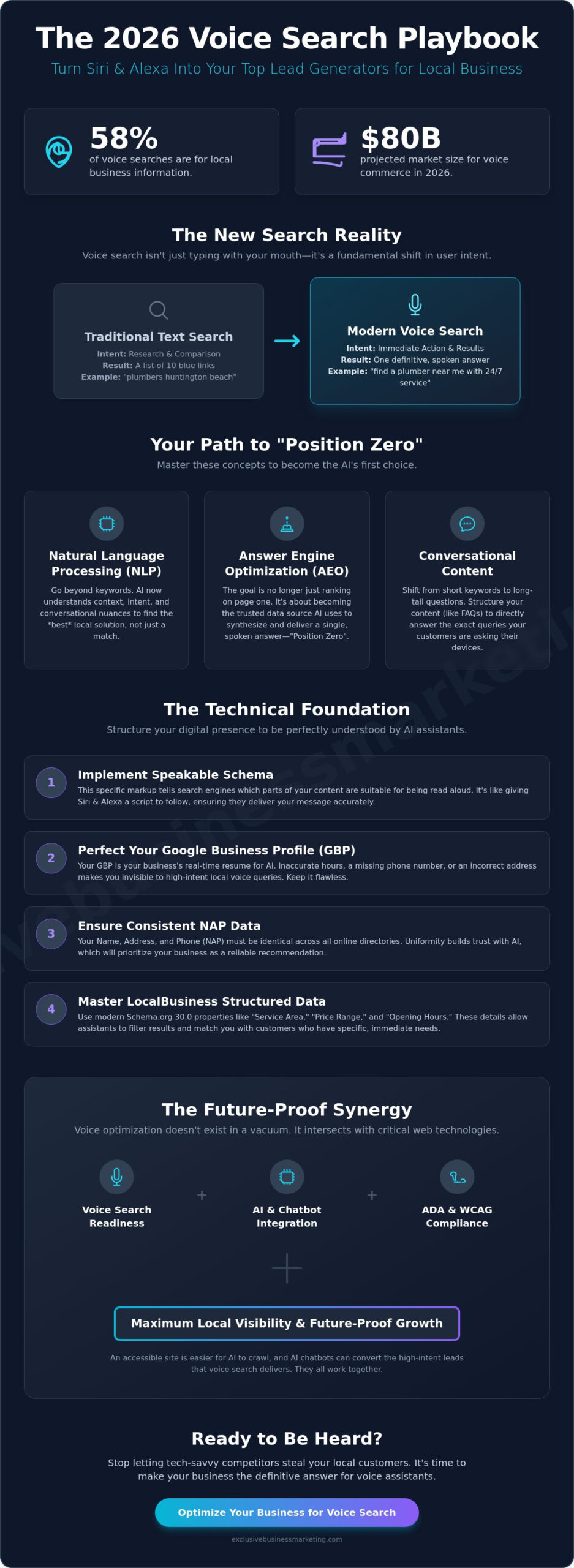
Did you know that 58% of voice searches are now specifically for local business information? As voice commerce reaches a projected $80 billion in 2026, mastering voice search optimization for local business is the most direct way to ensure your brand isn’t silenced by tech-savvy competitors. You’ve worked hard to build your reputation; however, if Siri and Alexa can’t find you, your local customers won’t either.
We know it’s exhausting to watch leads slip away while you try to decode Google’s March 2026 core updates and the latest Schema.org 30.0 standards. You need a strategy that works without demanding all your free time. This guide provides a clear roadmap to capture “near me” traffic and dominate “Position Zero” answers. You’ll learn how to future-proof your business against AI search changes and turn voice assistants into your most effective lead generators. We’ll preview the exact conversational keyword shifts and technical updates required to drive more phone calls and foot traffic starting today.
Key Takeaways
- Identify how Natural Language Processing (NLP) turns spoken queries into immediate foot traffic for your storefront.
- Implement Speakable Schema and real-time signals to ensure your voice search optimization for local business captures “Position Zero” results.
- Shift your content strategy to conversational, long-tail questions that mirror how customers actually talk to Siri and Alexa.
- Understand the technical overlap between WCAG 2.1 compliance and voice search to future-proof your digital presence.
- Discover how to deploy AI chatbots that qualify and convert high-intent leads arriving from local voice queries.
What is Voice Search Optimization for Local Business in 2026?
In 2026, voice search optimization for local business is the art and science of ensuring your brand is the definitive answer provided by AI assistants. It’s a massive shift from traditional SEO. While text search involves browsing a list of results, voice search is built on immediate action. When a customer asks Siri for a recommendation, they aren’t looking for a list of ten options. They want the best one right now. Understanding What is Voice Search today requires looking beyond simple keywords. We’ve moved into the era of Natural Language Processing (NLP), where search engines understand context, intent, and conversational nuances. This technology allows assistants to interpret the “why” behind a query, not just the “what.”
Local businesses are the primary winners in this landscape. Since 58% of voice searches are for local information, your physical location and immediate availability are your biggest assets. Text search is for research; voice search is for results. If someone types “plumbers,” they might be comparing prices. If they say “find a plumber near me with 24/7 service,” they have an emergency. They’re ready to call or drive to your door immediately. You must position your business to be that first and only recommendation. We help you capture that high-intent traffic by making your business the most logical choice for the AI to present.
The Rise of Answer Engine Optimization (AEO)
AI models like Perplexity and SearchGPT have changed the rules. They don’t just point to websites; they synthesize information to provide a single, spoken answer. This is Answer Engine Optimization. To win in 2026, you can’t just rank on page one. You need to be the specific data source these AI models trust. The goal is no longer “ten blue links.” The goal is becoming the “Position Zero” answer that an assistant reads aloud to a potential customer. This requires a shift in how you structure your digital footprint to be readable by machines, not just clickable by humans.
Why Local Context Matters More Than Ever
Context is everything for businesses in Huntington Beach and the wider Orange County area. Voice searches are significantly more likely to carry local intent compared to traditional typing. Users have moved past “near me” and now ask specific questions about your services, hours, and reputation. Using hyper-local data ensures that when someone asks for a specific service in their neighborhood, your business is the one the AI validates. We ensure your data is so clear and structured that assistants never hesitate to recommend you over a competitor. It’s about being present where the conversation is happening.
Technical SEO: Schema Markup and Local Visibility Signals
Technical precision is the backbone of any successful voice search optimization for local business strategy. If your website’s backend is a mess, Siri and Alexa will simply ignore you. You must implement Speakable Schema to identify which specific sections of your content are suitable for text-to-speech conversion. This markup tells search engines exactly what to read aloud when a user asks a question. Beyond code, your Google Business Profile (GBP) acts as your real-time resume. If your hours are wrong or your phone number is missing, you’re invisible to voice queries. Consistent Name, Address, and Phone (NAP) data across every local directory is non-negotiable. AI assistants prioritize businesses with verified, uniform information because they won’t risk giving a user a dead-end recommendation.
Mastering LocalBusiness Structured Data
With the release of Schema.org 30.0 in March 2026, the complexity of structured data has increased. You need to focus on specific properties like “Opening Hours,” “Service Area,” and “Price Range.” These details allow assistants to filter results based on the user’s immediate needs. There is a significant overlap between ADA compliant website design and voice search readiness. Accessible sites are naturally easier for AI to crawl and interpret. Achieving ADA Compliance for Voice Search ensures your site meets the U.S. Department of Justice standards while simultaneously boosting your local visibility. If you’re feeling overwhelmed by these technical requirements, we can help you audit your current site structure to ensure nothing holds you back.
Mobile Optimization: The Engine of Voice Search
Most voice searches happen on mobile devices or through in-car systems like Apple CarPlay. Your site must load in under two seconds to stay competitive. The March 2026 core algorithm update places heavy weight on Core Web Vitals like Interaction to Next Paint (INP). If your site is sluggish, voice assistants will skip over you in favor of a faster competitor. Mobile-first indexing isn’t just a suggestion; it’s a requirement for voice search optimization for local business success. Responsive design ensures that when a user transitions from a voice query to a screen interaction, the experience is seamless. High-speed performance and accessibility are the dual engines that drive your local reach, and experts like Webexpand emphasize that building high-performance growth engines is the key to maintaining this edge. Don’t let a slow server or outdated design cost you high-intent leads.
Content Strategy: Mastering Conversational Keywords and Direct Answers
You aren’t just writing for a screen anymore; you’re writing for an ear. The way people type is often cold and clinical, but the way they speak is warm and contextual. If your website still targets fragmented terms like “SEO Orange County,” you’re missing the conversational wave. Effective voice search optimization for local business demands that you mirror the way your neighbors actually talk. They don’t bark keywords at their phones. They ask, “Who is the best SEO agency in Huntington Beach?” Your content must meet them at that level of natural interaction to stay relevant in 2026.
We recommend using the “Who, What, Where, When, Why” framework for every local service page you publish. This structure ensures you cover all the bases that an AI assistant looks for when verifying a business. To see how a professional building firm implements these clear, punchy declarations on their site, click here. Keep your sentences under 20 words whenever possible. Short, punchy declarations are easier for Natural Language Processing (NLP) models to parse and read aloud. This clarity builds trust with both the search engine and the end user. It makes your information the most reliable choice for a voice assistant to relay.
Building the Ultimate Local FAQ Page
Start by identifying the top 10 questions your customers ask during their first phone call. These are your most valuable conversational keywords. Write a single sentence defining your primary service with a location-specific hook. This isn’t just about being found; it’s about being relevant to your specific community. Use long-tail phrases that reflect Southern California speech patterns. People here might ask about services “near the 405” or “close to the pier.” Integrating these local landmarks makes your business feel immediate and accessible to the AI.
Optimizing for Featured Snippets
The “People Also Ask” box is your gateway to becoming a voice search leader. To capture this space, you must structure your content with precision. Use your H2 and H3 headings to pose the exact questions your audience is asking. Follow these headers with a direct answer in the very next paragraph. For “How-to” queries, always use bulleted or numbered lists. Voice assistants prefer these formats because they can relay information in a logical, easy-to-follow sequence. This methodical strategy is a cornerstone of voice search optimization for local business and positions your brand as the ultimate authority in your local market.
The Intersection of Voice Search, AI, and ADA Compliance
Voice search isn’t just a convenience for multi-tasking drivers. For users with visual or motor impairments, it’s a primary gateway to the digital world. This makes voice search optimization for local business a matter of both performance and equity. The U.S. Department of Justice set a critical deadline of April 24, 2026, for many local entities to achieve ADA Title II compliance. This isn’t just a legal hurdle. It’s a roadmap for better search results. When you build a site that a screen reader can navigate, you’re simultaneously building a site that Siri and Alexa can understand.
The technical overlap between WCAG 2.1 requirements and voice search is undeniable. Both rely on a logical information hierarchy and clean code. If your site is a maze of unlabelled buttons and broken links, an AI assistant will struggle to extract the “near me” traffic you crave. Positioning accessibility as a core pillar of your orange county seo strategy allows you to dominate the market while serving all customers. It’s a dual-purpose approach that maximizes your digital footprint.
Voice as Assistive Technology
Assistive tools and voice assistants share the same DNA. They both read your site’s code to interpret meaning. Clear alt-text for images and descriptive heading structures are vital. They don’t just help visually impaired users; they provide the context AI agents need to narrate your business details accurately. An ada compliant web design is inherently better at ranking for voice queries because it removes the friction between the machine and the content. You gain legal protection and a significant SEO boost in one move.
Future-Proofing with Universal Design
Google prioritizes websites that offer a superior experience to every visitor. Inclusive design principles ensure that voice-driven visitors don’t bounce due to poor navigation or slow response times. Semantic HTML helps AI agents identify your business intent without guesswork. By focusing on universal design, you ensure your voice search optimization for local business efforts remain effective long after the next algorithm update. If you want to secure your place at the top of the search results, contact us to start your accessibility audit today.
Scaling Your Local Reach with Exclusive Business Marketing
Huntington Beach businesses need more than just a visible website; they need a digital presence that answers back. We integrate voice search optimization for local business with advanced AI to ensure you’re never out of reach. Our methodology doesn’t just stop at rankings. We look at total digital readiness. This includes a full audit of your current SEO, your ADA compliance status, and your voice visibility to identify exactly where you’re losing leads to tech-savvy competitors. You deserve a partner that handles the complex technical details so you can focus on running your shop.
Most agencies treat voice search as an afterthought. We treat it as the foundation of your future growth. By combining high-level technical SEO with local intent, we position your business as the definitive answer for Siri, Alexa, and Google Assistant. This comprehensive approach ensures that when someone in Orange County asks for a service you provide, your name is the one they hear. We’ve built our reputation on generating tangible growth and measurable outcomes for our clients. You’re not just getting a service provider; you’re getting a dedicated growth partner.
24/7 Lead Capture with Custom AI Chatbots
AI chatbots are the secret weapon for capturing voice-driven traffic. When a customer finds your business via a voice query, they often have immediate follow-up questions. A custom chatbot acts as a seamless voice-to-text bridge. It captures and qualifies these inquiries instantly. By integrating your FAQ strategy into an automated sales assistant, we reduce the operational burden on your staff. Your business stays open and responsive even when you’re off the clock. This automation increases your conversion rates and ensures no high-intent lead goes unanswered.
Additionally, for residential and commercial contractors who want to ensure every lead is a high-value opportunity, Web Services Pro offers a pay-per-estimate service that delivers exclusive, pre-qualified sales appointments.
Take the Next Step Toward Voice Dominance
Waiting until 2027 to take voice search seriously will be a costly mistake for your bottom line. The market is moving too fast to stay passive. You need a unified seo services orange county strategy that accounts for how people actually search today. As a premier local seo company near me, we provide the expertise needed to dominate “near me” queries. We’re ready to future-proof your business against the latest AI search changes. Contact Exclusive Business Marketing today for your custom voice and AI readiness report. Let’s start driving more foot traffic and phone calls to your business right now.
Dominate the Local Answer Engine Today
The transition toward voice and AI-driven results is no longer a distant prediction. It’s the current reality for every business in Huntington Beach and beyond. Success in 2026 depends on your ability to provide immediate, spoken answers to high-intent “near me” queries. By prioritizing technical Schema markup and conversational FAQ structures, you ensure your brand remains the definitive choice for virtual assistants. Remember that total digital accessibility is now a core ranking factor. Investing in voice search optimization for local business protects your market share while future-proofing your brand against constant algorithm shifts.
Our team of Orange County based experts is ready to manage the technical complexities for you. As ADA and WCAG compliance specialists, we ensure your site is readable for both humans and machines. We also provide comprehensive AI chatbot integration to qualify leads the moment they arrive. Get Your Free Voice Search & SEO Audit Today to see where your business stands in the new search landscape. You’ve worked hard to build your reputation; now it’s time to make sure your customers can hear you loud and clear. We’re here to make that happen.
Frequently Asked Questions
How does voice search optimization differ from traditional SEO?
Voice search focuses on the way people speak naturally rather than how they type. Traditional SEO often targets fragmented keywords, but voice search optimization for local business prioritizes complete, conversational questions. Assistants look for immediate, single answers rather than a list of options. You must shift your strategy toward natural language processing to ensure your brand is the one being read aloud to potential customers.
What are the most important conversational keywords for local businesses?
The most effective keywords are long-tail phrases that mimic real human speech. Instead of “plumber Huntington Beach,” think “who is the highest rated plumber near me?” Questions beginning with who, what, where, and how are the primary triggers for voice assistants. Including local landmarks or specific neighborhood names helps the AI verify your proximity and relevance to the user’s current location.
Do I need a special website to rank for voice search?
You don’t need a separate website, but your current one must meet modern technical standards. Assistants prioritize sites with lightning-fast load times and mobile-responsive layouts. Proper implementation of Schema.org markup is also vital. This code helps search engines identify which parts of your content are speakable. A clean, accessible site structure is the best way to ensure you’re ready for voice queries.
How does Google Business Profile affect voice search results?
Your Google Business Profile is the foundation of local voice results. Assistants rely on this profile to provide your current hours, physical address, and customer ratings. If your profile is incomplete or unverified, you’re essentially invisible to “near me” voice searches. We ensure your profile is fully optimized and synchronized across all directories to build maximum trust with search engines and AI agents.
Is voice search optimization expensive for a small business?
Optimizing for voice is a strategic investment in your business’s future growth. While technical updates require professional expertise, the cost is often more manageable than a perpetual PPC budget. It focuses on building long-term organic authority. By removing technical friction and improving accessibility, you create a more efficient lead generation system that works around the clock without requiring extra daily fees.
Can voice search help my business with ADA compliance?
There is a significant technical overlap between these two fields. Features that make a site accessible to visually impaired users, such as clear heading hierarchies and alt-text, also make it easier for voice assistants to parse. Following WCAG 2.1 standards ensures your site is voice-reader friendly. This dual-purpose strategy protects you legally while expanding your reach to a wider, more diverse audience.
What is the “Position Zero” in voice search and how do I get it?
Position Zero is the single answer a voice assistant provides from a featured snippet. You win this spot by answering a specific question directly and concisely at the beginning of a paragraph. Using bulleted lists and clear H3 headings helps the AI identify your content as the best possible response. Voice search optimization for local business is the process of structuring your site to claim these top spots.
How often should I update my local SEO data for voice assistants?
You should treat your local data as a living document. Any change in your phone number, holiday hours, or service area needs an immediate update across all platforms. Inconsistent information across the web is a major red flag for AI assistants. They prioritize accuracy and reliability. Regular monthly audits help you catch and fix discrepancies before they impact your rankings or customer trust.