

The Definitive On-Page SEO Checklist 2026: Optimizing for Humans and AI Agents
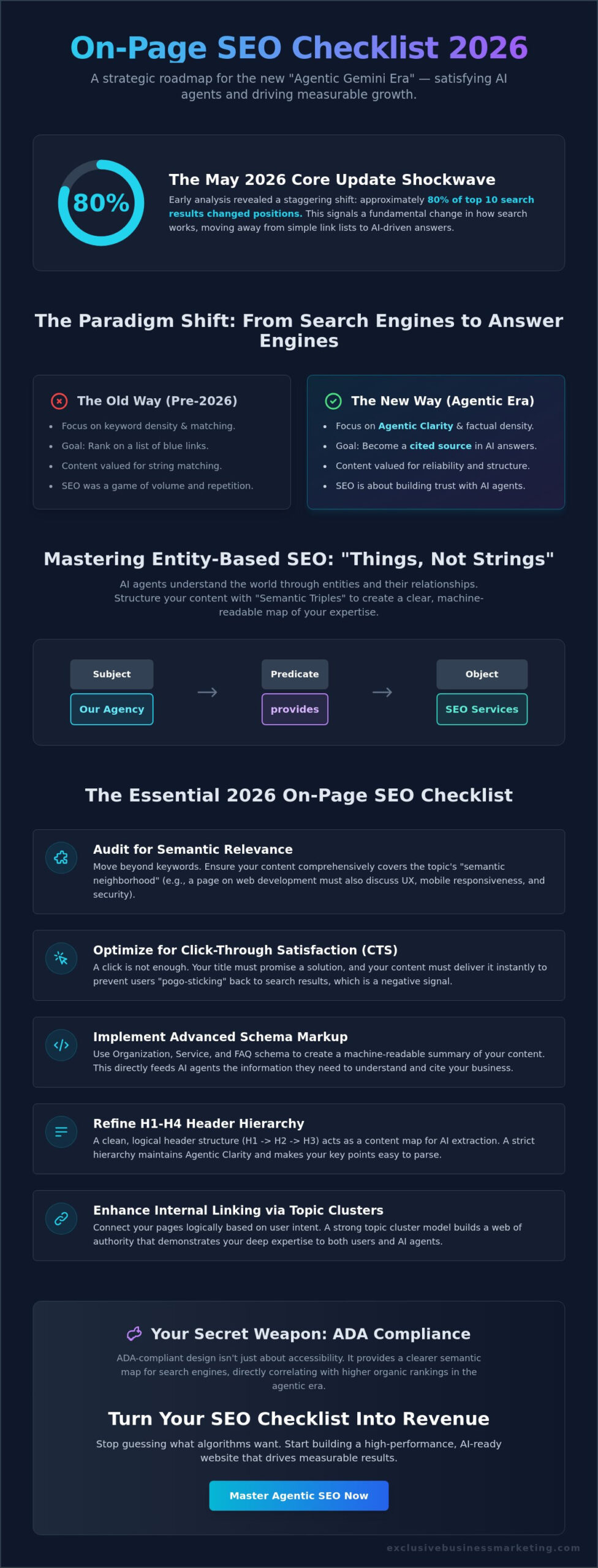
Did you know that early analysis of the May 2026 core update showed that approximately 80% of the top 10 search results shifted position? It’s a staggering figure that explains why so many professionals fear a decline in organic traffic. You’ve likely felt the pressure of the “agentic Gemini era” and found yourself overwhelmed by technical jargon. It’s frustrating to see the rules change just as you’ve mastered the old ones.
You can turn this shift into a major competitive advantage. Our on-page seo checklist 2026 provides the clear, actionable roadmap you need to satisfy both traditional search algorithms and the latest AI-driven agentic search tools. We’ll help you master the 2026 landscape by focusing on “Agentic Clarity” and high-performance content that builds genuine trust.
This guide previews essential Core Web Vitals thresholds and the latest E-E-A-T requirements. You’ll learn exactly how to structure your data so AI agents cite your site as a primary source. Let’s dive into the specific tasks that will improve your visibility in AI Overviews and drive higher conversion rates for your business.
Key Takeaways
- Shift your strategy from simple keyword matching to “Agentic Clarity” to ensure AI tools can easily reference and execute tasks using your content.
- Execute our on-page seo checklist 2026 to optimize your title tags for Click-Through Satisfaction and ensure every page meets modern semantic relevance standards.
- Format your high-ranking data into structures that AI agents can easily ingest, increasing your chances of appearing in Search Generative Experiences.
- Leverage ADA-compliant design to provide a clearer semantic map for search engines, directly correlating with higher organic rankings in 2026.
- Transform technical SEO tasks into measurable revenue by prioritizing updates with the highest ROI and implementing a proactive monitoring strategy.
Beyond Keywords: Why On-Page SEO in 2026 Requires Agentic Clarity
Agentic search isn’t a future concept; it’s the current reality. Unlike traditional search, which simply points users toward a list of links, agentic AI tools like Gemini 3.5 actually search, reference, and execute tasks for users. These agents don’t just read your content; they evaluate whether your data is reliable enough to act upon. This shift is the most critical update to any modern on-page seo checklist 2026.
Traditional Search Engine Optimization (SEO) once focused on matching specific strings of text. In 2026, keyword stuffing isn’t just ineffective; it’s a negative ranking signal. Following the May 2026 Core Algorithm Update, Google’s systems are now highly sensitive to “forced” language. If your content prioritizes keyword density over factual density, AI agents will likely skip your site entirely. You need “Agentic Clarity,” which means structuring your page so an AI agent can instantly identify your core value and cite your data with absolute confidence.
The Shift from Search Engines to Answer Engines
Large Language Models (LLMs) process your on-page content by looking for intent and verifiable facts. In 2026, being a “cited source” in an AI-generated response is the new first-page ranking. Your content must provide high factual density. This means you should swap vague marketing fluff for concrete data points that an AI can easily extract. If an agent can’t verify your claims through your page structure, it won’t recommend you to the user. It’s that simple.
Understanding Entity-Based SEO
Google’s Knowledge Graph has evolved to prioritize “things, not strings.” Modern on-page strategy focuses on entities, which are specific, well-defined objects or concepts. For example, if you’re building authority in Orange County, your content shouldn’t just repeat the city name. It needs to connect your brand to local landmarks, specific service categories, and verified professional entities. You can achieve this by using semantic triples; a structure consisting of a Subject, Predicate, and Object. For instance, “Our Agency (Subject) provides (Predicate) SEO services (Object).” This clear logic helps AI agents map your business’s expertise accurately. When you follow a structured on-page seo checklist 2026, you ensure these entity relationships are obvious to both humans and machines.
Stop guessing what the algorithm wants. Start building content that acts as a reliable data source for the AI agents that now control the majority of search traffic. By focusing on Agentic Clarity, you’ll secure your place in the answers of tomorrow.
The Essential 2026 On-Page SEO Checklist: 10 Non-Negotiable Steps
Mastering the 2026 search landscape requires more than just checking boxes. It demands a surgical approach to how your data is presented. Following our on-page seo checklist 2026 ensures your site remains visible as Google shifts toward an agentic model. This isn’t about doing more work; it’s about doing the right work to secure measurable growth.
- Step 1: Audit for semantic relevance. Stop focusing on how many times a keyword appears. Instead, evaluate if your content covers the “semantic neighborhood” of your topic. If you’re discussing website development, your page must naturally include related concepts like user experience, mobile responsiveness, and backend security.
- Step 2: Optimize for Click-Through Satisfaction (CTS). In 2026, the click is only half the battle. Search engines now measure how well your page satisfies the initial intent. Your title tags must promise a specific solution and your content must deliver it immediately to prevent “pogo-sticking” back to the AI results.
- Step 3: Implement Advanced Schema Markup. Use Organization, Service, and FAQ schema to provide a machine-readable layer of your content. This helps AI agents understand your business’s specific offerings without having to guess.
- Step 4: Refine H1-H4 hierarchy. A clean header hierarchy isn’t just for humans. It provides a logical map for AI extraction. Ensure your headers follow a strict numerical order to maintain “Agentic Clarity.”
- Step 5: Enhance internal linking with Topic Cluster intent. Link your pages based on how a user (or an AI agent) would naturally progress through a topic. This builds a web of authority that’s hard for competitors to break.
Mastering Meta Tags and URL Logic
Your
Optimizing for Search Generative Experiences (SGE) and AI Answer Engines
AI agents are the new gatekeepers of digital traffic. Winning in 2026 means your site must be “source-worthy” for Google’s AI Overviews. Start by identifying Featured Snippet opportunities within your existing high-ranking content. These snippets are often the primary data points AI agents use to build their answers. Google launched new AI performance reports in Search Console in June 2026; use these to track exactly how often your content appears in AI Mode. If you aren’t showing up there, your visibility is effectively zero for a massive segment of users.
Your on-page seo checklist 2026 must prioritize structured data ingestion. AI agents love tables and lists. They don’t want to hunt through paragraphs of flowery prose to find a specific metric, service detail, or process step. Formatting key data points into clear HTML tables allows LLMs to extract your information with 100% accuracy. Adopt a “Conclusion-First” writing style. State the answer or the result in the very first sentence of a section. Follow it with the supporting evidence. This structure mirrors how Gemini 3.5 and other agentic tools summarize information, making it easier for them to cite you.
The Anatomy of a Citational Sentence
To become a cited source, you need fact-dense sentences that minimize ambiguity. Avoid fluff. A citational sentence should be clinical and authoritative. For example, instead of saying “our services are very fast,” you should state “our website development team delivers fully functional prototypes within 48 hours.” Use Direct Answer blocks at the top of every H2 section. This provides a clear, high-contrast target for AI bots. You can still maintain your brand voice in the surrounding text, but these specific blocks must prioritize clarity above all else. It’s about being the most reliable data point in a sea of generic content.
Leveraging Schema for AI Context
Schema is your direct line to the AI’s understanding of your business. “Speakable” schema is no longer optional; it’s essential for voice and agentic search. It tells the agent exactly which parts of your page are best suited for audio playback or quick summaries. Additionally, use “About” and “Mentions” schema to link your content to established entities in the Knowledge Graph. This confirms your relationship to specific industries or locations like Orange County.
You should also integrate ADA compliant website design as a trust signal within your code. Clean, accessible code is significantly easier for LLMs to parse. When your site follows an authoritative on-page SEO checklist, you reduce friction for crawlers. This technical precision, combined with semantic clarity, ensures your brand isn’t just seen; it’s cited as a trusted authority. Don’t let your competitors own the AI conversation because your code was too messy to read.
Why ADA Compliance is Your Secret SEO Weapon in 2026
Accessibility isn’t optional. In 2026, the line between an accessible website and a searchable website has vanished. The core of any on-page seo checklist 2026 must include ADA-compliant structures because AI agents process your site’s code using the same semantic pathways as screen readers. When you implement ARIA labels and logical landmarks, you aren’t just helping users with disabilities; you’re providing a high-definition map for LLMs to navigate. If an agent can’t parse your site’s structure, it won’t recommend your content to the user.
The April 24, 2026 deadline for ADA Title II compliance for larger entities has set a massive precedent. In 2025, federal ADA website lawsuits hit a record high of over 5,100 filings, marking a 37% increase over 2024. This legal pressure has forced search algorithms to prioritize accessible code. There is now an undeniable correlation between high accessibility scores and top-tier organic rankings. Inclusive design naturally reduces bounce rates and improves user experience signals, which tells Google your site is a high-quality destination. For businesses seeking Orange County web design that drives revenue results, accessibility is now a core pillar of digital performance.
Alt Text: From Compliance to SEO Strategy
Alt text is no longer just a place to dump keywords. It’s a critical tool for AI search engines to understand visual context in 2026. Write descriptive alt text that doubles as semantic keyword placement without falling into the trap of keyword stuffing. If an AI agent can’t “see” what’s in your images through your descriptions, it won’t include that visual data in its generated answers. Focus on descriptive accuracy to satisfy both humans and bots. Your images should tell a story that search crawlers can read as clearly as your body text.
Readability and Structure as Ranking Factors
The WCAG 2.2 standards are now primary signals for Page Experience. Clear font contrast, logical navigation, and consistent layouts satisfy the latest algorithm updates that punish friction-heavy sites. An accessible site is inherently a more searchable site because it uses a clean, predictable hierarchy that crawlers can digest without technical errors. Don’t let a messy site structure hide your expertise from the world. You can optimize your website for accessibility and SEO today to ensure you don’t fall behind the competition.
Implementation: Turning Your SEO Checklist Into Revenue
Continuous monitoring is vital. The May 2026 Core Algorithm Update proved that search rankings are more volatile than ever. You can’t set your SEO and forget it. AI agents evolve. Their citation preferences change. Local businesses, in particular, face stiff competition from national brands with massive budgets. You need specialized Orange County SEO expertise to maintain your local authority. We handle the technical heavy lifting so you can focus on running your business. Transitioning from a DIY approach to professional execution removes the operational burden and ensures your site stays ahead of technological trends.
Measuring Success Beyond Rankings
Traditional keyword tracking isn’t enough in 2026. You must measure your “Share of Voice” within AI-generated answers and traditional search results. Use the Google Search Console AI performance reports launched in June 2026 to track impressions in AI Overviews. Monitor your conversion rates from SGE-referred traffic closely. Are these users finding the answers they need? Use GSC to monitor entity-based impressions. This tells you if search engines correctly associate your brand with your specific industry and location. Results-oriented marketing requires looking at these deeper metrics to understand your true market position.
Choosing a 2026 SEO Partner
Your agency must be more than a vendor. They should be a partner that understands the intersection of SEO services in Orange County and AI integration. Ask potential firms how they handle “Agentic Clarity.” Do they have a plan for WCAG 2.2 compliance? If they only talk about keywords, they’re living in the past. You need a team that proactively manages complex technical tasks. We provide a guided, step-by-step approach to ensure your growth is measurable and sustainable. Contact Exclusive Business Marketing today for a comprehensive SEO and ADA audit.
Future-Proof Your Brand for the Agentic Era
The search landscape has fundamentally changed. You can no longer rely on outdated keyword tactics that ignore the rise of AI agents. By prioritizing Agentic Clarity and structured data, you ensure that tools like Gemini 3.5 cite your brand as a trusted authority. We’ve shown how this on-page seo checklist 2026 bridges the gap between technical accessibility and organic visibility. Don’t let technical jargon or algorithm shifts slow your growth.
Our Orange County based experts specialize in WCAG and ADA compliant design that satisfies both humans and bots. We implement proven 2026 AI search strategies to keep your business at the top of AI Overviews and traditional results. It’s time to stop worrying about traffic drops and start focusing on measurable revenue. We’re here to remove the operational burden from your team with a hands-on, customer-centric approach that generates tangible growth.
Ready to take the next step toward digital dominance? Get Your Professional SEO & ADA Compliance Audit Report Now. We handle every complex detail so you don’t have to. Your path to search success starts with a single click. You’ve got the tools; now let’s build your success together.
Frequently Asked Questions
Is on-page SEO still relevant in 2026 with the rise of AI?
On-page SEO is more critical than ever. AI agents rely on your page structure to understand, reference, and cite your data in their answers. Without a precise on-page seo checklist 2026, your content remains invisible to the LLMs that now control a massive share of search traffic. It’s the foundation that allows AI to process your brand as a reliable, authoritative entity.
How often should I update my on-page SEO checklist?
Review your strategy at least once every quarter. Search algorithms and AI models evolve at a breakneck pace, as proven by the May 2026 core update. Regular audits ensure your technical structure and semantic logic stay aligned with the latest requirements for “Agentic Search.” Staying proactive prevents your traffic from dropping when new search features or ranking factors are introduced.
What is the most important on-page SEO factor for 2026?
“Agentic Clarity” is the defining factor for success this year. This means your content must be structured so AI agents can instantly extract facts and cite your site as a primary source. While E-E-A-T and page speed remain vital, your ability to serve as a verifiable data point for AI answer engines determines your total visibility in the modern search landscape.
Does ADA compliance actually help my Google rankings?
Yes, it serves as a powerful signal of quality and trust. Accessible websites use clean, semantic HTML that is significantly easier for search crawlers and AI bots to parse. By following WCAG standards, you improve your site’s crawlability and user experience. This directly correlates with better organic performance because search engines prioritize sites that are usable for every person and every machine.
How do I optimize my content for AI “agentic search”?
Focus on fact-dense sentences and structured data formats. Use clear Subject-Predicate-Object triples and place your key information into tables or lists. This allows AI agents to execute tasks or provide summaries using your data without needing to interpret vague marketing language. It’s about being the most helpful and readable source available for the agents that now mediate user queries.
What is the difference between a keyword and an entity in 2026 SEO?
A keyword is a specific string of text, while an entity is a well-defined concept or object in the Knowledge Graph. In 2026, search engines focus on “things, not strings.” You must optimize for the entity of your business by connecting it to specific categories, locations, and verified professional relationships. This provides the context AI needs to understand your brand’s true authority.
Can I use AI to write my on-page SEO content?
You can use AI for drafting, but expert human oversight is mandatory to maintain E-E-A-T. Google’s 2026 algorithms are highly sensitive to generic, low-value AI output that lacks “Agentic Clarity.” Your content needs unique insights and personal experience that generic LLM prompts often miss. Always refine AI-generated text to ensure it meets the rigorous standards of our on-page seo checklist 2026.
How long does it take to see results from on-page SEO changes?
You typically see initial ranking shifts within two to four weeks. While technical fixes like schema updates or title tag changes can be indexed quickly, the full impact on your share of voice in AI answers takes longer. Consistent monitoring is essential to track how your entity authority grows. We recommend a long-term view to see the full revenue impact of these optimizations.