

Mobile App vs. Mobile Website for Small Business: The 2026 Strategic Guide
Did you know that in 2026, mobile users spend 94% of their smartphone time inside native apps, leaving less than 6% for mobile browsers? If you’re still weighing the mobile app vs mobile website for small business debate, these numbers show that your choice will define your revenue potential. Most business owners feel stuck between high development costs and the fear of falling behind more tech-savvy competitors. You want growth, not a technical headache that drains your budget.
We understand the pressure to make the right call for your ROI. This guide provides the definitive framework you need to choose between a mobile app and a website with total confidence. You’ll learn how native apps drive 157% higher conversion rates and when a mobile-responsive site is the smarter move for reach. We’ll also outline a clear roadmap to leverage both tools for maximum lead generation in a market where mobile commerce now accounts for 73% of all sales. It’s time to stop guessing and start building a digital presence that delivers measurable results.
Key Takeaways
- Learn how a mobile-responsive website acts as your primary discovery engine to capture new leads with zero friction and instant accessibility.
- Discover how native apps foster deep customer loyalty and drive repeat sales through high-impact tools like push notifications and personalized experiences.
- Access our strategic framework to resolve the mobile app vs mobile website for small business dilemma by aligning technology with your specific ROI targets.
- Identify the right implementation sequence for your industry to ensure you don’t overspend on complex tech before establishing a strong search presence.
- Uncover why integrating ADA compliance and expert SEO is a non-negotiable foundation for any successful mobile growth strategy in 2026.
The Mobile-First Mandate: Defining Apps and Websites in 2026
The digital landscape has shifted permanently. Your customers don’t just use their phones to browse; they use them to live, shop, and solve problems in real-time. In 2026, the mobile app vs mobile website for small business decision isn’t just a technical choice. It’s a strategic move that dictates where your revenue lives. Think of a mobile-responsive website as your “digital front door.” It’s the first thing people see when they search for your services on browsers like Safari or Chrome. It’s accessible, open to everyone, and requires no commitment from the user.
Native mobile apps represent a different level of engagement. These are specialized tools that users download directly from the Apple App Store or Google Play. While websites focus on broad reach, apps focus on deep loyalty. Many small businesses are now finding success with Progressive Web Apps (PWAs). These act as the 2026 middle ground, offering the speed and offline capabilities of an app without requiring a download. However, simply being “mobile-friendly” is no longer enough. To win in this market, your presence must be mobile-optimized. This means every interaction is engineered for conversion, not just display.
How Mobile Browsing Has Evolved
Local search has undergone a massive transformation. Over 70% of local intent searches now happen on mobile devices. Google has fully committed to mobile-first indexing, meaning the mobile version of your site is the primary version used for rankings. If your mobile experience fails, your SEO fails. Beyond rankings, usability is a legal and moral requirement. Implementing ADA compliant website design ensures your site is accessible to every user, which directly boosts your mobile performance. Reviewing the history and development of the mobile web reveals why these standards are now the baseline for any serious business.
The Native App Advantage
Native apps provide an edge that browsers simply cannot match. They are software built specifically for iOS or Android hardware, allowing them to utilize the full power of the device. This includes seamless integration with cameras, GPS, and biometric security. The biggest advantage is the “always-on” presence. Your brand icon sits directly on the user’s home screen, serving as a constant reminder of your value. While browsers rely on rendering speeds and internet stability, native apps are pre-loaded and incredibly fast. This speed reduces friction and keeps your most loyal customers coming back. When considering a mobile app vs mobile website for small business, remember that apps are built for high-frequency interaction and long-term retention.
Mobile Websites: The Ultimate Tool for Reach and SEO
While native apps are revolutionizing business marketing by deepening engagement, the mobile website remains the undisputed king of reach. For most owners, the mobile app vs mobile website for small business debate starts with a simple question: how will new customers find me? A website is your primary discovery engine. It offers zero friction. There’s no download required, no account setup, and no storage space taken up on a user’s phone. This instant access is why websites are the most cost-effective starting point for growth. You maintain one codebase that works across every device, rather than building and updating separate versions for various operating systems.
The speed of a mobile browser allows a prospect to go from a search query to a phone call in seconds. This frictionless path is essential for capturing “top of funnel” traffic. If a user has to download an app just to see your pricing or location, they’ll likely bounce to a competitor. By prioritizing a web-first approach, you ensure that your business is available to the widest possible audience at the lowest acquisition cost.
SEO and Discoverability
Websites dominate the high-intent “near me” searches that drive immediate local foot traffic. When someone in Huntington Beach searches for a local service, they aren’t looking in an app store; they’re looking at Google search results. Effective orange county seo ensures your business appears exactly when these prospects are ready to buy. By targeting specific local keywords and optimizing your Google Business Profile, you capture traffic that an app simply cannot reach. Additionally, a high-performing mobile website serves as the essential foundation for any successful pay per click management services strategy to ensure your ad spend converts into tangible leads.
Accessibility and Compliance
In 2026, accessibility isn’t just a best practice. It’s a critical legal requirement. California businesses face increasing legal risks if their digital platforms don’t meet strict WCAG and ADA standards. Mobile websites are generally more straightforward to audit and update for compliance than native apps. Implementing these standards isn’t just about avoiding legal trouble. It’s about better business performance. Compliant design improves the mobile experience for every visitor by ensuring faster load times, clearer navigation, and better readability across all screen sizes. If you’re concerned about your current site’s performance or legal standing, our team at Exclusive Business Marketing can help you audit your digital presence for both speed and compliance. A truly accessible site welcomes every customer and removes the barriers that prevent sales.
Custom Mobile Apps: The Customer Loyalty and Retention Powerhouse
If your mobile website is your storefront, a native app is your VIP lounge. In the mobile app vs mobile website for small business debate, the app’s greatest strength is its ability to turn casual visitors into lifelong advocates. By living directly on a customer’s phone, you bypass the noise of the open web and the distractions of social media. Native apps utilize deep hardware integration that browsers simply can’t touch. Your customers can use FaceID for instant, secure payments or use the camera for augmented reality previews of your products. Choosing the right path in the mobile app vs mobile website for small business contest depends on your goals for customer lifetime value. Apps also facilitate offline access for critical business information. This means a contractor can view project blueprints or a client can check their membership QR code even when they lose cellular signal. This level of functionality builds a seamless, high-trust experience that keeps users locked into your brand’s ecosystem.
Push Notifications vs. Email Marketing
Push notifications are the crown jewel of mobile marketing. While email open rates often struggle to hit 20%, app notifications provide nearly 100% visibility. You can reach your audience instantly without worrying about spam filters or cluttered inboxes. For local businesses, geo-fencing changes the game. You can trigger a personalized alert the moment a customer walks within a block of your Orange County storefront. This isn’t just about sales; it’s about service. Use these alerts to reduce cart abandonment or ensure clients don’t miss their scheduled bookings. A well-timed notification feels like a helpful reminder, not a cold advertisement. This direct line of communication is why apps excel at retention.
AI Chatbots and Personalization
AI chatbots within an app environment offer a superior lead qualification experience compared to their web-based counterparts. Because the app already knows the user’s history and preferences, the chatbot can provide hyper-personalized recommendations without asking the same questions twice. This facilitates a “one-click” reordering or re-booking process that removes all friction from the sale. Designing these complex, high-conversion workflows requires the strategic insight of a business to business marketing agency that understands the technical nuances of 2026 mobile tech. When you prioritize the user’s convenience through AI, loyalty follows naturally. Your app becomes a tool they can’t live without, rather than just another icon on their screen.
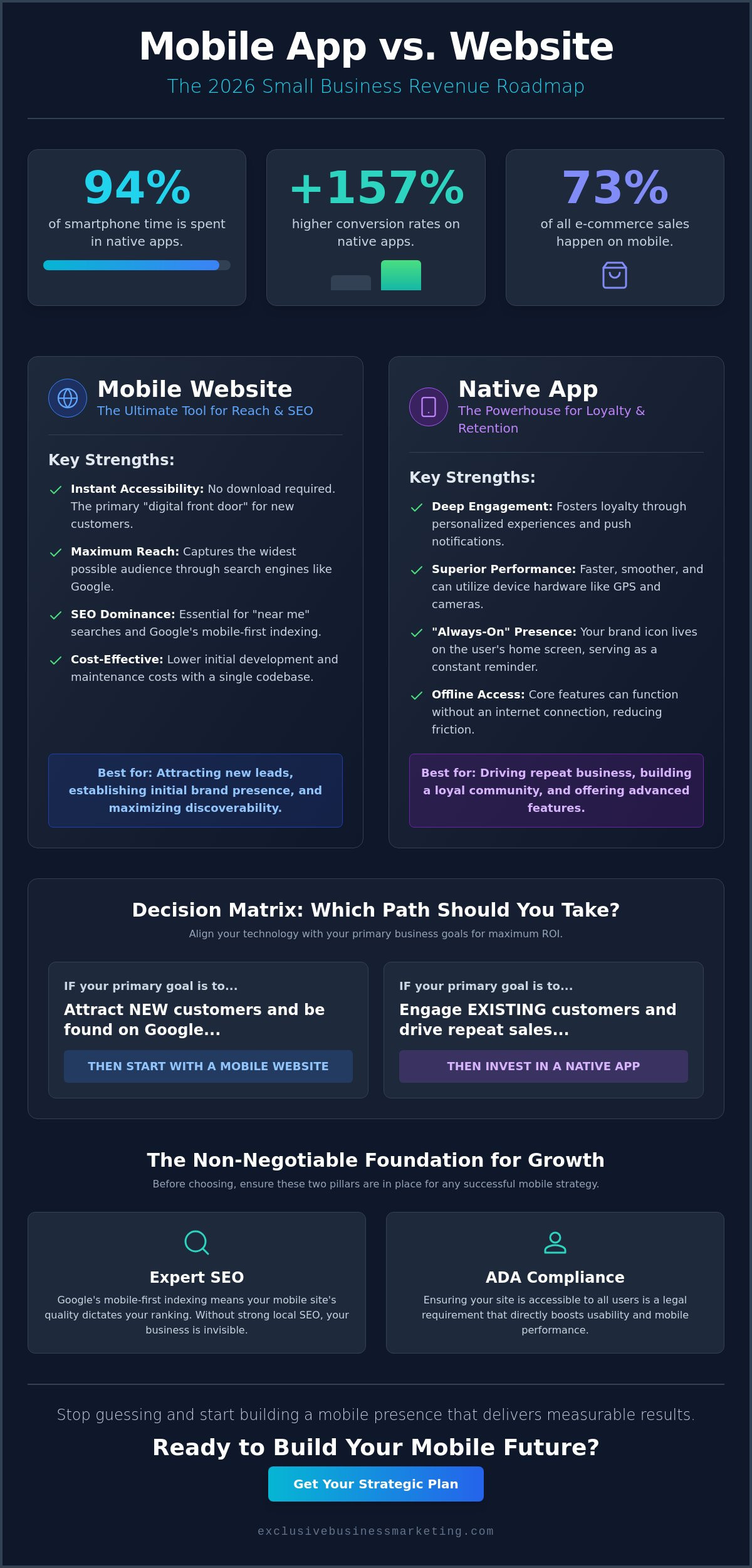
Decision Matrix: Which Path Should Your Business Take?
Choosing between a mobile app vs mobile website for small business requires a cold, hard look at your growth objectives. If your primary goal is discovery and reaching the widest possible audience, the website wins every time. However, if you’re focused on maximizing the value of your existing customers, a native app is the superior tool. We evaluate this choice across four critical pillars: cost, reach, retention, and speed. Most small businesses don’t need to choose one and stick with it forever. Instead, you should view it as a strategic sequence. Start where the ROI is most immediate and expand as your customer base matures.
Industry-Specific Recommendations
Your industry dictates your mobile priority. Service-based businesses like HVAC, Law, or Dental practices rely heavily on “near me” search intent. For these professionals, local seo company near me searches are the lifeblood of their lead generation. A high-performing website is non-negotiable for capturing this traffic. Conversely, retail shops, restaurants, and fitness studios thrive on repeat business. A local Huntington Beach restaurant recently saw a 30% increase in repeat orders after launching a custom app that streamlined their loyalty program. Establishing initial trust begins with orange county web design that looks professional and functions flawlessly. Once that trust is built, an app becomes the natural next step to secure customer loyalty.
Cost vs. Long-Term Value
You must weigh the total cost of ownership against the potential lifetime value of your users. A mobile website is the safest first investment because it covers both desktop and mobile users with a single platform. It allows you to test your market and refine your messaging without the higher upfront costs of app development. As your business scales, the Lifetime Value (LTV) of an app user often justifies the investment. App users tend to spend more and interact more frequently than web visitors. If you’re ready to determine which path will maximize your ROI, contact us at Exclusive Business Marketing to build your custom roadmap. We’ll help you analyze your data to decide exactly when to transition from a mobile site to a custom app.
Strategic Implementation: Building Your Mobile Future with Exclusive Business Marketing
Deciding on a mobile app vs mobile website for small business is only the first step toward digital dominance. The real challenge lies in the execution. At Exclusive Business Marketing, we provide a comprehensive approach that removes the guesswork from your digital strategy. Whether you need a high-conversion website to capture local search traffic or a custom app to lock in customer loyalty, we deliver results that move the needle. We don’t just build platforms; we build revenue engines. We manage the technical complexity so you can focus on running your business.
Our commitment to your success means we never treat essential features as optional add-ons. In 2026, ADA compliance and expert SEO are the non-negotiable foundations of any mobile presence. We integrate WCAG standards into every build to protect your California business from legal risks and ensure every customer has a seamless experience. Every site and app we develop is optimized for search engines from day one. This proactive strategy ensures you don’t just exist online; you lead your market. You’ll work with a team that prioritizes clear communication and rapid project turnaround to keep your growth on track.
Our Custom App Development Process
We’ve streamlined the path from initial concept to a live presence on the Apple App Store and Google Play. Our process begins with high-level UI/UX design focused on reducing friction and maximizing user engagement. We specialize in integrating advanced AI chatbots that act as 24/7 sales assistants, qualifying leads and answering customer queries while you sleep. Our developers handle the entire submission process, ensuring your app meets the latest 2026 hardware requirements for iOS and Android. You can expect constant availability from our team throughout the build. We’re here to answer your questions and refine your workflows in real-time.
Ready to Dominate the Mobile Market?
The Orange County business landscape is too competitive for a “wait and see” approach. Your competitors are already optimizing their mobile touchpoints to steal your market share. You need a partner who understands the nuances of the mobile app vs mobile website for small business debate and can guide you toward the highest ROI. Don’t let technical confusion or the fear of inefficient spending hold you back. We’re ready to analyze your specific industry data and build a roadmap that works for your unique goals. Contact Exclusive Business Marketing today for your custom mobile strategy!
Secure Your Competitive Edge in the Mobile Economy
The choice between a mobile app vs mobile website for small business isn’t just about code; it’s about your relationship with your customers. You now know that while a mobile-optimized website is your primary engine for new lead discovery, a custom app is the ultimate tool for securing long-term loyalty and repeat revenue. Success in 2026 requires a strategic sequence that balances immediate reach with deep engagement. You don’t have to navigate these complex technical decisions alone.
Our team of Orange County based experts is ready to handle every detail, from comprehensive SEO and ADA compliant design to high-performance app development. We manage the technical complexity so you can focus on scaling your operations. It’s time to stop worrying about falling behind and start leading your industry with a mobile presence that drives measurable ROI. Let’s turn your vision into a high-functioning reality that captures every lead and retains every customer.
Get Your Free Mobile Strategy Audit from Exclusive Business Marketing today and let’s build your roadmap to success. Your business deserves a digital partner that delivers results without the stress.
Frequently Asked Questions
Is a mobile app more expensive than a mobile website in 2026?
Native apps generally require a higher initial investment than mobile websites because they involve platform-specific development for both iOS and Android. A website uses a single codebase that works across all mobile browsers; which keeps maintenance costs lower. While Progressive Web Apps offer a middle ground; the specialized nature of native hardware integration makes apps the more significant financial commitment for a growing business.
Do I need a mobile app if my website is already responsive?
A responsive website is essential for broad reach; but an app is the right choice if you want to drive high-frequency engagement. Responsive sites adjust your content for different screens; yet they cannot offer features like push notifications or offline access. If your business model depends on repeat orders; membership management; or deep customer loyalty; a native app provides a superior return on investment.
Which is better for SEO: a mobile app or a mobile website?
A mobile website is the clear winner for organic discovery and search engine rankings. Google indexes web pages rather than the internal content of native apps; making your site the primary tool for capturing new leads through search. In the mobile app vs mobile website for small business debate; the website remains your foundation for SEO while the app serves as a powerful retention tool.
How long does it take to develop a custom mobile app for a small business?
A custom mobile app typically takes between three to six months to move from the initial concept to a live launch. This timeline includes the UI/UX design phase; hardware integration; and the rigorous approval process required by the Apple App Store and Google Play. We utilize methodical project management to ensure your build is rapid; secure; and ready to perform on day one.
Can a mobile app help with my local Orange County marketing?
Apps are exceptionally effective for local marketing through advanced features like geo-fencing and location-based alerts. You can trigger a personalized discount notification the moment a customer enters a specific radius around your Orange County storefront. This level of hyper-local targeting drives immediate foot traffic and conversions in a way that traditional mobile web browsing simply cannot match.
What is the difference between a native app and a Progressive Web App (PWA)?
Native apps are built specifically for device hardware and downloaded from stores; while PWAs are essentially websites that look and feel like apps. PWAs are accessed via a browser and can be added to a user’s home screen without a download. However; native apps provide the best overall performance and full access to device features like FaceID; biometric security; and advanced GPS.
How do I ensure my mobile website is ADA compliant?
Ensuring compliance requires a professional audit against current WCAG standards to identify barriers for users with disabilities. This process involves technical adjustments like adding ARIA labels for screen readers; ensuring high color contrast; and enabling keyboard-only navigation. Maintaining an ADA compliant mobile website protects your business from legal liability and ensures every user can navigate your digital front door without frustration.
Will an AI chatbot work on both a mobile website and an app?
AI chatbots are fully compatible with both platforms and act as a 24/7 sales assistant for your brand. On a website; they qualify leads and answer FAQs for new visitors. Within the mobile app vs mobile website for small business ecosystem; an app-based chatbot can provide even deeper personalization. It can access the user’s order history and saved preferences to create a frictionless; one-click reordering experience.