

Mobile App Development Cost in California: 2026 Guide
In May 2026, a single mobile gaming company paid $1.4 million to resolve CCPA violations, proving that cutting corners on compliance is now more expensive than the development itself. If you’re calculating the cost to develop a mobile app for my business in california, you aren’t just paying for code; you’re investing in a high-stakes regulatory environment where privacy and accessibility are non-negotiable. It’s natural to feel overwhelmed by the high labor rates in California tech hubs or the fear of hidden maintenance fees that could drain your budget long after launch.
You likely already know that building a premium digital product in the world’s tech capital requires a serious financial commitment. We’re here to turn that anxiety into a clear, actionable roadmap for your brand’s growth. This guide breaks down the real-world expenses of building a high-performance app in 2026, from initial UI/UX design to the critical post-launch marketing strategies that drive downloads. We’ll explore how to balance iOS and Android development while ensuring your project meets the latest ADA and CCPA standards to protect your investment.
Key Takeaways
- Define the 2026 California investment landscape, ranging from $40,000 for MVPs to over $300,000 for complex enterprise applications.
- Identify how complexity and platform selection directly impact the cost to develop a mobile app for my business in california.
- Protect your investment by learning the mandatory costs for WCAG 2.1 ADA compliance and CCPA data privacy requirements.
- Master the post-launch phase with a clear strategy for maintenance fees, App Store Optimization, and growth-focused marketing.
- Discover the advantage of a local Huntington Beach agency that integrates development with expert SEO to ensure your app actually gets found.
What Is the Average Cost to Develop a Mobile App in California?
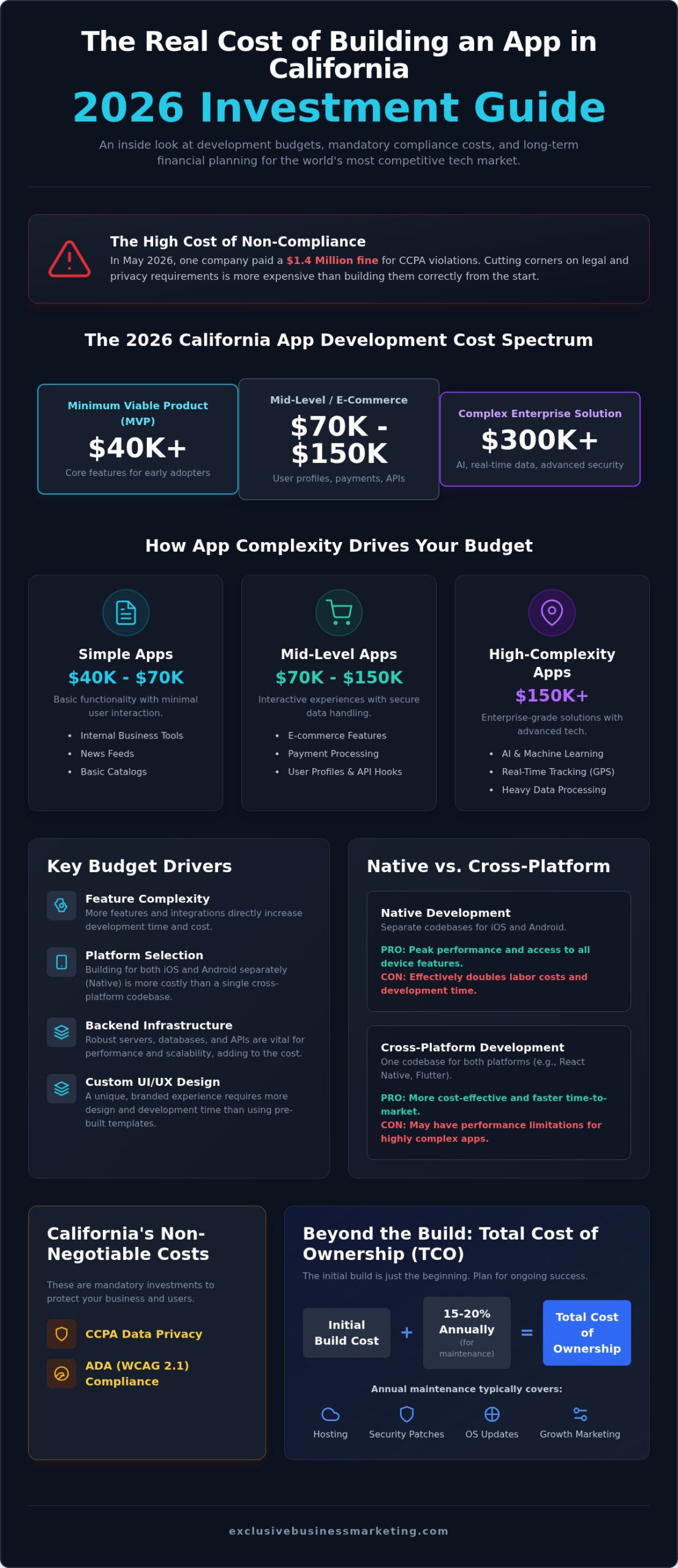
California isn’t just a state; it’s the global epicenter of digital innovation. When you look at the cost to develop a mobile app for my business in california, you’re entering a high-tier investment zone where quality and compliance standards are the highest in the world. For 2026, a realistic cost spectrum starts at approximately $40,000 for a Minimum Viable Product (MVP) and can exceed $300,000 for complex enterprise solutions. While these figures represent a significant commitment, “California-made” software carries a premium in security, performance, and legal readiness that offshore alternatives often lack. Choosing a local partner means you aren’t just buying code. You’re securing a product built to withstand the rigorous demands of the US market.
Offshore development might look cheaper on paper, but the trade-offs often include massive communication gaps and lower code quality. Local agencies provide a level of accountability that protects your brand from technical debt. Investing in a local team ensures your app is built to California’s strict standards from day one.
The California Tech Premium: Why Location Matters
The proximity to hubs like Silicon Valley and Silicon Beach keeps local labor rates high because the talent pool is elite. This concentration of expertise ensures your project benefits from the latest advancements in the process by which a mobile app is developed. Working with a Huntington Beach agency like Exclusive Business Marketing eliminates the friction found in overseas ventures. You get real-time collaboration within the California time zone and project managers who understand the nuances of your local industry. This local expertise translates to fewer revisions and a faster path to market, which ultimately saves money.
Total Cost of Ownership (TCO) vs. Initial Build
Smart business owners look beyond the initial sticker price of development. Building the app is only the first phase of a long-term digital asset. Your budget must account for the first year of hosting, mandatory security patches, and OS updates for both iOS and Android. These ongoing requirements ensure your app remains functional and secure against evolving threats. Total Cost of Ownership (TCO) includes the initial build plus an estimated 15-20% of that cost annually for essential maintenance and platform updates. By planning for these expenses early, you avoid the budget traps that stall many digital projects after their first year in the app stores. We help you calculate the cost to develop a mobile app for my business in california with these long-term factors in mind, ensuring your growth is sustainable and predictable.
Key Factors Influencing Your 2026 App Budget
Building an app is like building a house; the blueprint determines the final invoice. When calculating the cost to develop a mobile app for my business in california, your budget shifts based on feature complexity, platform selection, and the depth of the user experience. You also have to consider backend infrastructure. This is the engine of your app that manages data storage and user authentication. Skimping on the backend often leads to performance crashes during high traffic. Custom UI/UX design also adds to the total, as creating a unique branded experience takes more time than using standard templates.
Complexity Levels and Price Brackets
Complexity drives cost. We categorize apps into three main tiers based on their functional requirements:
- Simple Apps ($40k-$70k): These are usually internal business tools, news feeds, or basic catalogs. They have limited user interaction and no complex third-party integrations.
- Mid-Level Apps ($70k-$150k): These include e-commerce features, payment processing, user profiles, and API hooks. They require more rigorous testing and secure backend management.
- High-Complexity Apps ($150k+): These are enterprise-level solutions featuring AI integration, real-time tracking (like Uber), or heavy data processing. The cost to develop a mobile app for my business in california at this level reflects the need for advanced architecture and high-tier security protocols.
Native vs. Cross-Platform Costs
Your choice of platform is a major financial pivot point. Native development requires two separate codebases for iOS and Android, which effectively doubles the labor. While native apps offer peak performance, they are often too expensive for many Orange County small businesses. Cross-platform frameworks like Flutter or React Native allow developers to write one codebase that works on both platforms. This approach is the go-to for most businesses because it slashes development time and maintenance costs without sacrificing much in the way of performance. If you want to maximize your budget, cross-platform is usually the smartest path.
Legal guardrails also influence your technical requirements. Apps collecting user data must adhere to the California Consumer Privacy Act (CCPA). Implementing these security protocols isn’t just a technical task; it’s a legal necessity that impacts your final build price. If you’re looking for a partner who can manage these technical hurdles while keeping your budget on track, our team at Exclusive Business Marketing provides the local expertise you need to succeed.
California-Specific Costs: ADA, CCPA, and Legal Compliance
In California, your app must do more than just function; it must protect your business from litigation. The cost to develop a mobile app for my business in california includes a mandatory layer of legal engineering that other states often ignore. California regulators are aggressive. In May 2026, mobile gaming company Jam City paid $1,400,000 to resolve allegations regarding CCPA violations within its apps. This isn’t just a big-brand problem. Smaller businesses face similar risks if they skip the technical requirements of the California Consumer Privacy Act (CCPA) or the California Privacy Rights Act (CPRA). Many of the same principles found in ADA compliant website design apply directly to mobile applications. Building these safeguards in from day one is far cheaper than defending a lawsuit later.
Ensuring Your App is ADA Compliant
Accessibility is no longer optional. While government entities have specific deadlines through 2028, WCAG 2.1 Level AA has become the clear legal benchmark for all digital products in California. Your development budget must account for screen reader compatibility and high-contrast UI requirements. These features ensure that users with visual or motor impairments can navigate your app seamlessly. We recommend budgeting for a professional accessibility audit during the QA phase to catch potential roadblocks before you hit the App Store. Accessible design isn’t just a cost; it’s a revenue driver. By removing barriers, you open your business to a wider audience that competitors might be ignoring.
CCPA and Data Privacy Infrastructure
Data privacy requires a robust backend architecture. As of January 1, 2026, California law requires mobile apps to include a direct link to a CCPA-compliant privacy policy within the app’s settings menu. You must also budget for secure data encryption and user consent modules that allow people to opt out of data sharing easily. General Motors recently faced a $12.75 million settlement for selling driver data without proper consent, highlighting the massive stakes involved. Implementing these privacy modules typically adds roughly 5-10% to your total backend development time. This investment ensures your app remains compliant as privacy laws continue to evolve. Our team handles these complex technical tasks so you don’t have to worry about the operational burden or the threat of multi-million dollar fines.
Post-Launch Costs: Maintenance, Marketing, and Growth
Launching your app is a major milestone, but the financial lifecycle continues long after the “submit” button is pressed. The cost to develop a mobile app for my business in california includes a strategic post-launch budget for user acquisition and technical upkeep. In 2026, App Store Optimization (ASO) is mandatory to ensure your app doesn’t get buried under millions of competitors. You also need to plan for server scaling. As your California user base grows, your backend infrastructure must handle increased data loads without lagging. Regular updates for compatibility with iOS 19, iOS 20, and the latest Android versions are essential to prevent your app from becoming obsolete or vulnerable to security threats.
Marketing Your App in the Orange County Market
Success in the competitive Southern California market requires a multi-channel approach. High-performance pay per click management services can jumpstart your initial downloads by targeting users who are actively searching for your solution. This immediate visibility is vital for building momentum and improving your store ranking. Simultaneously, investing in orange county seo ensures your app’s landing page ranks high in local search results, driving organic traffic at a lower cost per acquisition over time. Social media management acts as the primary engine for community building and maintaining user engagement through regular updates and storytelling.
Continuous Improvement and Feature Iteration
A static app is a dying app. You must budget for user feedback loops and bug fixes that emerge once real-world data starts flowing in. Most successful businesses plan a “Version 2.0” roadmap before the first version even launches. This involves identifying high-value features that were too complex for the MVP but are essential for long-term retention. Budgeting for maintenance is a mathematical reality; expect to spend 15-25% of your initial build cost annually on hosting, security, and platform updates. Maintaining a retainer with a local agency is significantly safer than relying on ad-hoc, hourly fixes. A retainer ensures a dedicated team is always ready to respond to technical emergencies, protecting your reputation and your investment. We handle the technical heavy lifting so you can focus on scaling your operations.
Why Exclusive Business Marketing is Your Best California App Partner
Choosing the right partner is the most critical decision in managing the cost to develop a mobile app for my business in california. We aren’t just a group of developers; we’re a Huntington Beach based team that lives and breathes the California business landscape. While other firms treat code as a siloed product, we view your app as a comprehensive growth engine. We specialize in transforming complex ideas into functional, eye-catching applications that actually generate revenue. Our deep roots in Orange County mean we understand the local market competition and the specific legal hurdles that can sink a project before it even launches.
We bridge the gap between technical execution and market performance. By integrating our high-level seo services orange county with the development phase, we ensure your app is discoverable from day one. Many agencies build beautiful apps that nobody finds. We prevent that by baking visibility into the architecture. Our focus on WCAG and ADA compliance protects your business from the aggressive legal risks unique to California, providing a complete, worry-free solution that allows you to focus on your core operations.
From Idea to App Store: Our Process
Our journey begins with intensive discovery and strategy sessions right here in our Huntington Beach office. We don’t believe in generic templates or one-size-fits-all solutions. Our agile development methodology prioritizes constant communication and availability, ensuring you’re never in the dark about your project’s status. As a full-service agency, we handle every detail under one roof:
- Strategic development and design tailored to your specific brand identity.
- Advanced SEO and PPC strategies to drive immediate user downloads.
- Continuous maintenance and security monitoring to ensure long-term stability.
- Expert ADA and CCPA implementation to mitigate legal liabilities.
Get a Custom Quote for Your California Business
Generic online calculators often fail because they ignore the nuances of your specific industry and the true cost to develop a mobile app for my business in california when proper compliance is involved. You need a professional audit to determine a realistic budget that aligns with your ROI goals. We provide transparent project milestones and a commitment to no hidden fees, removing the operational burden from your shoulders. Our results-oriented approach ensures that every dollar spent is an investment in tangible, measurable growth. We’re ready to show you how a high-performance app can redefine your market position.
Take Command of Your Digital Future
Developing a high-performance app in 2026 requires balancing technical innovation with strict California legal standards. You’ve learned that complexity, platform choice, and mandatory ADA and CCPA compliance are the true drivers of your budget. Success doesn’t stop at launch. It requires a dedicated marketing and maintenance strategy to ensure your investment pays off in the competitive California market. Understanding the real cost to develop a mobile app for my business in california is about more than just the initial build; it’s about securing a compliant, scalable asset that grows with your brand.
Our Huntington Beach office provides the local expertise you need to navigate these challenges with confidence. We integrate top-tier development with full-service marketing and specialized WCAG compliance expertise to handle every detail. You don’t have to manage complex technical hurdles alone. Our team is ready to streamline the process and prioritize your ROI from day one. We take the operational burden off your shoulders so you can focus on your core business goals.
The path to a successful mobile launch is clear when you have a reliable partner by your side. Let’s transform your vision into a functional reality that drives measurable growth for your business.
Frequently Asked Questions
How much does it cost to build a simple business app in California?
Simple business apps in California typically start at approximately $40,000. This budget covers essential features like news feeds, product catalogs, or internal tools with basic user interactions. The final cost to develop a mobile app for my business in california depends on your specific design requirements and the level of backend integration needed. Investing in a local team ensures your MVP meets high-quality standards from the very first version.
How long does it take to develop a mobile app for a local business?
Most mobile app projects for local businesses take between 3 and 6 months to complete. A simple Minimum Viable Product (MVP) can often launch within 12 to 14 weeks. More complex applications with custom APIs and heavy database management usually require a longer timeline for thorough testing and quality assurance. Starting your project early allows for a methodical rollout that prioritizes user experience and security.
Should I build for iOS or Android first to save money?
Cross-platform development is the most cost-effective solution for launching on both platforms at once. If you must pick one, iOS is often the starting point for California businesses due to higher user spending patterns. However, building for both platforms from the start using a single codebase reduces long-term maintenance. This approach ensures you don’t alienate half of your potential local customers during your initial launch phase.
Are there ongoing monthly costs after the app is launched?
Ongoing expenses include server hosting, security patches, and OS compatibility updates. You should budget approximately 15% to 25% of your initial development cost annually for these essential services. The cost to develop a mobile app for my business in california includes this long-term maintenance to ensure your app stays functional and secure. Regular updates are the only way to prevent technical debt and maintain a high-quality user experience.
Does my mobile app need to be ADA compliant in California?
Your mobile app must be ADA compliant to mitigate legal risks in California’s aggressive litigation environment. Courts increasingly apply WCAG 2.1 Level AA standards to digital products, viewing them as essential extensions of your business. Implementing accessibility features like screen reader compatibility and high-contrast visuals isn’t just about legal protection. It also expands your reach to a wider, more diverse audience that values inclusive and thoughtful design.
Can I update the app myself after it is finished?
You can manage basic content like text, images, and notifications through a custom Content Management System (CMS). We build these interfaces to empower business owners with day-to-day control over their app’s information. However, technical updates, security patches, and new feature iterations require professional developer support. Maintaining a relationship with your agency ensures your code stays optimized as mobile operating systems continue to evolve every single year.
What is the difference between a mobile app and a progressive web app (PWA)?
Native mobile apps are downloaded from the App Store and offer superior performance, offline access, and full hardware integration. Progressive Web Apps (PWAs) are advanced websites that run in a mobile browser and don’t require an app store download. While PWAs are often cheaper to build, they lack the speed and deep feature access of a native app. For businesses seeking high user retention, a native app is the superior choice.
How do I protect my app idea before development starts?
Protect your intellectual property by signing a Non-Disclosure Agreement (NDA) before sharing the technical details of your concept. This legal document ensures your idea remains confidential during the discovery and strategy phases. Partnering with a licensed, local Huntington Beach agency provides a layer of professional accountability and legal protection that offshore developers cannot match. We prioritize your security and ownership throughout the entire development lifecycle.