

Measuring Social Media Marketing Success in 2026: The Definitive Guide
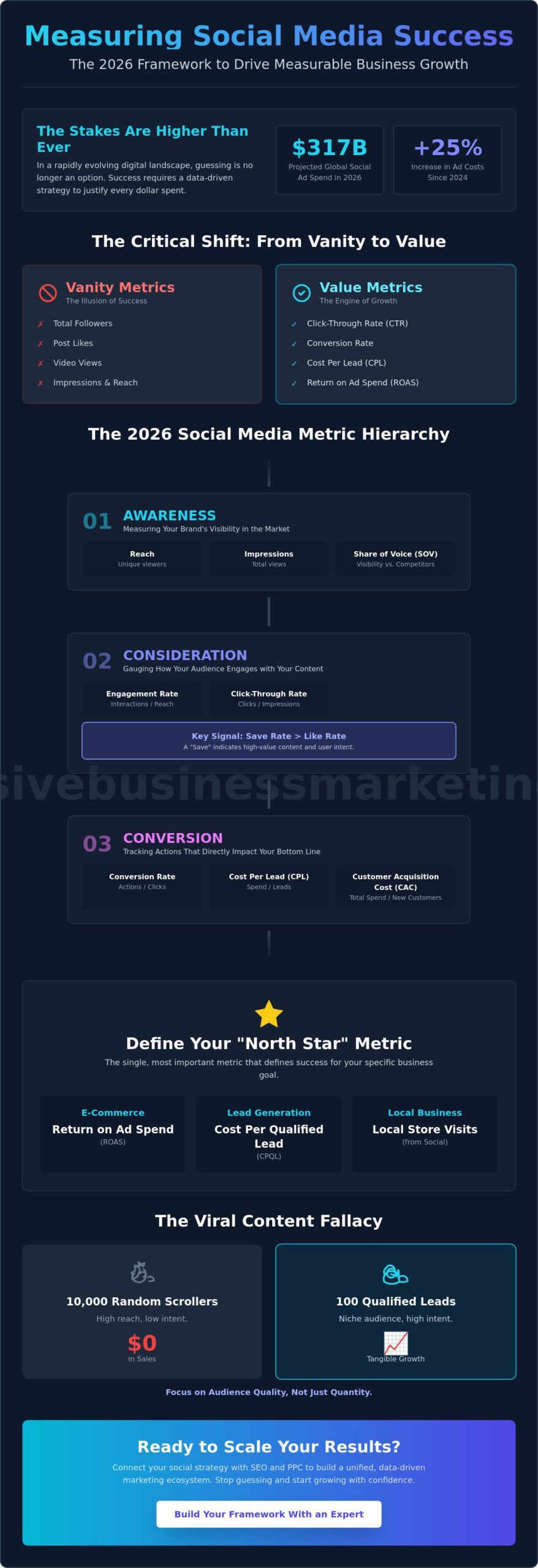
Did you know that global social media advertising spend is projected to hit $317.33 billion in 2026? Despite this massive investment, many brands are still struggling with the basics of measuring social media marketing success. With ad costs rising by up to 25% since 2024, you can’t afford to guess which posts are working. You’ve likely felt the frustration of spending hours on content only to have no clear idea of the return. It’s difficult to explain the value of a campaign to stakeholders when you’re buried in platform-specific analytics that don’t seem to connect to your bottom line.
We’re here to change that. You’ll learn how to move beyond vanity metrics and track the specific KPIs that drive real revenue and business growth. This guide provides a clear framework for measuring ROI and helps you understand which platforms perform best for your specific niche. We’ll give you the actionable data you need to improve your future campaigns and ensure every dollar spent on social media is a step toward tangible success.
Key Takeaways
- Stop focusing on empty vanity metrics and learn how to align your social media activity with core business objectives for measurable growth.
- Master the 2026 metric hierarchy to effectively track the customer journey from initial awareness through to conversion and brand loyalty.
- Use advanced attribution modeling to simplify measuring social media marketing success by identifying the exact touchpoints that lead to real-world sales.
- Build a robust measurement framework that maps specific KPIs to your unique goals, whether you’re driving local foot traffic or scaling national reach.
- Partner with experts who handle the technical heavy lifting of data integration, connecting your social strategy with SEO and PPC for a unified digital ecosystem.
Beyond Vanity Metrics: What Measuring Social Media Marketing Success Really Means
True success in social media isn’t about how many people saw your post; it’s about how many of those people took an action that grew your business. In 2026, measuring social media marketing success requires a shift from superficial popularity to strategic alignment. If your social activity doesn’t mirror your core business objectives, you’re just making noise. It’s time to stop treating social media as a separate silo and start treating it as a revenue engine.
For years, marketers obsessed over “likes” and “follows.” These are classic vanity metrics. They look great in a presentation but rarely pay the bills. A “like” is a low-effort interaction that doesn’t guarantee brand recall or intent to buy. Relying on these indicators is a dangerous way to judge business health. Instead, we focus on Value Metrics. These are data points that directly impact your bottom line and provide a clear picture of performance.
- Vanity Metrics: Total followers, post likes, video views, and reach.
- Value Metrics: Click-through rate (CTR), conversion rate, cost per lead, and revenue per follower.
Professional Social media measurement allows you to replace anxiety with certainty. There’s a specific emotional relief that comes from knowing exactly how your marketing spend translates into growth. You stop wondering if your budget is being wasted. You start seeing social media as a predictable, scalable tool for your brand. This data-backed certainty allows you to make bold decisions with confidence.
The Problem with Chasing Viral Content
Everyone wants to go viral, but virality is often a distraction. You might have a post reach 100,000 people and get 1,000 likes, yet see zero increase in sales. This happens because the content attracted the wrong audience or lacked a clear path to purchase. Misaligned goals drain your budget and waste time. With social ad costs rising by up to 25% since 2024, every misstep is expensive. Pivot your focus toward audience quality. It’s better to engage 100 qualified leads than 10,000 random scrollers who will never buy from you.
Defining Your North Star Metric
To succeed, you need one “North Star” metric. This is the single most important data point that dictates if a campaign was a win. If you’re in lead generation, your North Star might be “Cost Per Qualified Lead.” For an e-commerce brand, it’s likely “Return on Ad Spend” (ROAS). If your goal is local brand awareness, you might track “Local Store Visits” or “Map Direction Clicks.” Pick your metric and track it consistently. Changing your focus every week prevents you from seeing long-term trends. Clear, consistent tracking is the only way to achieve measuring social media marketing success in a competitive market.
The 2026 Social Media Metric Hierarchy: Tracking What Drives Revenue
Stop guessing which numbers matter and start using a hierarchy that reflects your actual business goals. Effective measuring social media marketing success requires a structured approach that separates noise from signal. In 2026, we categorize data into four distinct tiers: Awareness, Consideration, Conversion, and Loyalty. This structure shows you exactly where the customer journey is strongest and where it’s breaking down, allowing for rapid adjustments to your strategy.
Share of Voice (SOV) plays a vital role in this hierarchy by measuring your brand’s visibility against every competitor in your niche. If you aren’t winning the conversation, you won’t win the market. Tracking your visibility alongside your financial efficiency is mandatory for sustainable growth. Customer Acquisition Cost (CAC) is the total spend divided by new customers acquired. If your CAC is rising, it’s a sign that your social content isn’t working hard enough to convert the awareness you’ve built into tangible leads.
Platform algorithms have evolved to prioritize deeper intent over casual browsing. This is why Save rates have surpassed Like rates as a primary indicator of value. A save means your content was useful enough for a user to keep for later. It’s a high-value signal that often leads to a lower CAC over time. You can find more details on these essential social media metrics to track to ensure your 2026 strategy remains competitive and profitable.
Conversion Metrics: The Bottom Line
Conversions are the only metrics that directly put money in the bank. You must track Click-Through Rate (CTR) to see how many users actually leave the social app to visit your site. Are they downloading your lead magnets or filling out contact forms? High engagement is useless if it doesn’t lead to an entry in your CRM. Our social media management experts specialize in bridge-building, ensuring every post has a clear, optimized path to conversion.
The Social-to-SEO Connection
Social media is a powerful catalyst for search engine performance. When your content resonates, it triggers a spike in “Brand Searches” as users look for your official website on Google. These signals tell search engines that your business is relevant and authoritative. While social links are usually “no-follow,” the traffic and brand recognition they generate are invaluable for your organic rankings. We recommend pairing your social efforts with a professional orange county seo strategy to capture this high-intent search traffic. This integrated approach ensures you dominate both the social feed and the search results page.
Attribution and Tools: How to Connect Social Activity to Real-World Sales
Attribution modeling is the bridge between a social post and a bank deposit. It’s the process of assigning value to the various touchpoints a customer encounters before making a purchase. Without it, measuring social media marketing success is a guessing game. You might see a sale but have no idea if it started with an Instagram Reel or a LinkedIn article. Understanding the journey is the only way to replicate your wins.
There are three primary models to consider for your 2026 strategy. First-Touch attribution gives all the credit to the very first interaction. This is excellent for tracking brand discovery and top-of-funnel reach. Last-Touch attribution credits the final click before a conversion. While simple, it often ignores the weeks of nurturing that happened previously. Multi-Touch attribution is the gold standard. It distributes credit across the entire journey, providing a realistic view of how social media influences long-term buying decisions.
Google Analytics 4 (GA4) serves as your primary engine for this tracking. It allows you to see exactly how social referrals behave once they land on your site. You can track their path from the landing page to the checkout or contact form. However, GA4 only tells part of the story. To get the full picture, you need tools that capture intent in real time and engage users the moment they show interest.
Leveraging AI Chatbots for Measurement
Integrating AI Chatbot Installation into your strategy creates a definitive tracking point for social-to-lead conversion. These bots work 24/7 to capture lead data from social traffic the moment they arrive. Beyond just collecting emails, chatbots qualify intent by asking specific questions. This gives you a success metric based on lead quality rather than just quantity. You can also measure the reduction in response time, which is a critical KPI for modern customer service and brand loyalty.
Essential Tools for the Modern Marketer
Start with native platform analytics like Meta Business Suite and LinkedIn Page Analytics. These provide deep insights into how users interact with your content within the app. For a cross-platform view, use third-party tools that aggregate data into a single dashboard. This prevents data silos and makes measuring social media marketing success much more efficient across diverse channels.
Never share a link without UTM parameters. These simple snippets of code added to your URLs tell GA4 exactly which campaign, platform, and even which specific post sent the traffic. It’s the most basic yet effective way to ensure your data is clean and your ROI is undeniable. Use these tools to turn vague theories into hard evidence of growth.
Building Your Social Media Measurement Framework: A Step-by-Step Guide
Creating a framework for measuring social media marketing success is the only way to ensure your efforts lead to growth. Without a structured plan, you’re just throwing content at a wall and hoping it sticks. A professional framework turns vague hopes into a repeatable system for generating revenue. Follow these five steps to build a measurement engine that works for your brand.
- Step 1: Audit your presence. Look at your historical data from the last twelve months. Identify which posts drove clicks and which ones were ignored.
- Step 2: Map KPIs to business goals. If you want to increase local Huntington Beach foot traffic, track “Get Directions” clicks rather than just “Likes.”
- Step 3: Establish a baseline. Use your audit to set SMART goals. If your current conversion rate is 2%, aim for 2.5% by next quarter.
- Step 4: Implement technical tracking. Install tracking pixels and the Conversion API (CAPI) on your website. This ensures you capture data even with modern privacy restrictions.
- Step 5: Review and iterate. Analyze your performance reports every month. If a strategy isn’t hitting its targets, pivot immediately.
This systematic approach removes the guesswork from your digital strategy. It gives you the confidence to double down on what works and cut what doesn’t. If you’re ready to stop guessing and start growing, contact our marketing agency to build your custom measurement framework today.
Local Success: Measuring Impact in Orange County
For businesses in Southern California, local engagement is the lifeblood of success. You need to track specific actions like “Call Now” buttons or map direction requests. These are high-intent signals that a social user is becoming a local customer. We often use geo-targeted social ads to amplify these results. This strategy works best when paired with professional pay per click management services. By targeting specific zip codes in Orange County, you ensure your budget is spent on the people most likely to visit your physical location. Measuring social media marketing success at the local level requires this hyper-focused data approach.
Setting Realistic Benchmarks
Don’t compare your small business to a global conglomerate. Your historical performance is usually a better benchmark than broad industry averages. However, it helps to know the market context. In 2026, the average Meta CPM is around $11.20, while Instagram CPC averages $3.96. If your costs are significantly higher, it’s time to refine your creative or targeting. Remember to account for seasonal fluctuations. A retail brand will see different engagement levels in December than in July. Use competitor analysis to see what’s working for others in your niche, but keep your primary focus on beating your own previous records.
Scaling Your Results with Exclusive Business Marketing’s Social Strategy
Establishing a measurement framework is a vital first step, but managing the technical execution is a full-time commitment. Exclusive Business Marketing acts as your dedicated partner to handle the heavy lifting of data integration and analysis. We remove the operational burden from your team by managing the complex pixels, APIs, and cross-platform tracking required for modern growth. By letting experts manage the technical side of measuring social media marketing success, you ensure your data is clean and your strategy is always based on facts rather than feelings.
Our comprehensive approach doesn’t treat social media as an island. We integrate your social activity with your broader SEO and PPC ecosystems to create a unified revenue engine. When your social content drives brand searches, your organic authority climbs. When your social data informs your ad targeting, your costs drop. Professional Video Production is a central part of this strategy. High-quality video doesn’t just capture attention; it drives the deep engagement metrics, like saves and shares, that signal true brand loyalty to platform algorithms.
It’s time to stop guessing which posts might work and start investing in a strategy that delivers. We provide the data-driven certainty you need to scale your budget with confidence. Our team focuses on the metrics that actually move the needle, ensuring every dollar spent is a step toward your specific business objectives.
Why a Full-Service Agency Wins
There’s a massive advantage to having your local seo company near me and your social media experts working under one roof. This proximity creates a seamless feedback loop where search trends inform social content and social wins boost search rankings. We don’t just hand you a spreadsheet of confusing numbers. We translate complex data into clear, actionable growth reports that tell you exactly what’s working and what we’re optimizing next. Our commitment to rapid communication means you’re never left wondering about the status of your campaigns.
Get Your Custom Social Media Strategy Today
The first step to achieving predictable growth is a comprehensive digital audit. We’ll analyze your current presence, identify tracking gaps, and show you exactly how measuring social media marketing success can transform your bottom line in 2026. Don’t let your marketing budget disappear into a black hole of vanity metrics. Call us today at (714) 485-8405 to discuss your specific growth goals with a results-oriented expert. Contact Exclusive Business Marketing today to start measuring what matters!
Master Your Growth with Data-Driven Certainty
Mastering the art of measuring social media marketing success is no longer optional for brands that want to thrive in 2026. By shifting your focus from superficial likes to high-value attribution models and integrated digital strategies, you turn social media into a predictable revenue driver. You now have the framework to track every touchpoint and the tools to qualify leads with AI precision. This transition from guessing to knowing is what separates market leaders from everyone else.
Stop letting technical complexity or vague analytics stall your progress. Our Orange County-based expert team specializes in ADA compliant and conversion-focused design, ensuring your brand is both accessible and effective. We have a proven track record of driving measurable ROI for local businesses by aligning social activity with core growth goals. We handle the heavy lifting so you can focus on running your business with total confidence in your marketing spend.
Ready to see what is actually working? Get your comprehensive social media and SEO audit from Exclusive Business Marketing! We are ready to help you build a transparent, scalable, and highly profitable digital presence. Your path to measurable growth starts today.
Frequently Asked Questions
What is the single most important social media metric to track?
The single most important metric is your conversion rate because it directly measures how many social interactions result in a specific business outcome. While reach and engagement show brand interest, the conversion rate proves that your content is persuasive enough to drive action. Focus on tracking the percentage of users who complete a purchase or fill out a lead form. This ensures your efforts translate into actual growth rather than just empty popularity.
How often should I check my social media analytics?
Check your tactical analytics weekly to catch immediate trends and adjust your current posting schedule. This allows you to double down on high-performing content while it’s still relevant. However, you should reserve deep strategic reviews for a monthly cadence. A monthly report provides enough data to see beyond daily fluctuations and helps in measuring social media marketing success over a meaningful period. Consistent review prevents small issues from becoming expensive mistakes.
Can I measure social media success without a large budget?
You can absolutely measure success without a massive budget by utilizing free native analytics and Google Analytics 4. Tools like Meta Business Suite and LinkedIn Page Analytics provide deep insights into user behavior at no cost. Focus on tracking UTM-tagged links to see exactly which organic posts drive website traffic. This approach allows you to identify your most profitable content without spending a dollar on expensive third-party software or enterprise-level dashboards.
What is a good engagement rate for a business in 2026?
A good engagement rate typically ranges between 1% and 3%, but you should prioritize high-value actions like saves and shares over simple likes. In 2026, platform algorithms reward content that keeps users on the app or provides lasting value. If your save rate is climbing, it’s a strong indicator that your audience finds your content worth revisiting. Always compare your current performance against your own historical baseline rather than broad, generic industry averages.
How do I track if social media is driving offline sales in my Huntington Beach store?
Track offline sales by monitoring “Get Directions” clicks and “Call Now” buttons on your local social profiles. You can also offer unique, social-only discount codes that customers must present at your Huntington Beach location. This creates a direct link between a digital view and a physical purchase. We also recommend tracking local check-ins and tagged photos from your store to gauge the real-world impact of your digital community-building efforts.
Is it possible to track the ROI of organic social media posts?
It’s entirely possible to track organic ROI by using UTM parameters on every link you share. This allows GA4 to attribute specific website sales or leads back to an individual organic post. By calculating the labor cost of creating the content against the revenue generated, you get a clear picture of your organic performance. This data-driven approach is essential for measuring social media marketing success without relying on paid advertising alone.
What is the difference between reach and impressions?
Reach represents the total number of unique users who saw your content, while impressions count the total number of times your content was displayed. If one person sees your post three times, that counts as a reach of one and three impressions. Reach is better for measuring brand awareness and new audience discovery. Impressions help you understand how often your message is being reinforced to your existing followers through the platform’s algorithm.
How do I know if my social media followers are actually my target audience?
Verify your audience by analyzing the demographic data provided in your platform’s native analytics. Look at the location, age, and professional titles of your followers to see if they align with your ideal customer profile. Beyond the numbers, look at the quality of the comments and questions you receive. If your followers are asking about your services and pricing, you’ve successfully attracted a high-intent audience that is likely to convert.