

Local SEO for Multiple Locations: The 2026 Strategy to Scale Your Visibility
What if your brand could capture the top spot in the local map pack for every city you serve without Google flagging your content as duplicate? With over 51% of searches now ending without a single click, the competition for visibility is more aggressive than ever. You likely feel the frustration of managing dozens of Google Business Profiles while worrying that one wrong NAP entry or a bit of keyword cannibalization will tank your rankings. It’s a common anxiety for growing businesses, but you don’t have to let technical complexity stall your expansion. Mastering local seo for multiple locations is about building a repeatable, high-performance architecture that works as well in your tenth city as it did in your first.
We’ll show you exactly how to dominate local search results across your entire service area. You’ll learn the specific optimization strategies needed to satisfy Google’s 2026 core updates and the latest focus on entity and intent. This article covers everything from building WCAG-compliant location pages to navigating the strict new video verification requirements for Google Business Profiles. It’s time to stop guessing and start scaling your geographic lead flow with a framework built for modern search engines.
Key Takeaways
- Understand why subfolders outperform subdomains for site authority and how to structure your domain for maximum regional impact.
- Implement a strategy for individual landing pages that eliminates duplicate content risks while dominating city-specific search results.
- Secure your presence in the map pack by perfecting your Google Business Profile verification and maintaining strict NAP consistency across the web.
- Use this proven framework for local seo for multiple locations to scale your visibility and drive consistent lead flow to every branch.
- Align your website with the latest ADA and WCAG 2.1 standards to gain a ranking edge and provide a superior experience for all users.
Choosing the Right Website Structure for Multi-Location SEO
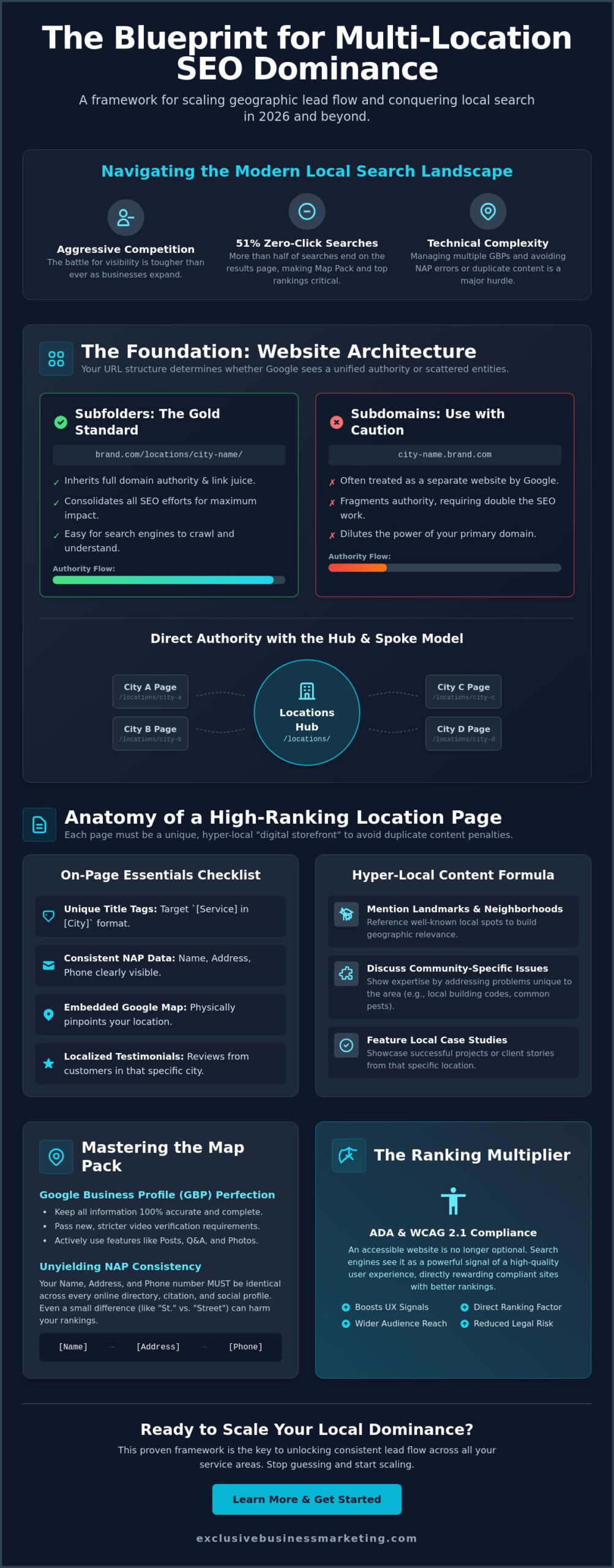
Your website’s architecture is the silent engine behind your search performance. If you’re managing local seo for multiple locations, the way you organize your URLs determines whether Google sees you as a dominant authority or a scattered collection of pages. Most businesses fail because they fragment their power across separate domains, forcing each site to fight for its own credibility from scratch. Don’t make that mistake. Consolidation is the key to winning in 2026. A unified domain strategy ensures that every ounce of marketing effort benefits your entire brand rather than just a single branch.
The subfolder structure, such as brandname.com/locations/city-name/, remains the gold standard for a reason. It allows every location page to inherit the link juice and domain authority of your primary site. This is a core component of local search engine optimization (local SEO) because it builds a unified front that search engines can easily crawl and trust. While subdomains might seem tempting for highly distinct regional brands with different service offerings, they often act as separate entities in Google’s eyes, requiring double the SEO effort to rank.
Subfolders vs. Subdomains: Which Wins for Your Business?
Google treats subfolders as part of the main site, passing authority directly to your local landing pages. We’ve seen businesses scale from five to fifty locations rapidly by using a subfolder hierarchy because each new page starts with the established trust of the parent domain. A logical URL hierarchy like /locations/city-name/ tells bots exactly what the page is about before they even read the first paragraph. Only consider subdomains if you’re managing a franchise where each region has a completely different branding or technical requirement.
Internal Linking Strategies for Local Branch Authority
Authority doesn’t just flow down; it needs to be directed. Link to your top-performing or highest-priority locations directly from your homepage to give them an immediate boost. Use breadcrumbs on every location page to signal geographic hierarchy to search engines and improve user navigation. The Hub and Spoke model for local SEO uses a central hub page to distribute authority to individual spoke location pages through strategic internal linking. This structure keeps your main navigation clean. Instead of listing every city in your top menu, use a “Locations” tab that leads to a directory or a searchable map to support discovery without clutter.
Optimizing Individual Location Pages for Maximum Reach
A location page is your digital storefront for a specific market. It’s a dedicated landing page meticulously designed to rank for [Service] + [City] keywords. To succeed with local seo for multiple locations, you can’t just copy-paste the same text and swap the city name. Google’s 2026 updates reward authenticity and depth. If your pages look like carbon copies, they’ll likely be filtered out of search results. Instead, integrate these pages into a comprehensive seo services orange county strategy that treats every geographic target as a unique opportunity for growth.
Every page must include essential on-page elements to signal relevance to both users and bots. This includes your NAP data (Name, Address, Phone), an embedded Google Map, and localized testimonials. Ensuring your location pages meet current standards for ADA compliance for websites isn’t just about legal safety; it’s a ranking signal that boosts user experience metrics. Search engines prioritize accessible sites because they provide a better journey for every visitor, regardless of how they interact with the web.
Hyper-Local Content: Beyond the City Name
To avoid the duplicate content trap, you must inject hyper-local details into every branch page. Mention nearby landmarks, specific neighborhoods you serve, and community-specific service details. If you’re a plumber, talk about the common pipe issues found in older homes in a specific district. You need unique localized reviews and case studies for every branch to build regional trust. A localized “About Us” section that highlights your involvement in the specific city can be the deciding factor for a customer choosing between you and a generic national competitor.
Advanced Schema Markup for Local Entities
Technical precision is non-negotiable. Implement LocalBusiness and PostalAddress schema correctly to provide search engines with structured data they can trust. Use the areaServed property to define your exact service boundaries, which helps Google understand your reach beyond just your physical office. JSON-LD is the preferred format for 2026 local SEO because it’s easy for AI-driven search engines to parse and understand the relationship between your different branches. This structured approach ensures your data appears accurately in AI Overviews and the local map pack.
Building these pages correctly takes time and technical expertise. If you want to accelerate your growth across multiple regions, consider partnering with a marketing agency that specializes in scalable local frameworks. We can help you build a system that turns every location into a lead-generating powerhouse.
Scaling Authority: Google Business Profiles and Local Citations
Managing local seo for multiple locations requires a shift from manual updates to a centralized, scalable system. Your Google Business Profile (GBP) is the most critical asset for capturing local map pack traffic. However, as of April 2026, Google has significantly tightened its verification and review policies. You must now navigate stricter video verification requirements that prove your physical presence and connection to the business. Failure to provide this proof often leads to immediate profile suspension, which can be devastating for a regional branch. Consistency is your best defense against these algorithmic filters.
The NAP Consistency Rule remains the foundation of local trust. Your Name, Address, and Phone number must be identical across every directory on the web. A single digit error in a phone number or a slight variation in a suite number can fragment your authority and confuse search engines. Managing this at scale is a massive undertaking. If the technical burden of syncing dozens of profiles feels unmanageable, partnering with a local seo company near me can provide the professional oversight needed to ensure your data remains clean and authoritative.
Managing Bulk Google Business Profiles Without Suspension
If you operate 10 or more locations, use Google’s bulk verification tool rather than verifying each site individually. This process is more rigorous but offers better protection against mass suspensions. Every branch needs its own freshness signals. Profiles that fail to upload new photos or posts within a 30-day window now see a measurable drop in visibility. For Service Area Businesses (SABs), you must accurately define your service boundaries without a physical address. Brick-and-mortar sites must ensure their store hours and holiday schedules are updated in real-time to maintain a high Visual Quality Score and avoid customer frustration.
Scaling Local Citations Across the Web
Citations still matter because they validate your business existence to search engines. Focus on the “Big Three” data aggregators that feed information to the rest of the web. Automating citation audits is the only way to find and fix inconsistent data across 20 or more locations efficiently. Beyond the major directories, identify niche industry sites specific to your market. These high-relevance links signal to Google that you aren’t just another generic brand, but a local expert in your field. Remember that Google’s April 2026 policy update strictly prohibits pressuring customers for reviews on-site or using review kiosks. Focus on authentic, organic feedback to build long-term regional authority.
ADA Compliance: The Secret Weapon for Local SEO Rankings
Google’s primary goal is to provide the best possible experience for every searcher. This is why accessibility has become a major ranking factor for local seo for multiple locations. If your site isn’t readable by screen readers or navigable by keyboard, you’re alienating a massive segment of your local audience. Implementing ada compliant website design isn’t just a way to avoid litigation; it’s a strategic move to improve your site’s authority. On April 20, 2026, the Department of Justice published an Interim Final Rule clarifying that WCAG 2.1 Level AA is the required standard for public entities. While specific deadlines for government entities are set for 2027 and 2028, the search algorithm has already shifted to favor sites that meet these high usability standards today.
Accessibility directly impacts your user experience (UX) metrics. When a site is easy to use, bounce rates drop and dwell times increase. Google notices these signals. For businesses with multiple branches, a high bounce rate on one location page can drag down the performance of your entire domain. By prioritizing accessibility, you ensure that every visitor can find your address, view your services, and contact you without friction. This creates a cohesive, trustworthy experience that rewards your brand with higher rankings across all service areas.
Accessibility as a Trust Signal for Local Customers
A screen-reader friendly page is almost always a mobile-friendly page. Since most local searches happen on the move, mobile conversion is the lifeblood of your branch. Proper alt-text and clear heading structures help search engines understand your local relevance while keeping users engaged longer. ADA compliance is no longer optional for Huntington Beach businesses because local regulations and Google’s emphasis on user experience demand a digital environment that is accessible to every resident without exception. This commitment to inclusion builds genuine trust with your local community.
Using AI Chatbots to Convert Local Traffic
Scaling your presence means being available even when your physical offices are closed. Localized AI chatbots can route leads to the correct branch 24/7, ensuring no geographic inquiry goes unanswered. These bots can be personalized based on the user’s specific geographic landing page, offering local promotions or specific service availability relevant to that city. Integrating these chatbots with your CRM allows for seamless multi-location lead tracking, giving you a clear picture of which markets are driving the most growth. This automation removes the operational burden from your staff while maintaining a high level of customer service.
Don’t leave your regional visibility to chance. Contact our expert team today to audit your site for accessibility and local search dominance.
Monitoring and Evolving Your Multi-Location Strategy
Dominating local seo for multiple locations isn’t a “set it and forget it” project. It’s a continuous cycle of measurement and refinement. You’ve built the architecture and optimized the pages; now, you must track how each branch performs against local competitors. Use Google Search Console to isolate regional keyword performance by filtering for specific city-based queries. This transparency allows you to see exactly where you’re winning and where your visibility is slipping. High-performing brands don’t just react to changes. They anticipate them by watching the data every single week.
Focus on your “Share of Voice” in the local map pack. Research shows that over 51% of Google searches now end without a click, meaning users find their answers directly on the results page. This “zero-click” trend makes the local pack the most valuable real estate on the web. Even if users don’t visit your website, they’re finding your phone number and office hours through your profile. Once you’ve secured the top spots in individual cities, it’s time to scale your strategy toward full orange county seo dominance to capture broader regional traffic and cement your brand as the market leader.
Tracking ROI Per Location
Use UTM parameters for every Google Business Profile link to accurately distinguish map traffic from organic search traffic in Google Analytics 4. Set specific conversion goals for high-intent actions like phone calls and direction requests. If a specific location is underperforming, diagnose the cause immediately. Check if the profile has gone 30 days without a fresh photo update, as this causes a noticeable drop in visibility. Identifying these gaps early prevents a single weak link from dragging down your overall regional authority.
- Monitor direction requests to gauge real-world foot traffic.
- Track click-to-call volume per branch to measure direct lead flow.
- Analyze regional keyword rankings to identify new local competitors.
Partnering with a Results-Oriented SEO Agency
Managing 20 or more locations is a complex technical job that requires professional oversight. Exclusive Business Marketing specializes in scaling high-performance local campaigns for brands that refuse to settle for second place. We handle the technical audits, citation management, and ADA compliance so you can focus on running your business. Our team provides the constant availability and rapid response times needed to navigate the 2026 search landscape. Ready to dominate your market? Reach out to Exclusive Business Marketing today and let’s start growing your visibility across every city you serve!
Take Command of Your Regional Market Today
Scaling your brand across multiple cities requires more than just local addresses. It demands a robust subfolder architecture and hyper-local content that avoids duplication. By prioritizing ADA compliance and maintaining strict NAP consistency, you build a foundation that search engines and customers trust. Mastering local seo for multiple locations is the only way to ensure your business stays ahead of the aggressive search updates seen throughout 2026.
Exclusive Business Marketing is Orange County’s leading expert in ADA compliant SEO. We have a proven track record of ranking businesses on the first page of Google and offer 24/7 lead generation through custom AI chatbot installations. Your expansion doesn’t have to be a technical burden. With the right framework and professional oversight, every new location becomes a predictable engine for growth. It’s time to stop worrying about keyword cannibalization and start dominating the local map pack in every city you serve.
Get your free multi-location SEO audit from Exclusive Business Marketing today!
Frequently Asked Questions
Do I need a separate website for each of my business locations?
No, you don’t need separate websites for each branch. Consolidating your presence under one domain is the most effective way to manage local seo for multiple locations. This approach allows every location page to benefit from the accumulated authority of your primary domain. Separate sites fragment your link power and force you to build trust from scratch for every new city you enter.
How do I avoid duplicate content on my location-specific pages?
Avoid the duplicate content trap by including hyper-local information unique to each area. Mention specific neighborhoods, nearby landmarks, and community events your business supports. Include localized testimonials and project galleries from that specific branch. These unique signals tell Google that the page provides genuine value to residents in that exact geographic area rather than being a generic template.
Will having multiple locations hurt my main website SEO?
Multiple locations won’t hurt your main SEO if you use a logical subfolder structure. This setup actually boosts your brand’s overall authority by signaling to search engines that you’re a significant regional player. Problems only arise if you use separate domains or messy URL structures that confuse bots. A clean hierarchy ensures that your main site and your local pages support each other’s growth.
What is the most important ranking factor for the local map pack?
Google prioritizes relevance, distance, and prominence for the local map pack. While you can’t change a user’s distance from your shop, you can dominate relevance and prominence. Keep your Google Business Profile active with weekly photo updates and posts. Consistent NAP data and high-quality reviews are the most critical factors for staying visible in the top three spots.
How do I manage reviews for 10 different locations efficiently?
Efficiency comes from using a centralized management system or partnering with a professional agency. You need a single dashboard to monitor and respond to feedback across all branches. Google’s 2026 policies forbid review gating or pressuring customers on-site, so focus on organic strategies. Rapid responses to both positive and negative reviews across all 10 locations signal that your brand is active and customer-centric.
Can I use the same phone number for all my business locations?
No, you should use a unique local phone number for every physical branch. Using a single toll-free or corporate number across all locations creates inconsistent NAP data, which confuses search engines and can tank your rankings. A local area code acts as a strong geographic signal. It reassures both Google and your customers that you have a real, accessible presence in their specific community.
How long does it take to see results from a multi-location SEO strategy?
You’ll typically see measurable movement in 3 to 6 months. While technical fixes and Google Business Profile updates can provide a quick boost in visibility, building long-term authority takes time. Competitive markets might require a longer lead time to break into the top of the map pack. Consistency in your content and citation management is the key to sustaining these results as your strategy matures.
Should I use subdomains or subfolders for my location pages?
Subfolders are the superior choice for your location pages. Using a structure like mysite.com/locations/city/ ensures that your local pages inherit the SEO power of your main domain. Subdomains are often treated as separate entities by search engines, meaning you’d have to work twice as hard to rank them. Stick to subfolders to maximize your efficiency when scaling local seo for multiple locations.