

How to Rank for ‘Near Me’ Searches: The 2026 Local SEO Strategy
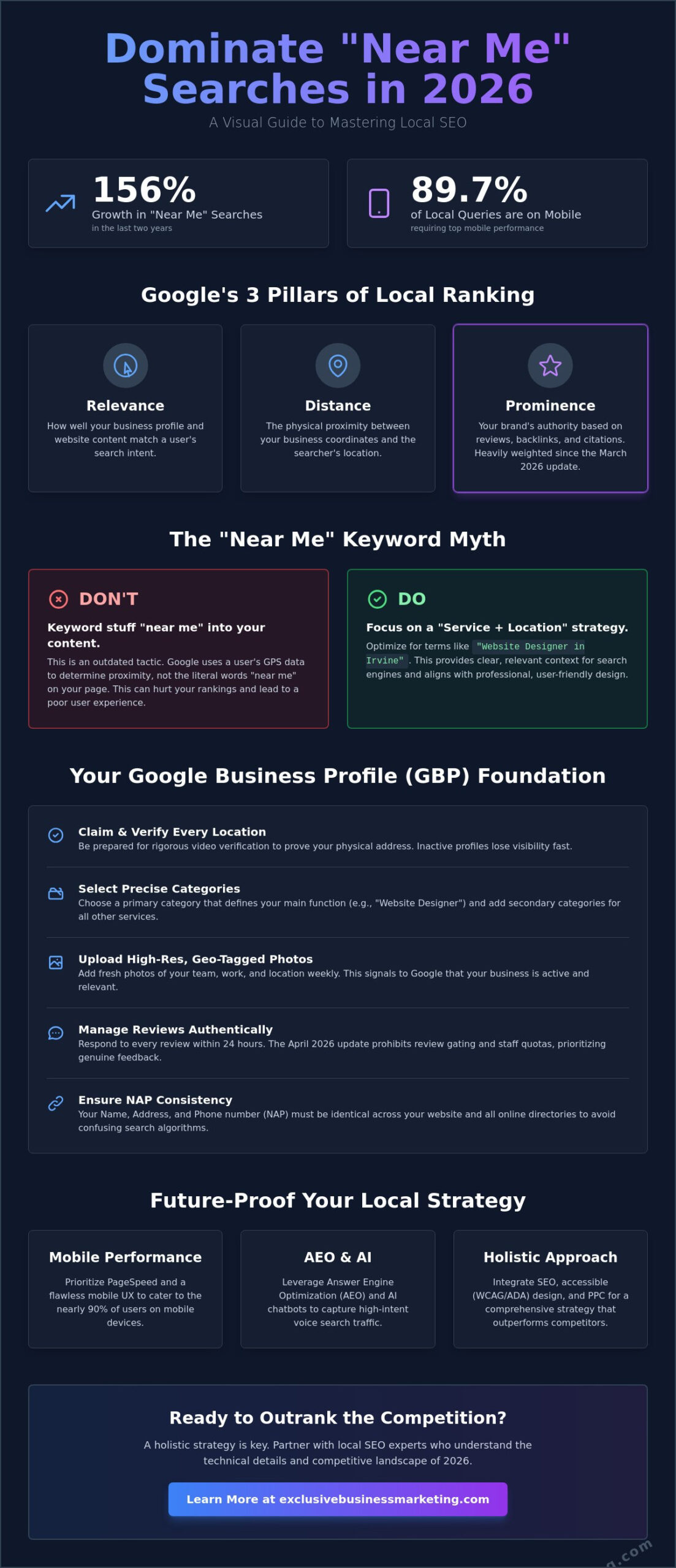
Did you know that mobile “near me” searches have grown by 156% in the last two years? With 89.7% of these queries happening on mobile devices, the battle for local dominance is won or lost in the palm of a customer’s hand. If you’re struggling to figure out how to rank for “near me” searches, you aren’t alone. You might even wonder if you need to clutter your website text with those exact words to get noticed. The truth is more complex, and many business owners feel the sting of losing local leads to competitors who seem to have cracked a code that remains a mystery.
It’s frustrating to deal with conflicting advice while watching your mobile bounce rates rise. We understand that you need a clear, results-oriented path to visibility. This article promises to help you master the proximity signals and technical optimizations required to dominate local results following the March 2026 Core Update. You’ll learn how to navigate the latest Google Business Profile verification rules and implement Answer Engine Optimization strategies that turn simple queries into loyal customers. We’ll walk you through the exact steps to ensure your brand remains the first choice for every local searcher.
Key Takeaways
- Master the three foundational pillars of local ranking—relevance, distance, and prominence—to align your digital presence with proximity-based search algorithms.
- Learn exactly how to rank for “near me” searches by optimizing your Google Business Profile with precise category selection and verified location data.
- Boost your visibility in the local Map Pack by prioritizing mobile performance and PageSpeed to cater to the 90% of local queries happening on mobile devices.
- Future-proof your strategy by leveraging AI chatbots and Answer Engine Optimization (AEO) to capture high-intent voice search traffic.
- Understand the value of a holistic approach that integrates SEO, WCAG & ADA compliant design, and PPC to outperform competitors in high-stakes local markets.
What Are ‘Near Me’ Searches and How Does Google Rank Them?
“Near me” searches are proximity-based queries triggered by a user’s specific location data. These searches represent a high-intent moment where a consumer is ready to visit a physical location or book a service immediately. In 2026, the local search landscape has moved far beyond simple map listings. Google now uses deep learning to predict what a user needs before they even finish typing. Learning how to rank for “near me” searches means mastering a delicate balance between technical accuracy and brand authority.
Relevance, Distance, and Prominence Explained
The core of local search engine optimization rests on three specific pillars. Relevance measures how well your business profile and website content match a user’s search intent. Distance is a literal calculation of the physical proximity between your business coordinates and the searcher. Prominence is perhaps the most critical for competitive markets; it reflects your brand’s authority based on digital footprints like reviews, backlinks, and local citations. Google’s March 2026 Core Update doubled down on prominence, rewarding businesses that prove they are active, authentic parts of their local community.
The ‘Near Me’ Keyword Stuffing Myth
One of the most persistent mistakes business owners make is thinking they need to include the phrase “near me” in their H1 tags or anchor text. This is a myth that can actually hurt your rankings. Google uses geofencing to determine a user’s location automatically. If someone searches for “dentist near me,” Google looks for “dentist” and then filters by the user’s GPS coordinates. It doesn’t look for the words “near me” on your page.
Targeting “Dentist Near Me” as a primary keyword is a poor strategy. It results in clunky, non-compliant website design that drives up bounce rates on mobile devices. Instead, focus on a “service + location” strategy. Optimizing for “SEO Agency in Orange County” or “Website Designer in Irvine” provides the context Google needs to confirm your relevance. This approach is more professional and aligns with how AI-driven discovery tools scan for data in 2026. The shift toward AI-driven local discovery means your digital presence must be comprehensive. Traditional search is merging with Answer Engine Optimization (AEO). Users now expect direct answers, not just a list of links. Your goal is to provide the data that fuels these AI summaries, ensuring your business is the obvious choice for the algorithm and the customer alike.
The Foundation: Optimizing Your Google Business Profile (GBP)
Your Google Business Profile (GBP) is the digital storefront of 2026. It serves as the primary data source for AI-powered local packs and traditional map results. To master how to rank for “near me” searches, you must first claim and verify every physical location you operate. Verification has become more rigorous. Google now frequently requires video verification, where you must provide a continuous recording of your signage, professional equipment, and the surrounding street to prove your physical existence. Profiles that remain unverified or inactive for over 30 days face a sharp decline in visibility.
Selecting the right categories is your next priority. Your primary category should reflect your main business function, while secondary categories capture your full range of services. For instance, a firm might list “Website Designer” as their primary category and “Search Engine Optimization” as a secondary one. Pair these selections with high-resolution, geo-tagged images. Uploading fresh photos of your team and projects weekly signals to Google that your business is active and relevant to the local community.
The April 2026 review policy update changed the game for building prominence. Google now explicitly prohibits review gating and staff review quotas. To build trust, you must earn authentic feedback and respond to every review within 24 hours. This responsiveness signals to Google’s algorithm that you are a reliable partner for their users. If managing these daily updates feels overwhelming, a professional marketing agency can handle the technical heavy lifting for you.
NAP Consistency Across the Web
Consistency is non-negotiable. Your Name, Address, and Phone number (NAP) must be identical across every digital directory. Discrepancies between your website and “zombie” citations on outdated platforms like YellowPages can confuse Google’s trust algorithm. This confusion directly lowers your ranking in proximity-based results. To build stronger authority, you should focus on reputable industry platforms; for example, Australian health providers can visit Aged Care Made Easy to see how a specialized directory facilitates these local connections. Audit your digital footprint to ensure every mention of your business is accurate and up to date.
Advanced GBP Features for 2026
Modern consumers demand instant gratification. Use the “Booking” and “Messaging” features to reduce friction and capture leads directly from the search results page. Detailed service menus and product catalogs help Google understand exactly what you offer, which is essential for how to rank for “near me” searches when users specify a product. Finally, leverage “Attributes” to highlight niche details like “Wheelchair accessible” or “Veteran-owned.” These labels help you stand out in a crowded market—as seen with established brands like BOS Jewelers Inc—and appeal to specific user preferences.
Technical Local SEO: Accessibility and Mobile Performance
Mobile devices account for 89.7% of “near me” searches in 2026. This statistic isn’t just a trend; it’s a mandate for your digital strategy. When a user searches for a local service while on the go, Google prioritizes results that load instantly and provide a frictionless experience. If you want to master how to rank for “near me” searches, you must look beyond aesthetic design. Technical performance is the invisible engine that drives your visibility in the local Map Pack.
High bounce rates on mobile devices are often a direct result of poor PageSpeed. In the wake of the March 2026 Core Update, Google has tightened the correlation between site performance and local rankings. A delay of even one second can cause a potential customer to click away to a competitor. Your site needs to be lean, fast, and technically sound to survive this competitive environment. We focus on generating tangible growth by ensuring your site meets these rigorous performance benchmarks.
Many business owners struggle with a common frustration: “My site looks fine on my phone, why am I not ranking?” The answer lies in the code. Looking “fine” is a visual metric, but ranking is a technical one. Google’s crawlers don’t see your beautiful color palette; they see your site’s structure, accessibility, and speed. If your technical foundation is weak, your proximity signals won’t matter.
ADA Compliance as a Competitive Advantage
Implementing WCAG 2.1 standards is no longer optional for businesses that want to dominate local search. Accessible code makes it easier for Google to parse your content and understand your local relevance. In California’s litigious environment, ignoring accessibility also carries significant legal risks. Prioritizing ADA compliant website design protects your business while simultaneously boosting your SEO performance. Google rewards sites that are usable for everyone, turning compliance into a powerful ranking signal.
Mobile-First Indexing and Local Intent
Your mobile interface must be designed for “thumb-friendly” navigation. This includes prominent click-to-call buttons and clear, accessible menus that allow users to find information in seconds. Beyond the UI, you must implement LocalBusiness Schema markup. LocalBusiness Schema is the digital ID card for your business. This structured data provides AI-driven search engines with instant, verified data about your location and services. This technical precision is essential for anyone learning how to rank for “near me” searches in an AI-first world.
AEO and AI: The Future of ‘Near Me’ Discovery
Traditional search is evolving into a dialogue. As of early 2026, 22% of people use AI tools like ChatGPT to find local service providers instead of scrolling through standard search results. This shift requires a strategy focused on Answer Engine Optimization (AEO). To understand how to rank for “near me” searches in this environment, you must provide structured, clear data that AI models can easily parse. This isn’t just about keywords; it’s about being the definitive source of information for your service area so that AI Overviews recommend your business first.
Capturing Leads with AI Chatbots
Immediate response time is the most critical factor for local conversion. A potential customer searching for a service “near me” won’t wait until the next business day for a call back. They want answers now, or they’ll move to the next listing. Our AI Chatbot Installation services turn your website into a 24/7 sales hub. These bots qualify local leads by asking specific questions about their needs and location, even while your office is closed. By the time you start your day, your CRM is already populated with high-intent prospects ready for a localized follow-up. If you’re ready to capture every lead that hits your site, we can implement an AI Chatbot Installation for your business today.
Voice Search and Conversational Keywords
Spoken queries like “Where is the best SEO agency near me?” differ fundamentally from typed searches. Voice search is more conversational and usually takes the form of a full sentence. To win these voice snippets, your content must target long-tail questions. Instead of just targeting “Orange County SEO,” create content that answers “What is the most effective local SEO strategy for Orange County businesses?” This approach aligns with the latest Orange County SEO guide, ensuring you capture users at every stage of their search journey. By providing direct, concise answers to local FAQs, you increase the likelihood that voice assistants like Siri or Google Assistant will read your business name aloud.
Modern PPC Ad Management also plays a vital role in this AI-first landscape. Geofencing and geotargeting allow you to serve ads to users within a specific radius of your physical location, appearing exactly when they are most likely to visit. When combined with AEO, this creates a comprehensive digital presence that captures both organic and paid local traffic. If you want to dominate the market, you must be visible where your customers are looking, whether that’s a traditional search bar, a voice assistant, or an AI-curated summary. We handle the technical complexity so you can focus on running your business.
Partnering with a Local SEO Expert in Orange County
Trying to manage local SEO on your own is like trying to hit a moving target in a windstorm. The March 2026 Core Update proved that Google has no patience for templated, low-value location pages. If you’re wondering how to rank for “near me” searches, the answer lies in a professional, multi-layered approach. Research shows that 51% of all Google searches now have local intent. This means that if your visibility slips, you’re missing out on half of your potential market. A DIY approach often fails because it lacks the technical depth required to manage proximity signals, ADA compliance, and AI-driven discovery simultaneously.
Exclusive Business Marketing specializes in building the “Prominence” signals that Google demands. For businesses in Huntington Beach and across Orange County, we create an authentic digital footprint that algorithms can’t ignore. We don’t just optimize a profile; we coordinate your Search Engine Optimization (SEO), WCAG & ADA Compliant Website Design, and PPC Ad Management into a single, high-performance engine. This level of integration ensures that you appear in the local Map Pack exactly when a high-intent customer is looking for you. We take the operational burden off your shoulders so you can focus on serving your clients.
Our Results-Driven Local Framework
Our process begins with an exhaustive audit of your current digital presence. We identify the technical bottlenecks, like slow mobile PageSpeed or broken schema, that prevent you from ranking. From there, we handle the technical heavy lifting, from code optimization to managing your online reputation. Since 78% of local mobile searches result in an offline visit within 24 hours, your response time and review quality are non-negotiable. We help you implement a review generation strategy that follows the latest 2026 GBP policies while building the trust you need to convert. Finding the right local SEO company near me is about finding a partner that understands these nuances.
Ready to Dominate Your Local Market?
2026 is the year to claim your territory. With over 51% of searches ending without a click, your business must stand out directly in the local pack and AI Overviews. We’re ready to show you exactly how to rank for “near me” searches and stay there. Don’t let your competitors capture the leads that belong to you. Contact us today for a custom local growth roadmap and a free accessibility audit. We’ll manage the complexity so you can focus on your customers. Contact Exclusive Business Marketing today!
Secure Your Spot in the 2026 Local Map Pack
The local search landscape is moving faster than ever. Success in 2026 requires more than just a physical presence; it demands a technically flawless, highly accessible digital footprint. You’ve seen how proximity, technical speed, and structured data work together to influence Google’s algorithm. Mastering how to rank for “near me” searches is no longer a luxury for local businesses. It’s a fundamental requirement for survival in an AI-driven market where users expect instant, accurate answers on their mobile devices.
As Orange County’s leading SEO experts, we handle the complexities of modern local growth so you don’t have to. We’re specialists in WCAG & ADA compliance, ensuring your site is protected and prioritized by search engines. Our team also provides AI chatbot installation to facilitate 24/7 lead generation, capturing high-intent traffic even while you sleep. Don’t let your competitors claim the top spot while you’re still navigating outdated advice. We’re ready to build your custom roadmap to dominance. Claim Your Free Local SEO & Accessibility Audit today and let’s start generating measurable results for your business. You have the tools; now it’s time to use them.
Frequently Asked Questions
Do I need to include the phrase ‘near me’ on my website to rank?
No, you don’t need to stuff your content with “near me” to appear in local results. Google determines proximity by analyzing the user’s GPS coordinates or IP address against your business’s verified location. Focus your efforts on optimizing for specific service and city combinations, which provides better context for both users and search engines.
How long does it take to see results from local SEO efforts?
Most businesses begin to see measurable improvements in their local rankings within three to six months. While some Google Business Profile updates can trigger faster changes, building the prominence required to dominate a competitive market takes consistent effort. Factors like your current domain authority and the strength of local competitors will influence your specific timeline.
Why is my business not showing up in the Google Map Pack?
Your absence from the Map Pack is usually caused by a lack of relevance, excessive distance from the searcher, or low prominence. Ensure your profile is fully verified and that you’ve selected the most accurate primary category. If your NAP data is inconsistent across the web, Google may lack the trust necessary to feature your business in the top three spots.
Does having an ADA compliant website help with local rankings?
Yes, accessibility is a significant factor in how to rank for “near me” searches because it directly impacts user experience and crawlability. Google’s algorithm rewards sites that are easy for all users to navigate, including those using assistive technologies. A compliant site structure helps search engines index your local content more effectively while reducing mobile bounce rates.
Can I rank for ‘near me’ searches if I don’t have a physical storefront?
You can certainly rank by setting up your Google Business Profile as a Service Area Business (SAB). This allows you to define a specific radius where you provide services without disclosing a home or warehouse address to the public. This is a highly effective strategy for mobile service providers like contractors, mobile car detailers, or home-based consultants.
How many reviews do I need to rank higher than my competitors?
There isn’t a magic number; you should aim to have a higher volume and better average rating than the top three businesses currently ranking in your area. Google also prioritizes review velocity and the recency of your feedback. Consistently earning new, authentic reviews is more impactful than having a large number of outdated ones.
What is the most important factor for ranking in local search?
Proximity remains the most powerful ranking signal, but since you can’t control where a user is standing, relevance is your most important lever. Providing Google with clear, structured data about your services ensures the algorithm understands exactly when to show your business. Combining this with high prominence through local citations and backlinks creates a winning strategy.
Is paid advertising (PPC) necessary for ‘near me’ visibility?
PPC isn’t required for organic ranking, but it’s an essential tool for maintaining visibility in a “pay-to-play” environment. With organic space shrinking in local packs, how to rank for “near me” searches often involves a hybrid approach. Running Local Services Ads or targeted PPC campaigns ensures you capture high-intent leads while your long-term SEO strategy gains momentum.