

How to Find Keywords for My Local Business: The 2026 Strategy Guide
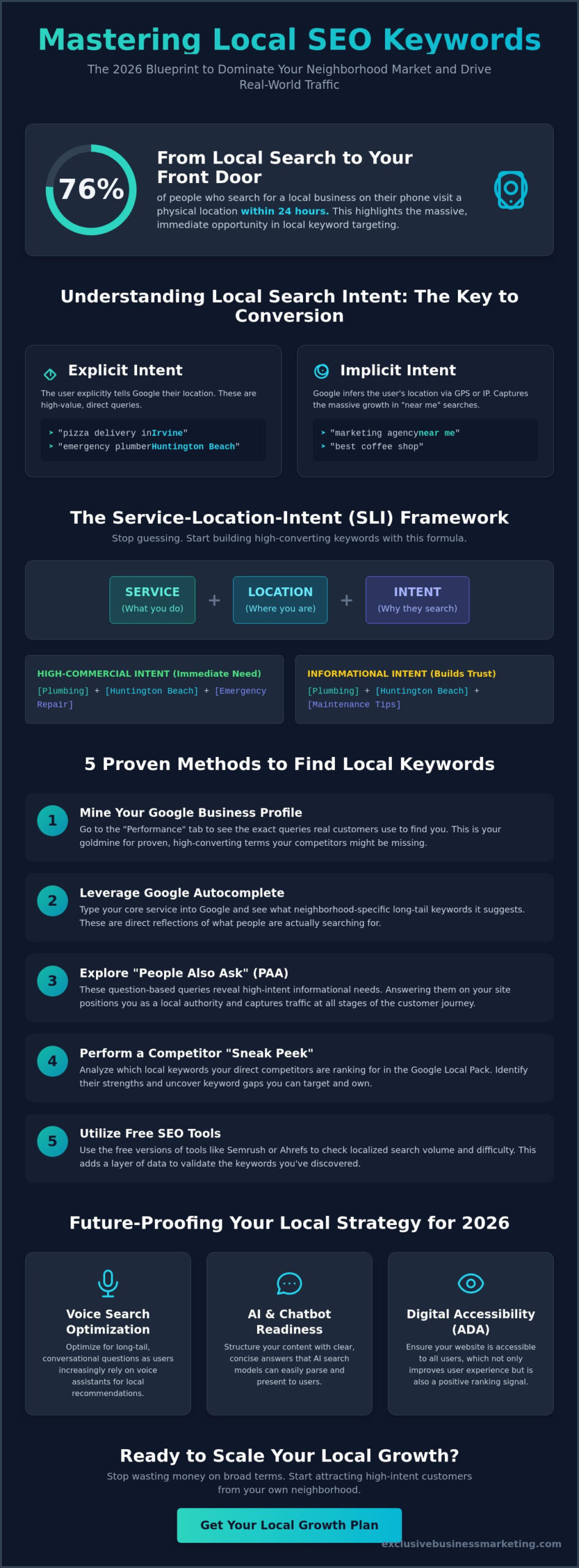
Did you know that 76% of people who search for a local business on their phone visit a physical location within 24 hours? This statistic highlights a massive opportunity, yet many owners still struggle with the specifics of how to find keywords for my local business that actually drive revenue. You’ve probably felt the frustration of wasting money on broad terms that bring traffic from three states away instead of your own neighborhood. It’s exhausting to compete with national brands that have endless budgets, especially when technical SEO jargon makes the whole process feel like a maze.
We know you’re looking for more than just clicks; you want more phone calls and walk-in traffic. You deserve a clear list of search terms that put you directly in the Google Local Pack and outshine the competition. This guide will help you master the exact process of identifying high-converting local search terms so you can dominate your neighborhood market. We’ll walk through the 2026 strategy that combines geographic intent with AI-readiness and digital accessibility to ensure your business stays ahead of every algorithm update.
Key Takeaways
- Distinguish between explicit and implicit intent to capture customers who search for specific city names or use “near me” phrases.
- Learn how to find keywords for my local business by leveraging neighborhood-specific long-tail terms found in Google Autocomplete and your own profile data.
- Map your search terms to the customer journey to build brand trust during awareness and capture high-intent shoppers in the consideration stage.
- Optimize for voice search and AI chatbots to stay ahead of the conversational search trends dominating 2026.
- Build a local tracking system to measure your performance and decide when to hire a professional marketing agency to scale your growth.
Understanding Local Intent: Implicit vs. Explicit Keywords
Success in your neighborhood market starts with understanding exactly what your customers are typing into that search bar. You can’t just throw generic words at a wall and hope for the best. When you’re learning how to find keywords for my local business, you have to look past raw search volume and focus on intent. Local intent carries significantly higher conversion rates than broad national terms because the user has an immediate, location-specific need. While a national term might provide information, a local term provides a customer.
We categorize these search terms into two buckets: explicit and implicit. Explicit keywords are terms where the user tells Google exactly where they are. Think “SEO Huntington Beach” or “pizza delivery in Irvine.” These queries leave no room for guesswork. Implicit keywords are more subtle. When someone searches for a “marketing agency near me,” Google uses their GPS coordinates or IP address to infer their location. This distinction is the backbone of local search engine optimization (local SEO) because it allows you to target users based on how they naturally search. Local keyword research is the strategic practice of balancing these explicit location-based terms with implicit intent phrases to capture users at the exact moment they need your specific services.
Why Geography Matters in 2026 Search
Google’s proximity factor is more aggressive than ever. You can’t realistically rank for a city 50 miles away just by mentioning it once on your homepage. The algorithm prioritizes distance to ensure users get the most convenient results. Modern searchers also use hyper-local landmarks to refine their queries. They aren’t just looking for a cafe in a large city; they’re looking for one “near Main Street” or “by the pier.” Mobile search behavior continues to favor “near me” queries, which have grown by 900% as users expect instant, relevant results based on their current physical location.
Service-Location-Intent (SLI) Framework
To dominate your market, use the Service-Location-Intent (SLI) Framework. This method breaks your target phrases into three essential parts: what you do, where you are, and why they want it. When you master how to find keywords for my local business using this framework, you stop guessing and start growing. Consider these examples:
Identifying these high-commercial terms ensures your budget goes toward keywords that trigger phone calls and walk-in traffic rather than just empty clicks.
5 Proven Methods to Find Local Keywords for Your Business
Identifying high-value search terms requires a methodical shift from guessing to data-driven observation. Many owners waste hours targeting broad terms that never convert because they lack geographic relevance. If you’ve been struggling with how to find keywords for my local business, you must start with the tools you already control. Beyond your own data, you should leverage Google’s Autocomplete feature by typing your core service into the search bar and seeing which neighborhood-specific long-tail terms appear. Additionally, the “People Also Ask” (PAA) boxes are a goldmine for question-based keywords that signal high intent. For more precise metrics, utilize the free versions of professional tools like Semrush or Ahrefs to check localized volume. Integrating these insights into broader local marketing strategies ensures your business remains visible across every relevant search query in your area.
Extracting Gold from Google Business Profile
Your Google Business Profile (GBP) offers direct insight into the behavior of your actual customers. Navigate to the “Performance” tab to see the exact queries used to find your business. It’s vital to distinguish between “total views” and specific search terms to identify what actually triggers your listing in the Local Pack. If you find a high-volume query in your data that isn’t featured prominently on your website, create a new service page for it immediately. This allows you to double down on what’s already working while uncovering “hidden” keywords that your competitors might be overlooking. This proactive approach turns raw data into a clear roadmap for growth.
The Competitor “Sneak Peek” Strategy
Your top local search competitors are the ones currently holding the rankings you want. Analyze their service pages and look specifically at their H1 tags and
Mapping Keywords to the Local Customer Journey
Finding the right terms is a great start, but you must understand how to place them strategically. A successful orange county seo strategy maps specific phrases to the exact stage of the customer’s mindset. If you only target “buy now” terms, you miss a massive audience that is still in the research phase. Conversely, focusing only on broad information won’t pay the bills. When you master how to find keywords for my local business, you learn to categorize them into three distinct buckets based on user intent.
The Awareness Stage is where trust begins. Here, you target broad “how-to” local terms. For example, a gardener might write about “the best time to plant sod in Irvine.” These users aren’t ready to hire yet, but they’ll remember your expertise when they are. Next is the Consideration Stage. These shoppers use “best [service] in [city]” keywords. They know they need a professional and are actively comparing options. Finally, the Decision Stage captures the ready-to-buy crowd. These users search for terms like “price,” “reviews,” or “online booking.” Your website must provide clear answers to these high-intent queries to secure the lead immediately.
Understanding how to find keywords for my local business requires looking at the intent behind the search, not just the word itself. Each stage of the funnel needs a dedicated page or section on your site. By matching your content to the user’s journey, you guide them from a simple question to a confirmed appointment without any friction. This methodical approach is what separates market leaders from businesses that are struggling to stay visible.
Creating Location Pages That Rank
Effective location pages prove your geographic relevance without looking like spam. Don’t just repeat your city name fifty times; that’s an outdated tactic that hurts your rankings. Instead, integrate mentions of local landmarks, community centers, or well-known streets. This shows Google you are a genuine part of the neighborhood. Consistency is also non-negotiable. Ensure your Name, Address, and Phone (NAP) information is identical on every page and matches your Google Business Profile exactly. This builds the trust necessary to outrank national competitors.
Service-Specific Keyword Clusters
Topical authority is a major ranking factor in 2026. Instead of one generic service page, create clusters of related keywords. If you’re a dentist, group terms like “teeth whitening,” “veneers,” and “cosmetic dentistry” together. Linking these pages internally helps search engines understand the depth of your expertise. Building these clusters effectively is a hallmark of a top-tier local seo company near me. One high-quality, comprehensive page that answers every user question is always better than five thin pages that offer no real value.
Future-Proofing: AI Search, Voice, and ADA Accessibility
As we move through 2026, the way your customers interact with search engines is undergoing a radical shift. You can’t rely solely on the tactics of five years ago. Modern search is conversational, visual, and increasingly powered by artificial intelligence. When you’re considering how to find keywords for my local business, you must account for how people speak to their devices. Voice search and AI chatbots are no longer futuristic concepts; they are the primary way many of your customers find services today. Search behavior is no longer a static list of words. It’s a conversation.
AI Search Engine Optimization (AEO) is the new frontier. AI chatbots and Search Generative Experience (SGE) tools extract answers directly from your keyword-rich content to provide instant results. If your content isn’t structured correctly, these bots will skip over your business entirely. Learning how to find keywords for my local business in an AI-driven market means focusing on structured data and natural language that these systems can easily parse. This ensures your business remains the top recommendation when an AI assistant answers a local query.
ADA compliance is a silent but powerful factor in local keyword ranking because it removes the technical barriers that prevent search bots from accurately indexing your location-specific content.
Optimizing for Voice and Conversational Queries
Voice search has changed the structure of local queries. People don’t speak in fragments; they ask full questions. You need to target “Who, What, Where, When” keywords to capture traffic from Alexa and Siri users. For example, instead of just “HVAC repair,” focus on “who is the best HVAC repair technician near me?” Long-tail keywords are now essential because they mimic natural human speech. Using Schema markup is another critical step. It provides the structured data that AI search engines use to understand your local keyword context and display your business in conversational results.
Accessibility as a Ranking Factor
Digital accessibility is now a core component of search visibility. An ada compliant website design ensures that both human users and search engine crawlers can navigate your content without barriers. When your site follows WCAG 2.2 standards, it sends strong user experience (UX) signals to Google. AI search engines prioritize accessible, well-structured data because it’s easier for them to parse and present to users. An accessible site is the foundation for any successful seo services orange county campaign. If the bots can’t read your site, they can’t rank your keywords.
Schedule a strategy session with our experts to future-proof your local search presence and ensure you dominate the 2026 market.
From Research to Results: Scaling Your Local Presence
Understanding how to find keywords for my local business is a vital skill, but data without action is just a spreadsheet. You need a robust system to track these terms and measure your return on investment. Many business owners start strong but lose momentum when they realize that SEO isn’t a one-time task. It requires constant monitoring of search engine updates and competitor movements. If you’re spending forty hours a week running your shop, you likely don’t have another twenty to devote to technical analysis. This is where the choice between DIY and hiring a professional business to business marketing agency becomes clear.
At Exclusive Business Marketing, we take the operational burden off your shoulders. Our approach combines traditional SEO with modern necessities like ADA compliance and AI chatbot installation. We don’t just find the traffic; we capture it. By using custom AI sales assistants, we turn visitors into leads while you’re busy serving customers. This ensures that every keyword you rank for translates into a tangible business outcome. We focus on generating measurable growth so you can focus on your craft.
The ROI of Professional Keyword Management
Basic keyword lists aren’t enough to beat established local competitors who have been optimizing for years. Professional management provides the advantage of ongoing optimization and algorithm monitoring. Search engines update their rules constantly, and a strategy that worked last month might fail today. To maximize your reach, professional pay per click management services can supplement your organic strategy. This multi-channel approach ensures you dominate both the paid ads and the organic Local Pack, leaving no room for competitors to steal your leads.
Taking the Next Step in Huntington Beach
Exclusive Business Marketing helps local businesses bridge the gap between “finding keywords” and “finding customers.” For Orange County businesses, our all-in-one marketing approach is designed to handle every technical detail so you don’t have to. We manage your SEO, ensure your site is accessible, and install AI chatbots that work around the clock. This comprehensive strategy builds a dominant local presence that scales with your business. Stop wondering how to find keywords for my local business and start seeing the results of a professional strategy. Our team is ready to help you outrank the competition and dominate your neighborhood market.
Contact Exclusive Business Marketing for a custom SEO audit today.
Take Control of Your Local Market Today
Mastering the process of how to find keywords for my local business is the definitive first step toward neighborhood dominance. You now have the strategic roadmap to move beyond broad, ineffective search terms and start targeting the high-intent phrases that drive actual phone calls and walk-in traffic. By mapping these keywords to the specific stages of the customer journey and future-proofing your site for AI and voice search, you build a digital presence that national brands simply can’t replicate. You don’t have to navigate this technical maze alone or worry about falling behind the latest technological trends.
We’re here to act as your reliable partner, providing a comprehensive solution that removes the operational burden from your shoulders. As Google Search Results Specialists and Orange County’s leading ADA compliance experts, we offer the AI chatbot and PPC integration needed to generate tangible growth. Ready to dominate your local market? Get your custom SEO audit from Exclusive Business Marketing today! Your neighborhood is ready to find you; let’s make sure you’re the first business they see. Reach out now and start outranking your competitors with confidence.
Frequently Asked Questions
What is the best free tool to find local keywords?
Google Business Profile is the best free resource for discovering high-converting terms. By analyzing the “Queries used to find your business” section in your performance tab, you get direct data on what customers are typing to see your listing. This is often more accurate than third-party estimates. Google Search Console is another powerhouse for tracking organic performance. These tools provide a solid foundation for anyone learning how to find keywords for my local business without an upfront investment.
How many keywords should I target on my homepage?
Focus on one primary keyword and two to three secondary variations for your homepage. Overloading a single page with too many terms dilutes your authority and confuses search engines. Your homepage should target your most important service and your primary location. Use specific service pages to target long-tail or neighborhood-specific terms. This structure ensures your most valuable digital real estate remains clear, authoritative, and optimized for conversions.
Is ‘near me’ a keyword I should actually put on my website?
You don’t need to type “near me” into your website copy. Google uses GPS and IP data to connect users with local businesses automatically. Instead, focus on mentioning specific neighborhoods, landmarks, and zip codes. These signals help the algorithm understand your physical location. By optimizing for your actual city and street names, you’ll naturally show up when users perform “near me” searches in your specific area.
How long does it take to rank for local keywords?
Ranking for local keywords typically takes three to six months of consistent effort. This timeline depends on your local competition and the current authority of your domain. New businesses might see initial movement in the Local Pack sooner if their profile is well-optimized. Be patient and stay consistent with your updates. SEO is a long-term investment that builds compounding value over time rather than providing instant, fleeting results.
Do I need different keywords for Google Maps vs. Google Search?
The keywords remain mostly the same, but the ranking factors differ. Google Search prioritizes website content and backlinks, while Google Maps relies heavily on your proximity to the user and your Business Profile completeness. Ensuring your keywords appear in both your website copy and your Business Profile services list is essential. This unified approach guarantees that you capture visibility regardless of whether a customer uses the main search bar or the map interface.
How often should I update my local keyword research?
Re-evaluate your local keyword research at least once every quarter. Search trends shift as new competitors enter the market or as consumer behavior changes. You should also perform a quick audit after major Google algorithm updates to ensure your strategy remains effective. Regular updates allow you to identify new “hidden” keywords in your performance data. Staying proactive ensures you don’t lose ground to more agile local competitors.
Can AI chatbots help with my local SEO strategy?
AI chatbots are incredibly effective for local SEO because they improve user experience signals. When a visitor engages with a bot, your “time on site” increases, which tells Google your content is valuable. Chatbots also collect common customer questions. You can then turn these questions into keyword-rich FAQ sections or blog posts. This creates a feedback loop that constantly improves your visibility and helps you master how to find keywords for my local business.
Does having an ADA-compliant website really help my rankings?
ADA compliance provides a significant boost to your rankings by making your site easier for search bots to crawl. When your website follows WCAG standards, it features clean code and a logical structure. Google prioritizes accessible sites because they offer a better experience for all users. A compliant site reduces bounce rates and improves engagement. These positive signals directly influence your position in both the organic results and the Google Local Pack.