

Google Ads vs Facebook Ads for Local Leads: The 2026 ROI Guide
Did you know that Meta Ads deliver a 23% lower average cost-per-lead than Google Ads across all industries in 2026? While that figure makes Facebook look like the obvious winner, the reality of google ads vs facebook ads for local leads is more complex than a single metric. You’ve likely noticed your digital advertising costs increasing by up to 7% this year, making every dollar of your budget feel more precious than ever. It’s exhausting to manage low-quality leads while trying to keep up with massive shifts like Google’s retirement of standalone Call Ads or Meta’s new location fees hitting the UK and Europe.
We understand the pressure to deliver measurable growth in a shifting market. This guide promises to clear the fog, showing you which platform delivers the highest quality local leads for your specific industry and how to use them together for maximum impact. We’ll preview the latest 2026 ROI benchmarks, explain how AI-driven tools like Google’s AI Max are redefining search intent, and provide a clear roadmap for your budget allocation. You’ll walk away with a proven strategy to generate a predictable stream of local phone calls and form fills while finally seeing the ROI your business deserves.
Key Takeaways
- Align your marketing strategy with user psychology by distinguishing between immediate demand capture on Google and long-term demand generation on Facebook.
- Discover the real ROI of google ads vs facebook ads for local leads by comparing cost-per-acquisition rather than just looking at surface-level click prices.
- Apply a tailored decision matrix to determine if your local business should prioritize “emergency” intent or “lifestyle” interest to maximize budget efficiency.
- Harness the power of 2026 AI-driven campaign types to automate your local targeting while keeping your brand voice consistent and compliant.
- Boost your conversion rates by pairing your ad campaigns with AI Chatbot Installation to ensure no local lead goes unanswered.
Google Ads vs Facebook Ads for Local Leads: The Demand Dilemma
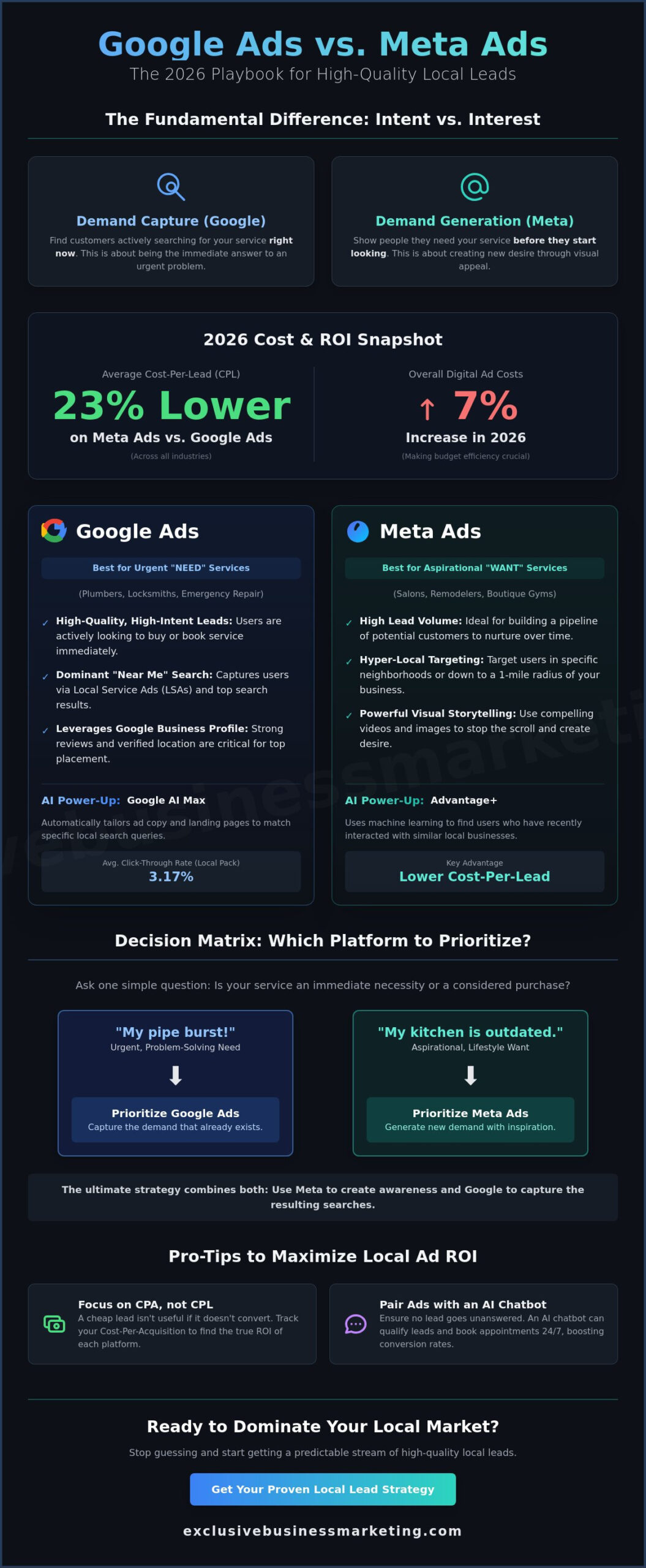
Local business owners often feel stuck in a digital tug-of-war. You want more customers, but your marketing budget isn’t infinite. The debate over google ads vs facebook ads for local leads usually boils down to one fundamental question: do you want to find people who are looking for you, or do you want people to find you while they’re doing something else? This is the split between demand capture and demand generation.
Google is a demand capture machine. When a pipe bursts at 2 AM, nobody scrolls through Facebook to find a plumber. They search. Facebook, conversely, is a demand generation engine. It’s where you show a stunning kitchen remodel to someone who didn’t realize they wanted a renovation until they saw your ad. As this online advertising overview highlights, both search and social play vital roles in the modern digital marketplace, but they serve different psychological needs.
Choosing between them is harder in 2026 because proximity has become the primary driver for local ad algorithms. Both platforms now prioritize how physically close your business is to the user at the moment the ad triggers. This makes “near me” intent highly competitive. You aren’t just fighting for keywords or interests; you’re fighting for a physical radius. This shift forces a choice between lead quality and lead volume. Google typically delivers higher quality leads ready to buy now, while Facebook provides a larger volume of leads that often require more follow-up and nurturing.
What is Google Ads for Local Businesses?
Google Ads focuses on high-intent searchers. For local professionals, this means prioritizing Local Services Ads (LSAs) and traditional Search ads. LSAs are particularly powerful because they appear at the very top of search results, even above standard PPC. They rely heavily on your Google Business Profile. If your profile has strong ratings and a verified location, Google rewards you with better placement. This platform captures “near me” intent instantly. It’s about being the immediate answer to a specific problem.
What is Facebook (Meta) Ads for Local Leads?
Meta Ads thrive on hyper-local geographic targeting. You can drop a pin on your storefront and target a tiny radius of specific neighborhoods. This is perfect for lifestyle services like boutique gyms, salons, or high-end landscapers. Visual storytelling is your best tool here. A high-quality video of a project transformation can stop a scroll faster than any text-based ad. However, Meta Lead Forms can be a double-edged sword. While they generate a high volume of leads quickly, the quality can vary. Since it’s so easy for a user to click “submit” with pre-filled info, you might find yourself chasing leads who don’t remember signing up.
Understanding the Mechanisms: Intent vs. Interest
To win the battle of google ads vs facebook ads for local leads, you must first understand where your customer’s head is at. A homeowner with a flooded basement has active intent; they’re looking for a solution right now. Conversely, someone browsing their feed might be interested in a kitchen remodel but hasn’t started searching yet. This psychological gap is the difference between capturing existing demand and generating new interest. According to a Google Ads vs. Facebook Ads comparison, choosing the right platform depends entirely on whether your service is a “need” or a “want.”
By 2026, AI has fundamentally changed how these platforms find your local customers. Google’s AI Max now automatically tailors ad copy and landing pages to match the specific nuances of a local search query. On the Meta side, Advantage+ campaigns use machine learning to identify users who recently interacted with similar local businesses. These systems prioritize efficiency, but they require high-quality data inputs to succeed. If you aren’t feeding these algorithms the right signals, you’re just burning through your budget.
Google: High Intent, High Competition
Google leads are almost always ready to buy today. When a user searches for a service, they’re often looking at the “Local Pack” first. This is the map section that highlights the top three local businesses. Ads that appear here or directly above it see an average click-through rate of 3.17%, which is significantly higher than social media benchmarks. However, this high intent comes with a price. In competitive local markets like Huntington Beach, cost-per-click (CPC) rates can spike as multiple businesses bid for the same small geographic radius. Intent-Based Marketing is the practice of delivering highly relevant ad content to users at the exact moment they express a specific need through a search query.
Facebook: Creating Demand Through Disruption
Meta Ads don’t wait for a search; they disrupt the user’s experience with something compelling. To succeed here, you must stop the scroll. This is where professional Video Production becomes a non-negotiable asset. A high-impact video showcasing a local project transformation can build trust faster than any text ad. You can also target specific life events, such as reaching new homeowners who likely need landscaping or security services. The key to Facebook success is the “Offer.” Whether it’s a free inspection or a limited-time local discount, your offer must be strong enough to pull someone away from their social feed. If you want to see how these strategies can scale your revenue, our team can help you refine your PPC Ad Management strategy for the 2026 market.
Comparing the Costs: Budgeting for Local Success in 2026
When you evaluate google ads vs facebook ads for local leads, it’s easy to get distracted by the initial price of a click. However, smart local business owners focus on two different metrics: Cost Per Lead (CPL) and Cost Per Acquisition (CPA). In 2026, industry data shows that Meta Ads deliver a 23% lower average CPL than Google Ads across most sectors. While that sounds like a win for Facebook, the CPA often tells a different story. A $10 lead from Facebook might seem like a bargain compared to a $50 lead from Google, but if that Google lead converts into a high-value customer at a 4.40% rate while the Facebook lead never answers the phone, the “expensive” lead is actually the cheaper one.
Budgeting for local success in Southern California requires a realistic understanding of these platform dynamics. You can’t just throw a few dollars at a campaign and expect a flood of calls. Successful local testing involves a minimum viable budget that allows the algorithms to learn. Hidden costs often lurk in poor ad management and unoptimized landing pages. If your website isn’t designed to convert, you’re essentially paying for traffic that disappears into a black hole. This is why professional pay per click management services are essential; they ensure your budget is spent on intent, not just impressions.
Google Ads Cost Benchmarks for Local Services
Google Ads prices vary wildly by industry. For high-value niches like legal and finance, average CPCs can range from $10 to $20, while the overall average across all industries sits closer to $4 to $6. Your Quality Score plays a massive role here. If Google deems your ad and landing page highly relevant to the searcher, you pay less for better positioning. By focusing on “near me” intent and maintaining a high Quality Score, you can capture leads that are ready to hire you today, even in competitive local markets.
Facebook Ads Cost Benchmarks and Lead Volume
Facebook generally offers a lower barrier to entry with a US average CPM of $12 to $15. This allows for a much higher volume of leads, but they come with a “Lead Decay” factor. Because these users are in “discovery” mode rather than “buying” mode, they require instant follow-up. Data shows that lead-gen campaigns on Meta can reach conversion rates of 8.8% to 9.2%, but those numbers plummet if you wait more than a few minutes to respond. Budgeting on Facebook should always include a portion for creative testing to see which visuals stop the scroll in your specific neighborhood.
Industry-Specific Strategies: What Works for Your Local Business?
Your industry dictates your digital battlefield. Choosing between google ads vs facebook ads for local leads isn’t just about budget; it’s about the nature of your service. If you solve immediate problems, you need Google. If you enhance lifestyles, Facebook is your best friend. A simple decision matrix helps: is your service an “emergency” or an “event”? Emergency services should put 70% of their budget into Google, while lifestyle and event-based services should lean 60% toward Meta.
Home Services & Blue Collar (HVAC, Plumbing, Roofing)
For trades like plumbing or HVAC, Google Local Services Ads (LSAs) remain the gold standard for 2026. These ads build instant trust through the “Google Guaranteed” badge, capturing users at their highest point of need. However, don’t ignore Facebook. It’s a powerhouse for showing off “Before and After” transformations of a new roof or a pristine kitchen remodel. Use Facebook to run seasonal maintenance offers before the summer heat or winter cold hits. Because emergencies don’t stick to a 9-to-5 schedule, 24/7 lead capture is mandatory. You can’t afford to miss a high-intent call just because your office is closed.
Professional Services (Legal, Medical, Dental)
Lawyers and doctors need to build authority before they build a client list. Google allows you to target high-intent search terms like “personal injury attorney” or “emergency dentist” where the user is ready to act. Facebook serves a different purpose here: patient and client education. Use social ads to share helpful tips or explain complex legal processes to stay top-of-mind. Conversion for these high-stakes services depends heavily on your digital home. An ADA compliant website design ensures you don’t alienate potential clients while protecting your business from legal risks.
Paid ads work best when they sit on a foundation of organic visibility. Working with a local seo company near me helps bridge the gap between paid clicks and long-term growth. When you balance google ads vs facebook ads for local leads, your organic presence acts as a trust signal for every paid click you receive. When seasonal demand shifts, you can pivot your ad spend. For example, an HVAC company might boost Google spend for “AC repair” in July but switch to Facebook for “furnace inspections” in October. If you’re ready to dominate your local market, partner with our marketing agency to build a custom strategy that scales.
Beyond the Click: How AI and Compliance Maximize Ad ROI
Winning the battle of google ads vs facebook ads for local leads is only half the job. You can spend thousands on high-intent clicks, but industry data shows that 70% of local ad spend is wasted on poor follow-up. If a potential customer calls your business or fills out a form and doesn’t get an immediate response, they’ll simply move to the next name on the list. In 2026, the speed of your intake process is just as important as the quality of your ad creative. You need a system that captures interest the second it happens.
Stop letting leads slip through the cracks while you’re busy on a job site or asleep. High-performing local campaigns now rely on a seamless transition from the ad click to a live interaction. This is where your website stops being a digital brochure and starts being a 24/7 sales assistant. By optimizing your post-click experience, you ensure that the traffic you’ve paid for actually turns into revenue. It’s about removing every possible point of friction between the user’s problem and your solution.
AI Chatbots: Converting Traffic While You Sleep
AI Chatbot Installation is the most effective way to qualify local leads before they ever reach your phone. These bots provide instant answers to common local service questions, such as “Do you service Huntington Beach?” or “Can you come out today?” By integrating chatbots with your PPC campaigns, you create a seamless lead flow that keeps users engaged. This reduces the bounce rate on your landing pages and ensures that when you finally pick up the phone, you’re talking to a lead who is already vetted and ready to book.
ADA Compliance: The Secret to Better Ad Performance
WCAG & ADA Compliant Website Design is no longer optional for local businesses. Beyond avoiding the “Accessibility Tax” of potential lawsuits, accessible design significantly improves user experience and conversion rates. Google rewards compliant, high-quality websites with better Quality Scores, which leads to lower ad costs for your local search campaigns. When your site is easy for everyone to navigate, your conversion rate naturally climbs. It’s a rare win-win where legal protection directly fuels your marketing ROI.
High-Conversion Local Landing Page Checklist:
- Local-First Headline: Match your headline exactly to the ad copy and specific neighborhood targeted.
- Click-to-Call Functionality: Ensure your phone number is prominent and easy to tap on a mobile device.
- AI Chatbot: Use an automated assistant to handle initial intake and lead qualification 24/7.
- Local Trust Signals: Feature photos of your actual team and reviews from customers in the local area.
- Accessibility Compliance: Maintain full WCAG standards to lower your CPC and protect your business.
Maximizing your ROI requires a hands-on approach to every stage of the funnel. From the first search to the final booking, every detail matters. Don’t let your budget go to waste on a broken process. Implement these conversion-focused tools today to turn your local ad spend into a predictable engine for growth.
Dominate Your Local Market with a Data-Driven Ad Strategy
The 2026 landscape for google ads vs facebook ads for local leads requires more than just a healthy budget. You’ve seen how Google captures urgent intent while Facebook builds your brand through discovery. True ROI comes from integrating these platforms while leveraging AI for instant lead qualification and ensuring your site meets strict ADA standards. Don’t let your marketing dollars go to waste on unoptimized campaigns or slow follow-up processes.
Our team specializes in Orange County Local Lead Gen, providing the expertise you need to scale. We are experts in AI Chatbot Implementation and ADA & WCAG Compliance, ensuring your digital presence is both effective and protected. It’s time to stop guessing and start growing with a partner who understands the local digital landscape. We handle the complex technical tasks so you can focus on running your business.
Get a Free Audit of Your Local Ad Strategy Today. We are ready to help you build a predictable stream of high-quality leads that actually convert. Your business deserves a results-oriented approach that delivers tangible growth and measurable outcomes. Let’s start building your success story today.
Frequently Asked Questions
Is Google Ads or Facebook Ads better for a small budget?
Facebook Ads usually offer a lower barrier to entry for small budgets because the average cost per mille (CPM) remains relatively affordable at $14.90. You can reach a large local audience and generate discovery-based leads without the high cost-per-click often found in search. However, Google Local Services Ads are incredibly efficient for small budgets in high-intent niches because you only pay for actual leads rather than just impressions or clicks.
How much should a local business spend on ads per month?
Your monthly spend should be high enough to generate at least 30 to 50 leads so the platform’s AI has enough data to optimize your campaigns. While specific totals vary by city and industry, businesses in competitive areas like Orange County often find that a blended approach works best. You should allocate your budget based on whether you need immediate “emergency” calls or long-term “lifestyle” interest to keep your pipeline full.
What is the average cost per lead for local services in 2026?
In 2026, Meta Ads deliver a 23% lower average cost-per-lead (CPL) than Google Ads across all industries. For example, home services average $34 on Meta, while Google leads can range from $25 to $110 depending on search urgency. When evaluating google ads vs facebook ads for local leads, remember that Google’s higher CPL often comes with a higher conversion rate because the user is actively searching for a solution.
Can I run Google and Facebook ads at the same time?
Running both platforms simultaneously is the gold standard for local growth in 2026. This multi-channel strategy allows you to use Facebook for brand awareness and “demand generation” while using Google to capture “demand” from users ready to buy. Using both ensures that even if a user doesn’t click your search ad, they’ve likely already seen your brand on their social feed, which builds instant trust.
How do I know if my local ads are actually working?
You’ll know your ads are successful when you see a predictable stream of local phone calls and form fills that convert into booked jobs. Don’t just look at clicks; track your cost-per-acquisition (CPA) to see exactly how much it costs to gain a new customer. Use conversion tracking tools to identify which platform is delivering the highest quality leads so you can adjust your budget allocation accordingly.
Why am I getting leads that don’t pick up the phone?
Leads often fail to answer because of “lead decay,” especially on social media where users aren’t always in a buying mindset. If you don’t respond to a Facebook lead within five minutes, the chance of connecting drops significantly. Implementing AI Chatbot Installation ensures every lead gets an instant response, qualifying them and keeping them engaged until you can step in to close the deal.
Do I need a special landing page for local ads?
A dedicated, high-conversion landing page is mandatory for any successful local ad campaign. It needs to match the specific offer in your ad and include local-first creative, such as photos of your team or neighborhood landmarks. A generic homepage lacks the focus needed to drive immediate action and usually results in a much higher cost-per-lead and lower Quality Score.
How does ADA compliance affect my ad ranking?
Google rewards WCAG and ADA compliant websites with higher Quality Scores, which directly leads to lower ad costs and better rankings. Accessible design improves the user experience for everyone, reducing bounce rates and increasing the likelihood of a conversion. Beyond the performance benefits, maintaining a compliant site protects your local business from the legal risks of accessibility lawsuits.