

Fixing a Bad Website Design in 2026: A Strategic Guide to Increasing ROI
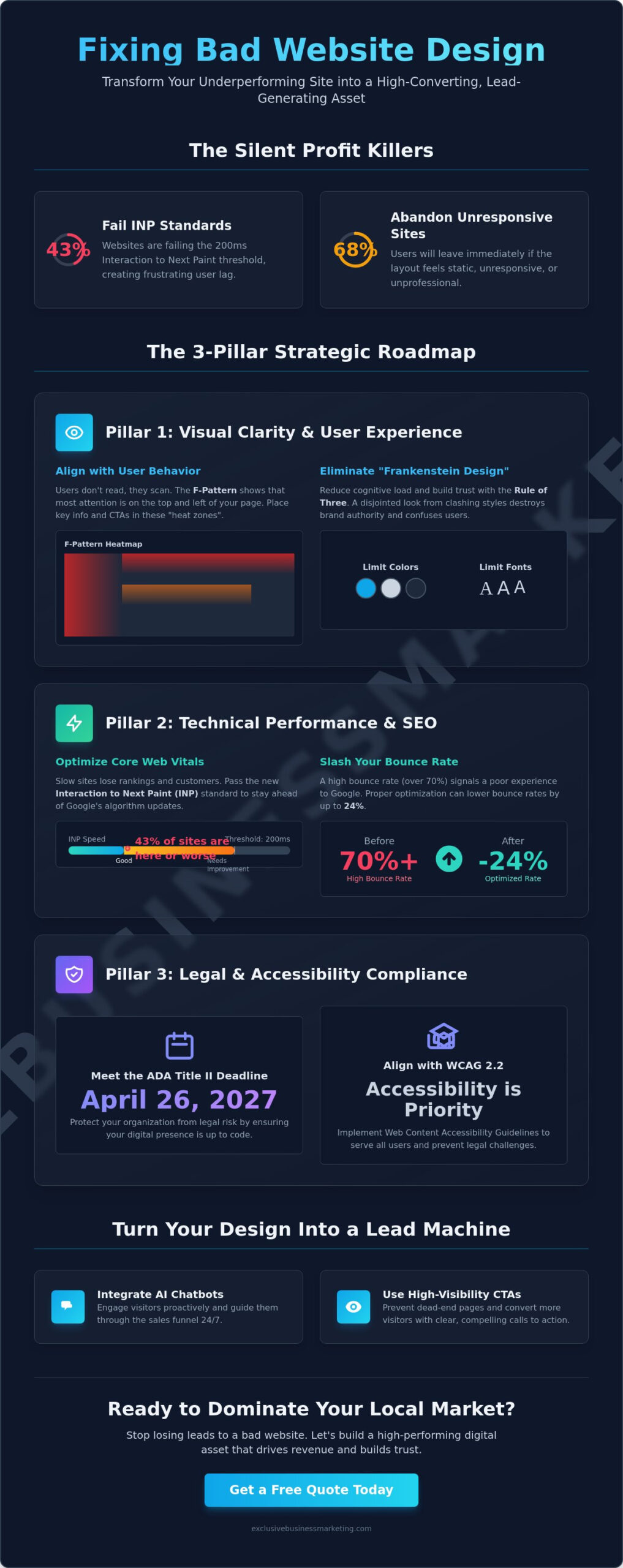
Did you know that 43% of websites in 2026 are currently failing the Interaction to Next Paint (INP) threshold of 200 milliseconds? This technical lag is a silent profit killer, contributing to the fact that 68% of users will abandon a site if the layout feels static or unresponsive. You likely know the frustration of watching potential leads slip away because your pages load too slowly or look unprofessional. It’s even more stressful considering the April 26, 2027, deadline for ADA Title II compliance, which puts many organizations at risk of legal trouble if their digital presence isn’t up to code.
Fixing a bad website design is a waste of resources if the final product doesn’t drive revenue. In 2026, the most successful sites have moved away from being “digital brochures” and have become proactive sales assistants. This transition requires a strategic focus on how you capture attention and guide users toward a decision. For businesses looking to grow their team, aligning your website with Recruitment advertising strategies ensures that your digital presence attracts both new clients and top-tier talent. The “Above the Fold” rule remains a non-negotiable standard. Your primary call to action (CTA) must be visible the moment a page loads, ensuring users don’t have to scroll to find out how to work with you. We also recommend placing social proof, like testimonials and case studies, immediately following your value proposition to build trust at the exact moment a user is considering your offer.
We understand these anxieties, and we’re here to help you stop the bleeding. By fixing a bad website design, you can transform a low-performing site into a high-converting asset that ranks at the top of Google search results. This guide provides a strategic roadmap to achieve a professional look and higher ROI through a three-pillar process: visual clarity, technical SEO, and total legal compliance. You will learn how to optimize your Core Web Vitals to see a 24% lower bounce rate and generate the consistent leads your business deserves. We are ready to show you exactly how to dominate your local market.
Key Takeaways
- Eliminate user friction by applying the Rule of Three and the F-Pattern to ensure your layout is professional and easy to navigate.
- Stay ahead of search algorithm updates by optimizing for the 2026 Core Web Vitals, specifically the new Interaction to Next Paint (INP) standard.
- Protect your business from legal risks by aligning your digital presence with current WCAG 2.2 accessibility requirements.
- Master the strategic process of fixing a bad website design to transform a low-performing site into a high-converting, local search powerhouse.
- Convert more visitors into customers by integrating AI chatbots and high-visibility CTAs that prevent users from getting stuck on dead-end pages.
What Is Bad Website Design and How Is It Hurting Your Business?
Bad design isn’t just about clashing colors or grainy images. It is any element that creates friction between the user and their goal. When a visitor lands on your page, you have exactly 0.05 seconds to convince them to stay. If your layout is confusing or slow, they will leave before reading a single word. Web design encompasses several critical disciplines, including user interface and technical performance, and neglecting even one can tank your ROI. Our research shows that an Orange County web design refresh can double conversion rates simply by removing these invisible barriers. Fixing a bad website design is the first step toward reclaiming your lost revenue and building a brand that customers trust.
The Psychology of a High-Bounce Website
High bounce rates often stem from a heavy cognitive load. When you present too many choices, users experience “analysis paralysis” and take zero action. Your site must provide clear trust signals to prove you are active and professional. Outdated copyright dates, broken links, or 2010-era graphics make your business look “closed” or unreliable. Visual hierarchy is the strategic map for a user’s eyes that guides them toward your most important call to action. Without this map, visitors wander aimlessly until they click the back button. We ensure every element serves a specific purpose in the sales funnel.
Signs Your Site Needs an Immediate Overhaul
Analyzing your data is the only way to see the truth. A bounce rate over 70% is a loud signal to Google that your site is irrelevant to searchers, which will eventually drop your rankings. You can also perform the “Squint Test” right now. If you squint at your screen for 3 seconds, can you still tell exactly what you sell? If the answer is no, your messaging is buried. Many businesses also suffer from “Frankenstein Design.” This occurs when multiple styles, fonts, and layouts clash over time as different people make small updates. This disjointed look destroys brand authority. We specialize in fixing a bad website design by unifying your brand voice and streamlining the technical foundation to drive results. Contact us today for a free quote, and let’s turn your site into a lead machine.
Streamlining User Experience: Fixing Navigation and Visual Clutter
User experience is the foundation of any high-converting site. Most visitors don’t read every word on your page; instead, they scan in an “F-Pattern.” They look across the top, down the left side, and then across the middle. If your most important information falls outside this path, it remains invisible. Fixing a bad website design requires you to align your layout with this natural scanning behavior. By placing your primary value proposition and call to action within these heat zones, you ensure that 100% of your visitors see what you offer within their first few seconds on site.
Professional branding relies on the “Rule of Three.” You should limit your site to three primary colors and three font families. Exceeding these limits creates a “Frankenstein” look that confuses the brain and increases cognitive load. This mental fatigue leads to analysis paralysis, where a user becomes overwhelmed by choices and decides to take no action at all. You can combat this by removing unnecessary sidebar widgets, social media feeds, and aggressive pop-ups that distract from the main goal. Following usability best practices allows you to use white space as a strategic tool to make your content breathe and your offers pop.
Restructuring Your Navigation Menu
Your header menu is the roadmap for your business. Follow the “7-item rule” by keeping your main navigation to seven links or fewer. Human short-term memory struggles to process long lists, which leads to frustration. Use descriptive, keyword-rich labels instead of generic terms. For example, replace “Services” with “SEO Services” to help both users and search engines understand your value. Since 68% of users will leave a site if the layout feels static or unresponsive, ensure your mobile “hamburger menu” is large and thumb-friendly. If your current menu is a maze, a professional design refresh can immediately clear the path for new leads.
Fixing Visual Clutter and Typography
Typography is more than just a style choice; it is a tool for accessibility. Choose clean, sans-serif fonts for your body text to ensure readability across all devices. You must also standardize your button styles to create a consistent “visual language.” If your buttons change shape or color on every page, you lose trust. Finally, delete low-quality stock photos that look staged or artificial. Authentic imagery or high-quality custom graphics build the credibility needed to drive conversions and increase your long-term ROI. We help you replace these “trust-killers” with a polished, professional look that converts.
Optimizing Technical Performance: Speed, Mobile, and SEO Alignment
Most agencies treat design and SEO as separate silos. This is a mistake that kills your ROI. A beautiful site that fails to load or rank won’t generate revenue. Fixing a bad website design requires a deep dive into Core Web Vitals, which are Google’s 2026 metrics for measuring real-world user experience. Currently, 43% of sites fail the Interaction to Next Paint (INP) threshold of 200 milliseconds. If your site feels sluggish when a user clicks a button, Google will penalize your rankings and users will bounce. We ensure your technical foundation is as polished as your visual layout.
High-performance design strategies to drive traffic focus on technical alignment. This includes moving beyond the “mobile-friendly” label. In 2026, mobile-first design is the only standard that matters because only 48% of mobile pages currently pass all three Core Web Vitals. We replace heavy, outdated image files with WebP formats to slash load times. We also use strategic internal linking to bolster your SEO services Orange County strategy, ensuring search engines can easily crawl and index your most valuable pages.
Improving Page Load Speed
Speed is the ultimate conversion killer. You must hit a 2-second load threshold to keep users engaged. Research shows that every second of delay after that 2-second mark costs you a 7% drop in conversions. We eliminate background “bloat” by minifying CSS and Javascript files to reduce the amount of data a browser has to process. For your returning Huntington Beach local customers, we leverage browser caching to ensure your site loads almost instantly on their second visit. This level of optimization turns a slow, frustrating site into a high-speed lead machine.
Designing for Search Engine Visibility
Search engines don’t see images; they read code. We establish a clear “Header Hierarchy” using H1, H2, and H3 tags to tell crawlers exactly what your content is about. Alt-text for images acts as a bridge between SEO and accessibility, ensuring your site is searchable and compliant with current standards. We also make sure your “Call Us Now” buttons are crawlable text rather than static images. This small fix ensures Google recognizes your conversion points. When your design and SEO work together, your business dominates the local search results. Contact us today for a free quote, and we will prove it to you.
Solving the Accessibility Gap: Why ADA Compliance is a Design Priority
In 2026, accessibility is a core business requirement rather than a secondary feature. Fixing a bad website design means addressing the technical and legal gaps that leave your company vulnerable. The California legal landscape is particularly challenging, with Orange County businesses frequently becoming targets for digital accessibility lawsuits. To stay safe, you must align your site with WCAG 2.2, the current global standard for digital inclusivity. Neglecting these standards doesn’t just invite legal trouble; it alienates a massive portion of your audience. Approximately 1 in 4 adults in the United States lives with a disability, and if your color contrast is poor, your text becomes invisible to them. For a deep dive into these requirements, check out our ADA compliant website design guide.
Common Accessibility Design Fails
Simple design choices often create the biggest barriers. Keyboard navigation is a perfect example. If a visitor cannot browse your services or fill out a contact form using only the “Tab” and “Enter” keys, your site is non-compliant. Your underlying code must also ensure screen reader compatibility so visually impaired users can understand your content through audio. We also prioritize “Focus States,” which are visual cues that highlight exactly where a user is on a page as they move through forms or menus. These elements are essential for a professional, inclusive digital presence. We build these features into every project to ensure no lead is left behind.
The Business Case for Inclusive Design
Inclusive design is a powerful tool for market expansion. When you fix accessibility issues, you improve the user experience for everyone, including mobile users and older demographics. There are also direct SEO benefits to consider. Accessible code uses a clean, semantic structure that helps Google understand your content hierarchy more effectively. This leads to better indexing and higher visibility in local search results. A site that is easy for everyone to use is a site that generates more revenue. Contact us today for a free quote on a comprehensive accessibility audit to protect your business and drive more growth. We are ready and available now to help you secure your digital future.
Turning Your Design into a Lead Machine with AI and Strategic CTAs
Fixing a bad website design is a waste of resources if the final product doesn’t drive revenue. In 2026, the most successful sites have moved away from being “digital brochures” and have become proactive sales assistants. This transition requires a strategic focus on how you capture attention and guide users toward a decision. The “Above the Fold” rule remains a non-negotiable standard. Your primary call to action (CTA) must be visible the moment a page loads, ensuring users don’t have to scroll to find out how to work with you. We also recommend placing social proof, like testimonials and case studies, immediately following your value proposition to build trust at the exact moment a user is considering your offer.
Dead-end pages are silent profit killers. These are pages where a user finishes reading but has no clear next step. We solve this by integrating AI chatbots that engage visitors in real-time, answering questions and qualifying leads while you sleep. By combining these proactive tools with a clean, high-performance layout, you turn every visitor’s click into a potential conversion. We are ready to help you implement these cutting-edge features today.
Crafting High-Conversion Call-to-Actions
Generic buttons like “Submit” or “Click Here” are relics of the past. To drive results, you must use action-oriented language that highlights the benefit to the user. Replacing a standard button with “Get My Free Quote” or “Start My Growth Plan” can significantly increase click-through rates. You must also ensure your buttons “pop” by using high-contrast colors that stand out from your background without clashing with your brand palette. We follow the “power of one” principle, which dictates that every page should have one clear, primary goal. This focus eliminates confusion and makes the path to conversion obvious for every visitor.
Implementing AI for 24/7 Lead Capture
Modern users suffer from “contact form fatigue.” They often prefer the instant gratification of a chat interface over waiting 24 hours for an email response. Our custom AI chatbots act as a 24/7 sales assistant for your Huntington Beach business, providing immediate answers and capturing contact information instantly. This technology ensures that you never miss a lead, even on weekends or holidays. Fixing a bad website design in 2026 means embracing these automated engagement tools to stay competitive. Contact us today for a free quote on installing a custom AI chatbot and let us prove how we can improve your revenue. We are ready and available now to transform your site into a high-performance lead machine.
Transform Your Digital Presence into a Revenue Engine
Your website is the digital face of your brand. It should work as hard as you do to generate growth. By prioritizing Core Web Vitals and securing WCAG 2.2 compliance, you protect your business from legal risks while reclaiming the 24% of users who bounce from slow, unstable sites. Fixing a bad website design is no longer just about aesthetics; it’s a technical and strategic necessity to remain competitive in 2026. You deserve a digital platform that proactively drives sales rather than just sitting static on the web.
Exclusive Business Marketing is here to handle every detail. Our Orange County based team is available 7 days a week to ensure your marketing never sleeps. As certified WCAG and ADA compliance experts, we have a proven track record of increasing ROI by 110% for our clients. We remove the technical burden so you can focus on running your company. Are you ready to dominate local search and turn your site into a high-performing lead machine? Contact Exclusive Business Marketing today for a free website audit and quote! We will prove our value to you and help you achieve the tangible outcomes you deserve.
Frequently Asked Questions
How do I know if my website design is actually bad?
High bounce rates exceeding 70% and failing scores on Google Core Web Vitals are the most objective signs of a failing design. If 68% of your visitors leave because your layout feels static or ignores their past interactions, your site is creating too much friction. You can also use the “Squint Test” to see if your primary offer is visible within 3 seconds. Clashing styles or “Frankenstein Design” elements further prove your site needs a professional overhaul.
Can I fix my website design without losing my SEO rankings?
Yes, you can preserve and even boost your rankings by following a strategic migration plan that protects your URL structure and metadata. Fixing a bad website design actually improves SEO because Google’s 2026 algorithm heavily weights user experience metrics like Interaction to Next Paint (INP). We ensure your H1 through H3 tag hierarchy remains intact while cleaning up technical debt. This process makes it easier for search crawlers to index your most valuable pages.
How much does it cost to fix a bad website design in California?
Redesign costs in 2026 depend on your site’s scale, with small business websites of 10 to 20 pages typically costing between $15,000 and $40,000. Mid-market sites with 30 to 75 pages generally range from $40,000 to $100,000. These investments cover essential upgrades like WCAG 2.2 compliance, custom AI integrations, and technical SEO optimization. For businesses looking for capital to manage these costs, Legacy Funding Advisors provides fast and flexible funding solutions. Contact us today for a free quote tailored to your specific business goals and technical requirements.
How long does a typical website redesign or fix take?
A comprehensive redesign usually takes between 8 and 14 weeks from the initial audit to the final launch. This timeframe allows our team to conduct deep user behavior research, create custom design iterations, and perform rigorous accessibility testing. Larger enterprise sites with over 100 pages or complex third-party integrations may require 6 months or more. We provide a methodical project roadmap to ensure your new site launches on schedule without any technical hitches.
What are the most common website design mistakes for small businesses?
The most frequent errors include cluttered navigation menus with more than seven links and the use of slow image formats that kill load speeds. Many businesses also fail to place a clear call to action “Above the Fold,” which forces users to hunt for contact info. Additionally, 52% of small business sites still ignore mobile-first usability in 2026. These mistakes create “Dead-End” pages where potential leads get stuck and eventually leave your site.
Is my website required to be ADA compliant by law?
Digital accessibility is a legal requirement, and several critical deadlines are approaching. State and local government entities must comply with WCAG 2.1 Level AA standards by April 26, 2027, or 2028 depending on their population size. Healthcare organizations receiving federal funding faced a compliance deadline of May 11, 2026. For private businesses, the California legal landscape makes you a high-priority target for lawsuits if your site isn’t accessible to the 1 in 4 adults with disabilities.
Will a new design improve my Google Search rankings?
A modern design directly influences your rankings by improving Core Web Vitals, which leads to a 24% lower bounce rate on average. When your site loads faster and provides a stable visual experience, Google recognizes it as a high-quality destination for users. Better engagement signals, such as longer session durations and higher click-through rates, tell the algorithm that your content is relevant. This technical alignment is the foundation of any successful local search strategy.
Can an AI chatbot really improve my website’s performance?
AI chatbots significantly improve performance by providing 24/7 engagement and fixing pages where users typically get stuck. Modern visitors often prefer instant chat over traditional contact forms, which can feel like a chore. By delivering immediate answers to common questions, a custom AI chatbot keeps users on your site longer and captures lead data that would otherwise be lost. Contact us today for a free quote on installing a custom AI sales assistant for your business.