

The High Risk of Not Having an Accessible Website: 2026 Legal & SEO Guide
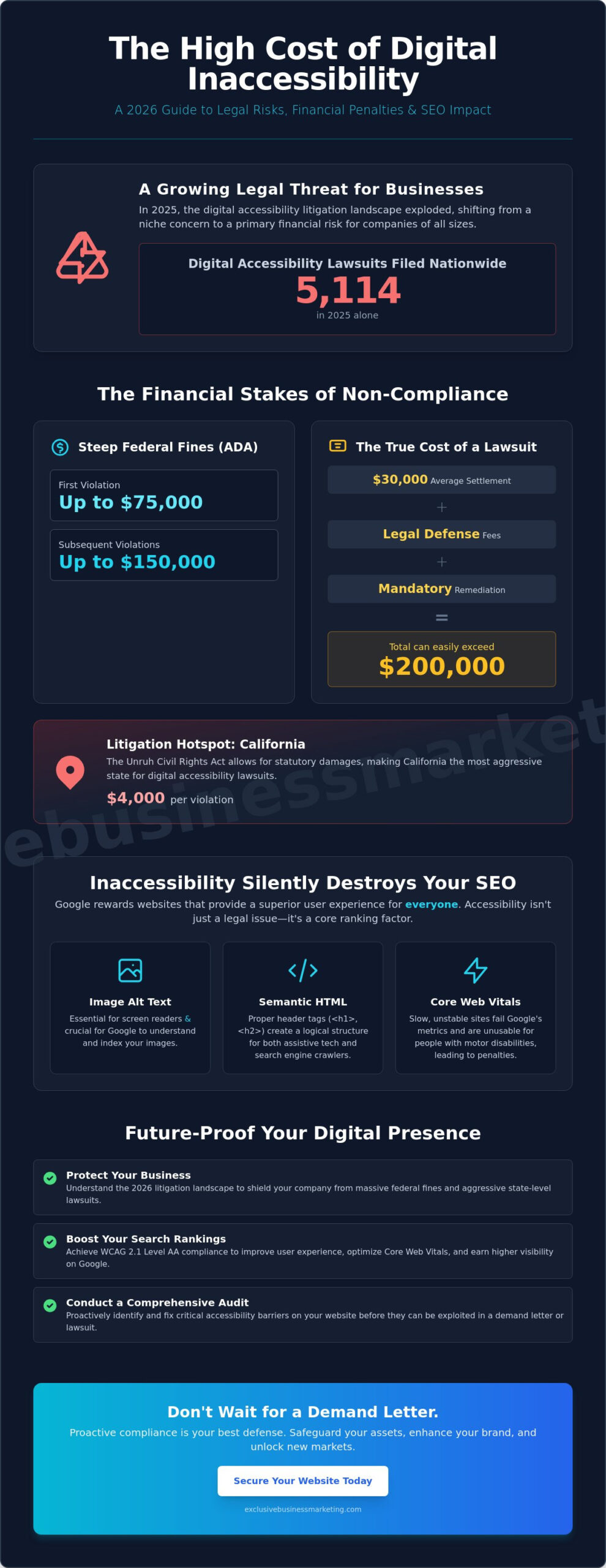
Did you know that 5,114 digital accessibility lawsuits were filed nationwide in 2025? For many business owners, the risk of not having an accessible website has shifted from a minor concern to a major financial liability. It’s natural to feel uneasy about predatory legal claims or worry that meeting WCAG 2.1 standards will compromise your site’s aesthetic. You want to grow your business, not spend your budget on avoidable legal fees or settlement payments that often average $30,000.
We agree that the technical side of compliance can feel complex and intimidating. That’s why this 2026 guide is designed to give you total peace of mind. You’ll learn how to safeguard your brand against federal fines that can hit $75,000 for a first violation while simultaneously improving your search engine visibility. We’ll break down the latest legal requirements and show you how to create a frictionless experience for every user. Read on to discover how a proactive approach to accessibility protects your assets and positions your company as a market leader.
Key Takeaways
- Understand the 2026 litigation landscape to protect your business from federal fines and aggressive state-level lawsuits.
- Learn how WCAG compliance boosts your search rankings by optimizing Core Web Vitals and reducing user bounce rates.
- Evaluate the true financial risk of not having an accessible website, including the hidden costs of market exclusion and brand erosion.
- Discover how to conduct a comprehensive accessibility audit to identify and fix critical barriers before they lead to legal action.
- Future-proof your digital presence by integrating inclusive design from the start, saving you from expensive retrofits and technical debt.
The Legal and Financial Landscape of ADA Non-Compliance in 2026
The Americans with Disabilities Act (ADA) Title III prohibits discrimination on the basis of disability in places of public accommodation. While this law once focused on physical ramps and wide doorways, the Department of Justice (DOJ) has firmly expanded this definition to include the digital world. In 2026, the risk of not having an accessible website is no longer a theoretical concern for business owners. It’s a direct threat to your financial stability. The DOJ now views Web accessibility standards, specifically WCAG 2.1 and 2.2 Level AA, as the gold standard for compliance. If your site fails to meet these technical benchmarks, you’re effectively barring millions of users from your services.
The litigation landscape has become increasingly aggressive. In 2025 alone, over 5,100 digital accessibility lawsuits were filed nationwide. These aren’t just targeting massive corporations anymore. Small and medium-sized businesses are now the primary targets of high-volume law firms. Federal fines for non-compliance are steep, with first-time violations reaching up to $75,000. Subsequent violations can double that amount to $150,000. When you add mandatory remediation timelines and your own legal defense fees, the total cost of a single lawsuit can easily exceed $200,000.
Federal vs. State Level Risks: The California Factor
California remains the most active hotspot for accessibility litigation. Plaintiffs in the state frequently leverage the Unruh Civil Rights Act, which allows for statutory damages of $4,000 per violation. Courts have rapidly shifted their focus from physical barriers to digital ones, ruling that a website is an essential extension of a business’s public services. California law often imposes stricter penalties and higher standards for digital accessibility than federal ADA requirements. This makes any business with a digital presence in the state a prime target for opportunistic litigation.
The Escalating Cost of Demand Letters and Settlements
For a business in Orange County, the lifecycle of an accessibility demand letter is fast and expensive. You typically receive a notice alleging specific WCAG failures, followed by a demand for an immediate settlement. The true risk of not having an accessible website isn’t just the $30,000 average out-of-court settlement; it’s the hidden cost of business disruption. You lose weeks of productivity while your team scrambles to address legal threats and technical debt. Using a free ADA compliance checker is the first line of defense to identify these vulnerabilities before a law firm does. Proactive compliance is a strategic move that prevents these predatory expenses from draining your marketing budget.
How Inaccessibility Destroys Your SEO and Search Visibility
Many businesses view accessibility as a legal hurdle. It’s actually a massive competitive edge. Google’s algorithm is designed to reward websites that provide a superior user experience for everyone. When you ignore legal requirements under the ADA, you’re also ignoring the very factors that drive search engine rankings. The risk of not having an accessible website includes more than just lawsuits; it includes a steady decline in organic traffic and visibility. Search engines prioritize sites that are easy to navigate, and accessibility is the foundation of that ease.
Think about alt text. It’s essential for screen readers to describe images to visually impaired users. It’s also exactly what Google’s crawlers use to understand the content of your images for search optimization. Similarly, using semantic HTML structure, like proper header tags, helps both disabled users and search engine bots navigate your content logically. This clarity makes it easier for search engines to index your pages accurately and rank them for relevant queries. If your site’s architecture is a mess, bots will struggle to categorize your content.
Core Web Vitals and the Accessibility Connection
Google’s Core Web Vitals measure speed, responsiveness, and visual stability. These metrics are inherently tied to accessibility. Unexpected layout shifts or slow interactive elements don’t just frustrate average users. They make a site completely unusable for individuals with motor disabilities who rely on precise interactions. The technical risk of not having an accessible website is that you’ll fail these vital metrics. If your site doesn’t perform, your rankings will suffer. Check out our Orange County SEO guide to see how these technical elements fit into a broader local ranking strategy.
Poor keyboard navigation is another silent ranking killer. Users with disabilities often use the “Tab” key to move through a site. If your navigation menu is keyboard-locked or illogical, those users will bounce immediately. Google interprets high bounce rates as a sign of low quality. By fixing these gaps, you ensure every visitor stays longer, sending positive signals to search engines. It’s a simple equation: better access equals better engagement.
The “Invisible” Penalty: Why Your Rankings Might Be Stalling
Search bots crawl your site much like a screen reader does. If your site has missing headers or broken navigation links, bots get stuck. This creates an invisible penalty where your content isn’t fully indexed. Accessible sites enjoy longer dwell time because they’re easier to use for everyone. Implementing accessible design principles ensures your site’s foundation is built for both humans and algorithms. Don’t let technical debt sink your visibility. If you’re worried your current site structure is holding you back, you can partner with an expert marketing agency to turn these risks into opportunities for growth.
Brand Erosion and the Massive Cost of Market Exclusion
Beyond the courtroom and search engine rankings, your brand’s reputation is on the line. The risk of not having an accessible website extends into the social fabric of your business. In 2026, consumers are more socially conscious than ever. They don’t just buy products; they buy into values. If your digital presence excludes people with disabilities, you aren’t just losing a transaction. You’re signaling that your brand doesn’t care about inclusivity. This can quickly lead to negative sentiment on social media. One viral post about a screen reader failure can spark a wave of “cancel culture” that takes months of expensive PR to fix.
Losing the 27%: The Revenue You’re Leaving on the Table
Approximately 27% of the adult population in the U.S. lives with some form of disability. When your site lacks captions on videos or keyboard-friendly forms, you’re effectively closing your doors to over a quarter of your potential market. This creates an “Avoidance Tailspin.” Once a user finds a site difficult to use, they rarely return and often warn their network to stay away. Our approach to Orange County web design focuses on eliminating these barriers to drive actual revenue results. We ensure your site is a welcoming environment for every visitor, regardless of their ability.
Building Trust Through Radical Inclusivity
Trust is the currency of the digital age. Simply publishing a clear accessibility statement on your site can build immediate rapport with your audience. It shows you’re proactive, transparent, and committed to serving everyone. This leadership in digital inclusion creates positive PR within your local community and sets you apart from laggards. Inclusive brands consistently see higher customer loyalty and referral rates because they provide a frictionless experience that people appreciate. Don’t view accessibility as a burden. View it as a way to build a more resilient and respected brand.
Identifying and Mitigating Digital Accessibility Barriers
Mitigating the risk of not having an accessible website requires a methodical strategy. You can’t fix what you haven’t identified. We recommend a proactive approach that moves beyond simple patches and addresses the root causes of digital exclusion. Follow these five steps to secure your digital assets and ensure every user has a seamless experience:
- Step 1: Conduct a comprehensive accessibility audit. Combine automated scanning with manual testing to catch complex errors that software misses. This provides a clear roadmap for your remediation efforts.
- Step 2: Prioritize “Level A” failures. Focus on critical blockers that prevent users from completing basic tasks, such as filling out a contact form or checking out. These are the most common triggers for legal action.
- Step 3: Remediate technical debt. Fix your site-wide templates and navigation menus first. This ensures that a single technical fix improves hundreds of pages simultaneously, maximizing your ROI.
- Step 4: Implement ongoing monitoring. Compliance isn’t a one-time event. Use monitoring tools to flag new issues as you update your site content or add new features.
- Step 5: Train your content team. Ensure everyone who uploads media or writes blogs understands how to use alt-text, descriptive links, and proper heading structures.
Common “Red Flags” That Trigger Lawsuits
Plaintiffs’ attorneys often look for easy targets. The “Top 5” red flags include missing alt-text, poor color contrast, empty links, missing form labels, and keyboard traps. If a user can’t navigate your site using only a keyboard, you are at high risk. Beware of “quick fix” accessibility widgets or overlays. In the first half of 2025, 22.6% of lawsuits targeted websites that had these widgets installed. They often act as a magnet for litigation because they signal that the site has known vulnerabilities. For modern compliance, you must also provide captions for all video content and transcripts for audio files to serve users with hearing impairments.
Manual vs. Automated Testing: Why You Need Both
Automated software is a great starting point, but it typically only catches 30 to 40% of accessibility issues. It can’t tell you if a screen reader’s description of a product actually makes sense to a human user. True usability requires manual testing by experts, including people who use assistive technologies daily. This dual-layered approach is the only way to ensure your site is truly inclusive and legally sound. Investing in professional ADA compliant website design is the most effective way to eliminate these risks permanently. If you want to stop worrying about compliance and start focusing on growth, contact our expert marketing agency today to begin your comprehensive audit and remediation plan.
Future-Proofing Your Business with Compliant Web Design
Waiting to fix your digital presence is a high-stakes gamble that rarely pays off. The risk of not having an accessible website grows every day as new regulations and litigation trends emerge across the country. “Bolting on” accessibility features as an afterthought is significantly more expensive than “designing in” compliance from the start. It creates technical debt that often forces you to rebuild core components later, sometimes at triple the original cost. Beyond 2026, we expect even stricter enforcement as international standards evolve and federal oversight expands into more niche industries. Proactive design ensures you stay ahead of these shifts rather than constantly playing catch-up.
Your website is your most valuable digital asset. Protecting it requires a forward-thinking approach that accounts for both human users and search engine crawlers. When you integrate accessibility into your core development process, you create a more resilient platform. This foundation allows you to scale your marketing efforts without the fear of sudden legal interruptions or ranking drops. It’s about building a site that works for everyone, every time, regardless of how they access the internet.
The ROI of Proactive Compliance
Proactive compliance isn’t just about avoiding a lawsuit; it’s a strategic growth lever that delivers measurable returns. Accessible sites are inherently cleaner, faster, and more mobile-friendly. These performance gains lead to better user retention and lower customer acquisition costs over time. You gain a dual benefit: legal immunity from predatory claims and a significant boost in search engine traffic. Proactive compliance is a one-time investment that prevents recurring legal costs and ensures your site remains a high-performing asset for years to come. It turns a potential liability into a competitive advantage.
Partnering with an Orange County Accessibility Expert
Based in Huntington Beach, Exclusive Business Marketing serves as a dedicated partner for national and local businesses looking to secure their digital future. We bridge the gap between complex legal requirements and high-performing digital marketing. Our team doesn’t just check boxes; we build comprehensive digital experiences that combine SEO dominance with ADA compliance. We offer 24/7 support and custom AI chatbot installation to enhance site interaction for all users, ensuring no visitor is left behind. We handle every technical detail and manage the operational burden, so you don’t have to worry about the evolving digital landscape.
Don’t wait for a demand letter to arrive before you protect your business assets. Taking action today ensures your brand remains resilient, visible, and inclusive in an increasingly litigious digital environment. Contact Exclusive Business Marketing today for a site evaluation.
Secure Your Digital Future with Inclusive Design
Navigating the digital landscape in 2026 requires more than just a visually appealing site; it demands a commitment to every user. We’ve explored how proactive compliance safeguards your assets from predatory lawsuits and average settlements that reach $30,000. Beyond legal protection, accessible design serves as a powerful engine for SEO and revenue growth. By meeting WCAG 2.2 standards, you ensure your content is discoverable by search engines and usable by the 27% of adults living with a disability. Understanding the risk of not having an accessible website is the first step toward building a more resilient, authoritative brand.
Don’t leave your business vulnerable to avoidable technical debt or legal threats. As Huntington Beach local experts, we specialize in turning compliance hurdles into competitive advantages. Our team is ready to help you implement proven strategies that drive measurable results in SEO and revenue growth. Take charge of your site’s performance and accessibility today. Get Your Free ADA Compliance Audit and Protect Your Business Today! We look forward to helping you reach a wider customer base and achieve lasting digital dominance with a site built for everyone.
Frequently Asked Questions
Is my small business really at risk for an ADA website lawsuit?
Yes, small businesses are frequently targeted because they often lack dedicated legal teams to handle rapid litigation. In 2025, a majority of the 5,114 filed lawsuits were against small and mid-sized companies rather than large corporations. Online retailers are especially vulnerable, as nearly 70% of all 2025 accessibility cases targeted e-commerce sites. Don’t assume your size protects you from legal scrutiny.
What is the difference between WCAG 2.1 and WCAG 2.2?
WCAG 2.2 is the updated version of 2.1 and includes nine additional success criteria designed to help users with motor disabilities and cognitive limitations. While WCAG 2.1 Level AA remains a standard requirement, 2.2 is now the preferred benchmark for businesses looking to future-proof their digital assets. Conforming to the latest version minimizes the risk of not having an accessible website in a changing regulatory environment.
Can I just use an accessibility plugin or overlay to be compliant?
Relying solely on a plugin or overlay is an ineffective defense strategy that often invites more trouble. The FTC’s $1 million settlement with AccessiBe in 2025 highlighted that these tools don’t guarantee ADA compliance. In fact, 22.6% of website accessibility lawsuits in early 2025 were filed against sites that already had these widgets installed. They often fail to fix underlying code issues that screen readers require.
How much does it typically cost to settle a website accessibility lawsuit?
Settling a lawsuit out of court typically costs around $30,000 in settlement payments alone. However, the total financial impact including legal defense, expert witnesses, and mandatory remediation usually ranges between $55,000 and $270,000. These figures don’t include the long-term cost of lost business or brand damage while your site is under legal scrutiny. Proactive compliance is always the more cost-effective choice.
Do I need an accessibility statement on my website?
Yes, an accessibility statement is a vital component of a compliant digital presence. It serves as a public declaration of your commitment to inclusion and provides users with a clear path to report issues directly to you. This transparency can often prevent a frustrated user from turning to legal action as their first step. It shows you’re proactive and reachable, which builds immediate trust with your audience.
How long does it take to make an existing website ADA compliant?
The timeline for achieving compliance varies based on your site’s complexity and current technical debt. A comprehensive audit and remediation process generally takes several weeks to a few months to complete properly. Starting this work immediately is the best way to mitigate the risk of not having an accessible website before a demand letter arrives. Fast action protects your revenue and your reputation.
What happens if my website is not accessible to someone using a screen reader?
If your site is incompatible with screen readers, you’re effectively blocking users with visual impairments from accessing your services. This is a major red flag for law firms and often leads to immediate litigation under ADA Title III. It also damages your search visibility, as Google’s crawlers navigate your site using similar logic to screen reading technology. Inaccessible sites simply can’t rank as well as compliant ones.