

PPC Reporting for Clients: The 2026 Strategic Guide to Proving ROI
What if your clients stopped viewing your monthly reports as a confusing expense and started seeing them as a profit statement? Most agencies spend hours on manual data entry only to receive a lukewarm response from a client who’s secretly wondering why they’re paying for clicks instead of revenue. You likely feel the pressure as CPCs have increased 12% this year in competitive industries like legal and insurance. Masterful ppc reporting for clients isn’t just about delivering data. It’s about building a strategic bridge between ad spend and the client’s bank account.
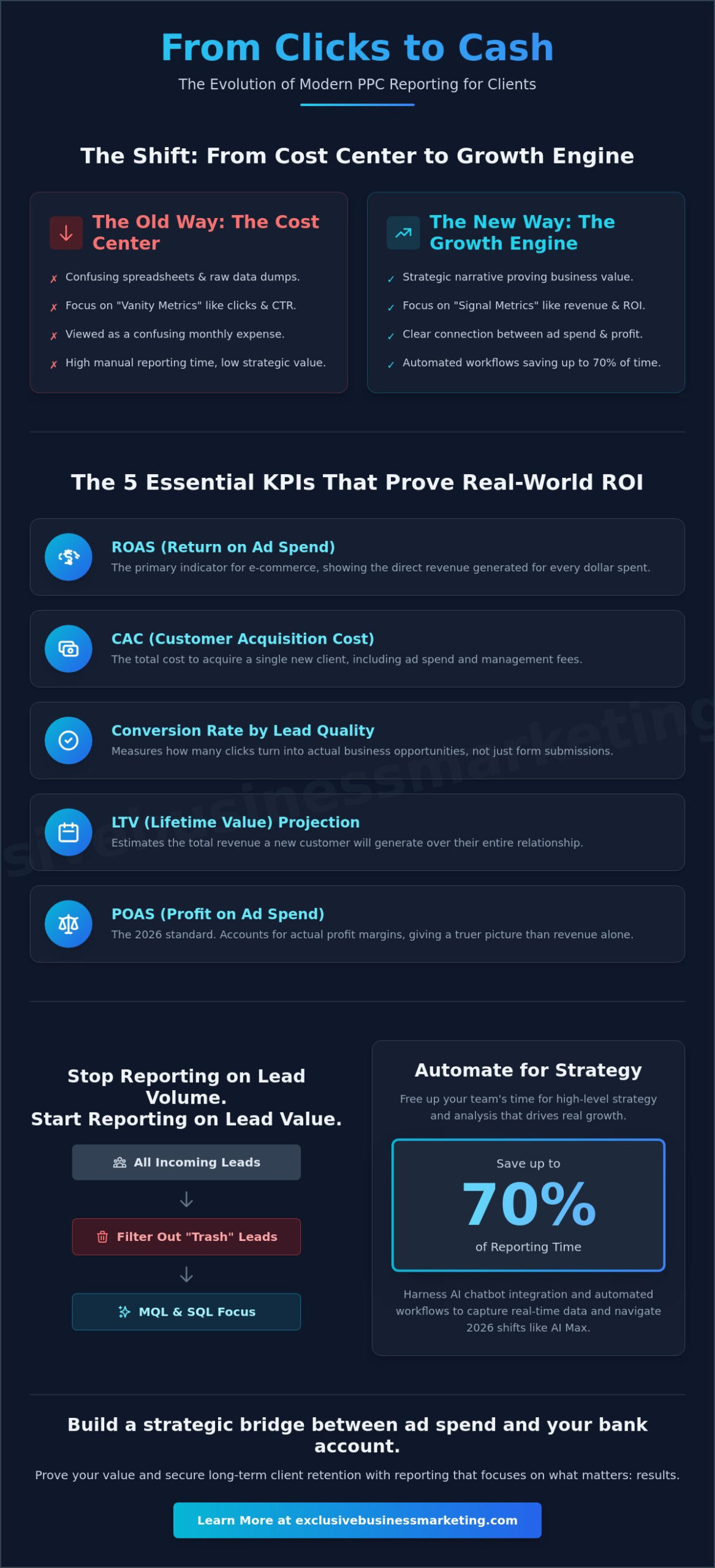
We understand that your goal is to spend less time on spreadsheets and more time on strategy. This guide will teach you how to automate your workflows to save up to 70% of your reporting time while navigating 2026 shifts like the transition to AI Max and new data retention policies. You’ll learn how to transform raw technical metrics into a high-impact narrative that proves your value and secures long-term retention. We’re going to break down the exact framework needed to communicate ROI clearly, leverage first-party data, and drive tangible business growth for every account you manage.
Key Takeaways
- Shift your perspective from delivering raw data to crafting a strategic narrative that proves your value through every campaign update.
- Focus on high-impact KPIs like ROAS and CAC to demonstrate exactly how your ad spend translates into new customers and bottom-line growth.
- Streamline your ppc reporting for clients by using 30-second executive summaries and visual charts that highlight long-term momentum.
- Harness the power of AI chatbot integration and automated workflows to capture real-time lead data while freeing up time for high-level strategy.
- Adopt a revenue-first approach that eliminates vanity metrics and focuses entirely on the outcomes that matter most to your business stakeholders.
Beyond Clicks: The Evolution of PPC Reporting for Clients
Effective Pay-per-click (PPC) management requires more than just launching ads and watching the dashboard. It demands a sophisticated approach to communication. In 2026, ppc reporting for clients has evolved from a simple data dump into a high-level strategic narrative. Your clients don’t want to see a wall of numbers they can’t interpret. They want to know how your efforts are driving their business forward. This transition marks the difference between a service that’s viewed as a cost and one that’s recognized as a growth engine.
The Death of the Vanity Metric
High click-through rates (CTR) used to be the gold standard for success. Today, they are often just noise. A high CTR can actually signal a problem if those clicks aren’t converting into revenue or qualified leads. We focus on the “Signal” metrics: Revenue, Customer Acquisition Cost (CAC), and lifetime value. Metrics like reach and CPM are secondary indicators that don’t tell the full story. Business Impact Reporting is the new industry standard that prioritizes financial outcomes over platform-specific technical data. It ensures every stakeholder understands the direct link between ad spend and the bank account.
Why Transparency Builds Unbreakable Trust
Clients value honesty over perfection. If a campaign underperforms, your report shouldn’t hide the facts. Instead, use that data to explain exactly what happened and how you’re pivoting. This level of clarity turns a standard vendor relationship into a true strategic partnership. Transparent ppc reporting for clients sets realistic growth expectations and proves you’re managing their budget with the same care they would. Honest data prevents the perceived lack of results that often leads to high client churn. It builds a foundation where both parties are aligned on what success looks like.
We’ve seen a massive shift toward full-funnel attribution in 2026. Clients now expect to see how every ad dollar impacts the entire journey, from the first touchpoint to the final sale. This transparency is the foundation of long-term retention. When a client understands the “why” behind the numbers, they’re more likely to stay through market fluctuations. Our approach ensures you always have a clear view of your ROI. By moving away from superficial spreadsheets and toward meaningful business insights, we help you secure your position as an indispensable asset to your client’s growth strategy.
The 5 Essential KPIs That Prove Real-World ROI
To run an effective and profitable PPC campaign, you must look past the surface of the ad platform. In a year where Google Ads CPC has increased 12% in competitive verticals like legal and insurance, high-level ppc reporting for clients requires a focus on bottom-line growth. We use a CPC to Revenue Bridge to visualize how every dollar travels through the funnel. This transforms abstract spending into a clear path toward profit. By focusing on these five essential KPIs, you move from guessing to knowing exactly how your budget performs.
- ROAS (Return on Ad Spend): This remains the primary indicator for e-commerce, showing the direct revenue generated for every dollar spent.
- CAC (Customer Acquisition Cost): You need to know the total cost to acquire a single new client, including ad spend and management fees.
- Conversion Rate by Lead Quality: This measures how many clicks turn into actual business opportunities, not just form submissions.
- LTV (Lifetime Value) Projection: We show clients the long-term impact of PPC traffic by estimating the total revenue a new customer will generate over years.
- POAS (Profit on Ad Spend): This 2026 standard accounts for your actual margins, providing a more accurate picture than revenue alone.
Tracking Lead Quality, Not Just Quantity
Stop reporting on lead volume and start reporting on lead value. We integrate CRM data to track which specific keywords drive your highest-paying clients. This allows us to distinguish between a Marketing Qualified Lead (MQL) and a Sales Qualified Lead (SQL). By identifying “trash” leads early, we can instantly reallocate your budget toward the traffic that actually closes. Our team at Exclusive Business Marketing prioritizes this level of granular tracking to ensure your budget is never wasted on low-intent clicks.
ROAS vs. POAS: Why Profit Matters More Than Revenue
A high ROAS looks great on paper, but it doesn’t always mean your business is growing. POAS (Profit on Ad Spend) is the metric that truly matters in 2026. It factors in your cost of goods sold and operational overhead. Sometimes, a lower ROAS is actually more profitable if it targets high-margin products or services. We build these profit margins directly into our ppc reporting for clients to provide a realistic view of your campaign’s health. This level of clarity helps you make informed decisions about scaling your spend with total confidence.
Structuring the Perfect Client Report for Maximum Clarity
A great report is more than a collection of graphs. It’s a communication tool that saves time and builds confidence. When you handle ppc reporting for clients, you must remember that your audience often lacks the time to dig through every campaign detail. They need to see the big picture immediately. We structure our reports to provide high-level insights first, followed by the granular data that supports our strategic decisions. This ensures that every stakeholder, from the marketing manager to the CEO, finds exactly what they need within seconds.
Visual data trends are non-negotiable for proving long-term value. We use charts to track performance over 3, 6, and 12 months. This perspective helps clients see momentum even during seasonal dips or market shifts. While a granular breakdown of platforms and creative performance is included, it always serves the larger narrative. You aren’t just showing numbers. You’re justifying your retainer by answering the “So what?” for every data point provided. This clarity is what separates a standard report from a growth-focused strategy.
The 30-Second Executive Summary
Busy business owners need the most critical metrics above the fold. We put the primary KPIs right at the top. Use green and red color coding to signal performance status instantly. This visual shorthand allows a client to see that things are on track without reading a single word. Pair these visuals with 3-4 “Wins of the Month” bullet points that highlight specific successes, such as a record-low CAC or a breakthrough in lead quality. This makes ppc reporting for clients an efficient part of their day rather than a burden.
The Strategy & Recommendations Section
This is where you move from being a vendor to a strategic partner. Every report must include a clear roadmap for the upcoming month. Frame your technical optimizations as business growth opportunities. If you’re adjusting bidding strategies, explain how it will lower the cost per acquisition. This section is also where you handle the “Hard Conversation.” If performance is down, address it directly. Explain the external factors, show the data, and outline your immediate corrective actions. Honest reporting during tough months builds more trust than a perfect report ever could. Use these data-backed projections to set the stage for budget increases when the opportunity for scale is clear.
Automating for Strategy: Tools and AI Integration
Automation isn’t just a convenience. It’s a fundamental requirement for high-level ppc reporting for clients. By 2026, the sheer volume of data from diverse platforms makes manual entry impossible and prone to error. Sophisticated tools like Looker Studio and Power BI act as the central nervous system for your marketing data. They pull information from disparate sources to create a unified, clear narrative. Research from DesignRush in July 2025 shows that automating PPC reporting can reduce administrative time by up to 70%. This efficiency shift allows your team to stop acting as data entry clerks and start acting as strategic partners who focus on driving revenue.
We also utilize automated alerts to monitor budget pacing and performance anomalies. If a campaign suddenly spikes in cost or conversions drop unexpectedly, we know instantly. This proactive management prevents wasted spend and ensures your campaigns stay on track between monthly reviews. It’s about moving from reactive reporting to real-time optimization.
AI Chatbots as a Reporting Asset
Most traditional reports ignore the valuable data generated during the first few seconds of a customer interaction. Strategic AI Chatbot Installation bridges this gap by providing immediate lead attribution and engagement metrics. We now report on “Chat-to-Lead” conversion rates, which often reveal high-intent traffic that static forms might miss. Advanced AI can even perform sentiment analysis on these interactions. This allows us to qualify leads based on the tone and urgency of their messages before they ever hit your CRM. It adds a layer of qualitative data to your ppc reporting for clients that competitors simply can’t match.
Building an Automated Data Pipeline
A single-platform view is no longer sufficient in a multi-touch world. Your data pipeline must connect Google Ads, Meta, and LinkedIn into one cohesive dashboard to provide true cross-channel attribution. This shows exactly how a prospect might interact with a search ad and a social ad before finally making a purchase. Real-time dashboards are quickly replacing the outdated monthly PDF. They offer total transparency and allow you to check your ROI whenever you want. This constant access builds trust and ensures everyone is aligned on current performance levels.
Ready to see your data in action? Partner with our marketing agency to deploy a high-impact reporting dashboard that proves your ROI every single day.
The Exclusive Business Marketing Approach to Results
Our Huntington Beach-based team takes a different approach to digital growth. We don’t just manage budgets; we drive revenue. Our “Revenue-First” philosophy ensures that every aspect of ppc reporting for clients focuses on the metrics that actually impact your bottom line. We understand that a click is only valuable if it turns into a customer. This is why we integrate our PPC management services with organic strategies to create a comprehensive market presence. By aligning paid and organic data, we provide a 360-degree view of your digital performance.
Conversion optimization is at the core of our reporting strategy. We prioritize WCAG and ADA compliant website design to ensure your landing pages are accessible to every potential customer. This isn’t just about meeting legal requirements. It’s about maximizing your conversion potential across all demographics. An accessible site provides a better user experience, which directly lowers bounce rates and improves your ad quality scores. We handle these complex technical tasks so you don’t have to, providing a complete, worry-free solution for your marketing needs.
Local PPC Expertise in Orange County
Navigating the Southern California market requires specialized local knowledge. High-competition niches in Orange County demand a more nuanced strategy than a generic national agency can provide. We utilize geo-specific reporting to show you exactly how your ads perform in specific neighborhoods or cities. These local insights allow us to optimize bids based on real-world regional trends and consumer behavior. This level of precision ensures your budget is spent where it has the highest chance of success. We outperform national competitors by staying reactive to the local market shifts that others miss.
A Partner, Not a Vendor
We position ourselves as an extension of your team. Our commitment to responsiveness means you’re never left wondering about your campaign status or performance. The synergy between our Orange County SEO and PPC teams allows for total market dominance. We share data across departments to ensure your paid and organic efforts work in harmony. This collaborative approach provides a complete, worry-free solution for your digital marketing needs. We’re here to remove the operational burden from your business while delivering measurable outcomes.
Ready to see your real ROI? Contact Exclusive Business Marketing today to start building a high-impact narrative for your business. We are ready to show you exactly how our strategic ppc reporting for clients can transform your growth trajectory.
Drive Growth Through Data Clarity
Success in 2026 requires a total shift from delivering raw data to crafting a strategic narrative. You’ve learned how to move past vanity metrics and embrace profit-focused KPIs such as POAS and lifetime value. By automating your data pipelines and integrating AI chatbots for real-time lead qualification, you transform your strategy from a monthly chore into a powerful growth engine. This transition ensures your ppc reporting for clients provides the transparency and confidence needed for long-term retention and business expansion.
Our Orange County based experts specialize in revenue-driven PPC management that prioritizes your bottom line. We handle the technical complexities of AI and CRM integration so you don’t have to. It’s time to stop delivering confusing spreadsheets and start providing clear, actionable insights that prove your worth. Take control of your marketing performance and secure your position as an indispensable strategic partner through data clarity.
Get a Professional PPC Audit and Reporting Strategy Session
You now have the framework to turn raw numbers into a high-impact story of success. We’re ready to help you dominate your market and drive the measurable results your business deserves.
Frequently Asked Questions
What is the most important metric in a PPC report?
Profit on Ad Spend (POAS) is the most critical metric because it accounts for actual business growth instead of just platform revenue. While ROAS is a common standard, POAS incorporates your specific margins and overhead to show the true health of your campaign. It moves the conversation from “how much did we sell?” to “how much did we actually make?” This clarity is essential for making informed scaling decisions.
How often should I send PPC reports to my clients?
You should provide a comprehensive monthly report while maintaining real-time dashboard access for constant transparency. Monthly deep dives allow for strategic analysis and trend identification that short-term data might miss. However, providing a live dashboard ensures your clients can check their performance at any moment. This dual approach builds trust and keeps stakeholders aligned on current progress without waiting for a scheduled meeting.
Should I include “bad” data in my client reports?
Yes, you must include all performance data, even when results are down, to maintain professional integrity and trust. Honest ppc reporting for clients requires addressing underperformance directly with a clear explanation and a corrective action plan. This transparency transforms a standard vendor relationship into a strategic partnership focused on long-term growth. Clients value honesty over perfection, especially when you provide a clear path to recovery.
What is the best tool for PPC reporting in 2026?
Looker Studio and Power BI are the industry leaders for creating unified, automated PPC dashboards in 2026. These tools allow you to connect multiple data streams, such as Google Ads and CRM data, into a single view. They provide the visual clarity needed to communicate complex ROI narratives to busy stakeholders quickly. Automated pipelines reduce manual entry errors and ensure your data is always current and actionable.
How do I explain a high Cost Per Click (CPC) to a client?
Frame a high CPC within the context of lead quality and market competition. In 2026, CPCs in competitive sectors like legal services increased by 12% year-over-year. Explain that paying more for a high-intent click that converts at a higher rate is more profitable than buying cheap, low-quality traffic. Focus the conversation on the Cost Per Acquisition (CPA) and total revenue rather than the cost of a single click.
Can I automate my PPC reports without losing the personal touch?
You can automate data collection and visualization while keeping the executive summary and strategic recommendations manual. Automation reduces reporting time by up to 70%, which frees up your schedule to provide deeper analysis. Use that extra time to write personalized “Wins of the Month” and custom roadmaps that address your client’s specific business goals. This balance ensures your reports are both data-accurate and strategically insightful.
What is the difference between ROAS and ROI in PPC reporting?
ROAS measures gross revenue generated per dollar of ad spend, while ROI calculates the net profit after all expenses, including management fees and product costs. ROAS is a platform-specific efficiency metric. ROI is a business-wide success metric. High-quality ppc reporting for clients must distinguish between the two to show real-world profitability. Understanding this difference prevents clients from confusing high sales volume with actual business profit.
How do I track phone calls and offline conversions in my reports?
Use call tracking software and CRM integrations to import offline conversion data back into your reporting dashboard. As of June 2026, Google Ads requires using specific API protocols or enhanced conversions for leads to track these interactions accurately. This ensures every offline sale is attributed to the specific keyword or ad that triggered the initial interest. It provides a complete picture of how your digital spend drives real-world business.