

Justifying Marketing Spend to Stakeholders: The 2026 Guide to Winning Budget Approval
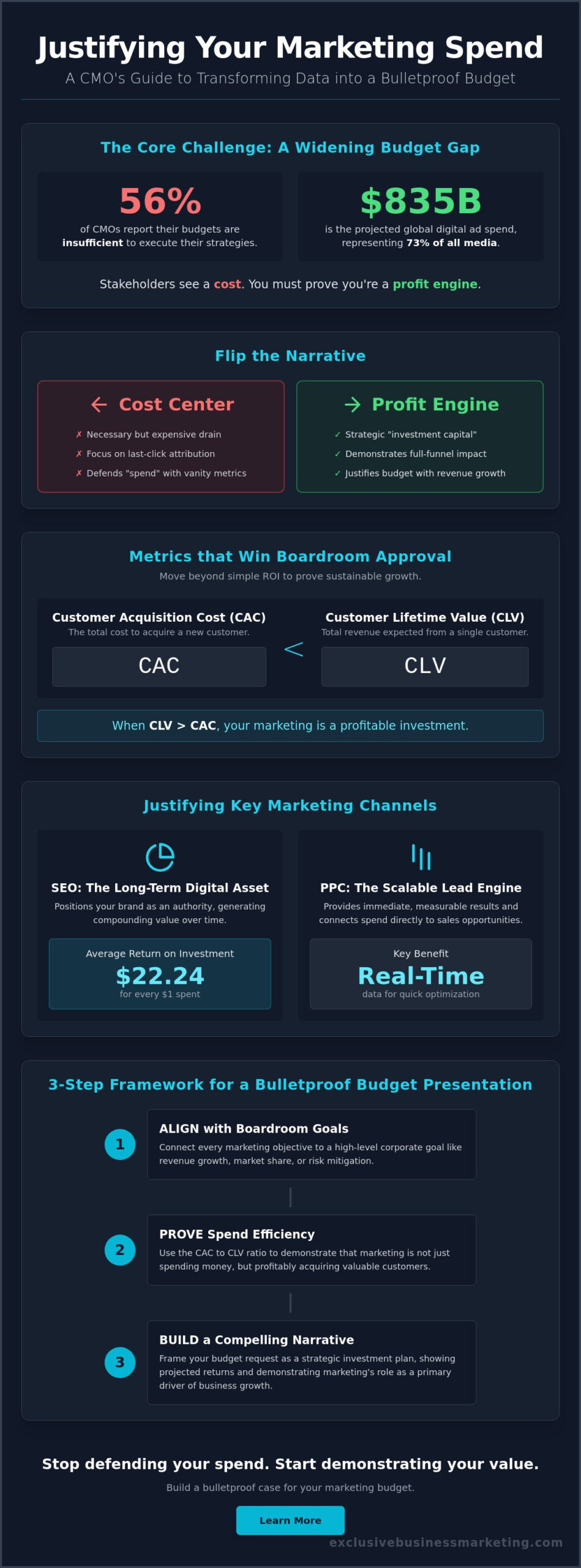
Did you know that 56% of CMOs still report that their budgets are insufficient to execute their strategies, even as global digital ad spend hits $835 billion this year? It’s a common challenge when you’re justifying marketing spend to stakeholders who only focus on the bottom line. You know your long-term SEO and branding efforts are working. However, if you can’t translate that value into their specific financial language, your budget remains on the chopping block.
It’s frustrating to be viewed as a cost center rather than a profit engine. You deserve to have your impact recognized and your initiatives fully funded. This 2026 guide will teach you how to transform complex marketing data into a compelling growth narrative that secures stakeholder buy-in and protects your budget. We’ll explore how to align metrics with corporate goals, use current ROI benchmarks to prove your worth, and bridge the gap between the customer journey and the balance sheet. It’s time to stop defending your spend and start demonstrating your value.
Key Takeaways
- Learn how to shift your reporting from vanity metrics like social likes to high-impact business metrics that demonstrate real revenue growth.
- Discover why Customer Acquisition Cost (CAC) is the most powerful tool for proving spend efficiency and moving beyond simple, lagging ROI indicators.
- Master the strategy of justifying marketing spend to stakeholders by framing SEO as a long-term digital asset and PPC as a scalable lead generation engine.
- Implement a proven three-step framework to align your marketing objectives with boardroom goals and build a bulletproof budget presentation.
- Find out how partnering with a results-oriented agency provides the real-time data transparency needed to maintain stakeholder trust and protect your funding.
The Stakeholder Gap: Why Justifying Marketing Spend Is Harder in 2026
Stakeholders are more skeptical than ever. In 2026, the global digital ad spend is projected to reach up to $835.82 billion, representing 73% of total media spend. With that much capital on the line, the “black box” approach to marketing is a guaranteed way to see your budget slashed. Boardrooms no longer accept vague promises of brand affinity. They demand hard evidence. Currently, 83% of marketing leaders state that ROI is their top priority, and 64% of companies now base future funding entirely on documented past performance. If you aren’t justifying marketing spend to stakeholders using concrete business metrics, you’re leaving your department’s future to chance.
The gap between marketing teams and the C-suite often stems from a language barrier. While you might see a successful social campaign as a win because of high engagement, a CFO sees it as a potential waste of resources if it doesn’t move the needle on revenue. This caution is amplified by market volatility and the rapid integration of AI. While 61% of marketers now use AI for data analysis and media planning, stakeholders view these new tools as both a high-cost investment and a potential risk. To bridge this gap, you must present a comprehensive marketing plan that aligns every dollar with risk mitigation and aggressive growth.
Marketing as a Profit Center vs. Cost Center
Leadership often defaults to viewing marketing as a cost center, a necessary but expensive drain on resources. You must flip this narrative. Reframe every dollar spent as an “acquisition cost” for future revenue. Don’t fall into the last-click attribution trap. Many stakeholders only value the final touchpoint before a sale, but this ignores the complex 2026 customer journey. Show them that marketing is a profit engine. When you demonstrate that SEO generates an average ROI of $22.24 for every $1 spent, you stop asking for “spend” and start asking for “investment capital.”
Common Misconceptions That Kill Budgets
Misunderstandings about what marketing actually does can be budget killers. Many executives still believe the myth that “marketing is just advertising.” They don’t see the technical foundations that make sales possible. For example, ignoring WCAG and ADA compliant website design isn’t just a branding issue; it’s a massive legal and financial risk. You must also explain that brand awareness is a mandatory precursor to conversion. A customer rarely buys from a brand they’ve never heard of. By positioning technical excellence and brand visibility as the bedrock of your funnel, you make your budget requests feel essential rather than optional.
Moving Beyond Simple ROI: The Metrics That Win Boardroom Approval
ROI tells you where you’ve been, not where you’re going. While it’s a staple in boardroom discussions, relying on it as your sole defense is a mistake. ROI is a lagging indicator. It measures the success of past decisions rather than the potential of future ones. In a market where only 36% of marketers feel confident in their ability to measure campaign ROI, you need a more robust strategy for justifying marketing spend to stakeholders. You must shift the focus toward spend efficiency and long-term asset value.
Consider the concept of incrementality. This metric answers the CFO’s favorite question: “What would happen if we stopped spending?” By demonstrating the specific revenue lift that only occurs because of your marketing efforts, you prove that your budget isn’t just a placeholder. It’s a vital engine. If you can show that a reduction in spend leads to a disproportionate drop in sales, you’ve made a bulletproof case for your funding. This proves that your efforts aren’t just riding the wave of existing brand demand but are actively creating new revenue.
The Power Couple: CAC and CLV
Customer Acquisition Cost (CAC) is often called the gold standard for spend efficiency. It tells stakeholders exactly what it costs to bring in a new client. However, CAC alone doesn’t tell the full story. You must pair it with Customer Lifetime Value. Customer Lifetime Value (CLV) is the total projected revenue a business can expect from a single customer account. When you show that your CLV is significantly higher than your CAC, you prove your marketing is sustainable. By building the business case around these ratios, you can justify a higher initial spend on premium leads that offer better long-term value.
Return on Ad Spend (ROAS) vs. Marketing Efficiency Ratio (MER)
ROAS can be misleading. It focuses on a single channel in a vacuum. In 2026, the customer journey is rarely linear. A potential client might see a PPC ad, ignore it, then find you via organic search three days later. If you only look at ROAS, that PPC spend looks like a failure. This is why you should use the Marketing Efficiency Ratio (MER). MER provides a holistic view of your total marketing health by comparing total revenue to total marketing spend across all channels. It captures the “halo effect” where your paid efforts boost your organic visibility. Tracking these relationships is much easier when you partner with a marketing agency that understands the nuances of multi-channel attribution. By presenting a blended view of success, you earn the boardroom’s trust and protect your resources from short-sighted cuts.
Service-Specific Justification: From SEO Long-Term Gains to PPC Quick Wins
When you are justifying marketing spend to stakeholders, you must match your argument to the service’s specific lifecycle. You can’t justify a long-term SEO strategy the same way you justify a high-velocity PPC campaign. One builds equity. The other buys immediate opportunity. By breaking down your budget into growth assets and performance tools, you make it much harder for the boardroom to cut your funding. You aren’t just spending money; you’re building a diversified portfolio of leads.
Don’t overlook the “invisible” foundations of your digital presence. A WCAG & ADA compliant website is no longer just a design choice. It’s a legal necessity and a conversion engine. By ensuring your site is accessible, you mitigate significant legal risks while opening your brand to a wider audience. Similarly, AI chatbot installation provides a tangible reduction in sales overhead. These bots handle 24/7 lead capture, ensuring you never lose a prospect because your team is off the clock. This directly supports the bottom line without increasing your headcount.
SEO: The Compounding Interest of Marketing
Think of SEO as a digital asset rather than a monthly bill. Unlike paid ads where traffic stops the second you stop paying, organic search visibility builds compounding value over time. For B2B companies, the average SEO ROI is a staggering 748%. You should frame this to stakeholders by comparing the cost of organic traffic to what you would pay for those same clicks in a PPC auction. If you want to dominate a specific region, utilizing Orange County SEO strategies allows you to capture local market share that competitors can’t easily buy. This creates a “moat” around your business. It protects your lead flow from competitor spending spikes and market volatility.
PPC and Social Media: The Precision Tools
PPC is your “marketing tap.” You turn it on to get immediate results and turn it off if you hit capacity. The primary value here is speed to lead. With the average cost per click across all industries rising to $2.85 in 2026, precision is your best defense. Use your A/B testing data to prove you are optimizing for the highest quality conversions, not just buying clicks. Social media management works similarly by shortening the B2B sales cycle. It keeps your brand top-of-mind during long consideration periods. When you show stakeholders that your social presence reduces the time it takes to close a deal, you’ve successfully moved the conversation from “cost” to “efficiency.”
The 3-Step Framework for a Successful Marketing Budget Presentation
Winning budget approval is an art. It requires more than just a data dump; you need a narrative that resonates with the C-suite’s financial priorities. If you enter the boardroom with a 50-slide deck of spreadsheets, you’ve already lost. Stakeholders want clarity, confidence, and a clear path to growth. By following a structured framework, you move from defending your department to leading a strategic business conversation. This approach ensures that justifying marketing spend to stakeholders becomes a collaborative session on how to scale the company’s success.
Step 1: Radical Alignment
Start your meeting by talking about the CEO’s goals, not your campaign metrics. If the company’s primary focus is increasing market share by 15%, your first slide should show how marketing will deliver the leads necessary to hit that target. Budget alignment begins with identifying the primary revenue drivers for the current fiscal year. Show exactly how your marketing KPIs support sales quotas. When you lead with their objectives, you position yourself as a partner in their success rather than a cost they need to manage.
Step 2: The Transparency Report
Honesty is your greatest tool for building boardroom credibility. Don’t just highlight the wins. Briefly address what didn’t work and explain the pivots you’ve made to optimize performance. This level of transparency proves you are a responsible steward of the company’s capital. Use executive summaries to provide a high-level view of your most effective channels. For instance, show how your pay per click management services connect directly to new customer intake. This clear line of sight from spend to revenue is exactly what stakeholders need to feel secure in their investment.
Step 3: The ‘Ask’ and the ROI Projection
Never present a single budget number. Instead, offer tiered options: a conservative “maintenance” budget and an aggressive “growth” budget. This gives stakeholders a sense of control and allows them to choose the level of risk they are comfortable with. Use your historical data to forecast future performance for each tier. Close the presentation with a concrete “Next Steps” action plan that outlines exactly how you will deploy the funds. If you want to simplify this process and ensure your data is always boardroom-ready, you can partner with our marketing agency to handle the heavy lifting of performance tracking and reporting.
Visual storytelling is the final piece of the puzzle. Replace dense tables with clean, interactive dashboards that highlight trends over time. Stakeholders can digest a well-designed chart in seconds, whereas a spreadsheet requires work to understand. By making the data accessible, you remove the friction from the approval process and keep the focus on the growth narrative.
Partnering for Accountability: How a Results-Driven Agency Simplifies Your Reporting
You don’t have to carry the burden of justifying marketing spend to stakeholders alone. Many marketing leaders spend more time defending their budgets than they do executing their strategies. This operational drain is unnecessary. Exclusive Business Marketing acts as your dedicated back-office data team, providing the technical evidence needed to prove your department’s value. We handle the complex data collection and analysis so you can focus on high-level strategy. By providing 24/7 transparency through real-time reporting dashboards, we eliminate the “black box” that often leads to boardroom skepticism.
Professionalizing your growth is about more than just buying ads; it’s about building a scalable, accountable system. Partnering with a specialized business to business marketing agency is an investment in that professionalization. We don’t just deliver leads. We deliver the specific business metrics your CFO needs to see. This partnership shifts the dynamic from a standard vendor relationship to a strategic alliance focused on tangible outcomes and measurable growth.
Expertise That Stakeholders Trust
Stakeholders often value an outside perspective to validate internal performance. We provide unbiased performance data through comprehensive audits that confirm your marketing impact. If your executive team has tough questions about attribution or spend efficiency, you have a dedicated account manager ready with the answers. We take care of the technical heavy lifting, from SEO infrastructure to website development, ensuring every part of your digital presence is optimized for performance. This proactive approach builds a level of trust that makes future budget approvals much smoother.
Ready to Secure Your 2026 Marketing Budget?
Don’t walk into your next budget meeting without a clear plan. You need a data-backed strategy that shows stakeholders exactly where the opportunities lie. We are ready to help you build that growth narrative. Take control of your department’s future by following these steps:
- Request a comprehensive SEO and website audit to reveal hidden growth potential and competitive gaps.
- Schedule a consultation to build your customized growth roadmap for the coming fiscal year.
- Take the first step toward data-backed confidence and secure your funding today.
Our team is standing by to manage the details so you don’t have to. We provide the clarity and results your stakeholders demand. Let’s start building your case for growth today.
Take Command of Your Marketing Budget Today
Securing your department’s future requires a shift from defensive reporting to strategic leadership. You’ve learned how to bridge the stakeholder gap by replacing vanity metrics with high-impact business drivers like CAC and CLV. By aligning your goals with the C-suite’s vision and framing services as long-term assets, justifying marketing spend to stakeholders becomes a transparent, results-backed conversation. You don’t have to manage this complex process on your own.
As Orange County’s leading results-oriented agency, we specialize in delivering the tangible outcomes that boardroom leaders demand. We are specialists in ADA compliant design and high-ROI SEO. We also provide dedicated 24/7 sales assistants via custom AI chatbots to ensure your funnel never sleeps. It’s time to stop worrying about budget cuts and start focusing on scalable growth. We are ready to help you demonstrate your true value with data that speaks for itself. Get Your Professional Marketing Audit and Justify Your Spend Today. You have the framework to succeed; now take the final step toward data-backed confidence.
Frequently Asked Questions
What is the best way to justify marketing spend to a CFO?
The most effective method for justifying marketing spend to stakeholders like a CFO is to speak their language of financial risk and return. You must frame marketing as a revenue-generating investment rather than a sunk cost. Present a plan that aligns directly with the company’s fiscal targets for the year. Use hard data like Customer Acquisition Cost (CAC) and projected Customer Lifetime Value (CLV) to prove that your spending drives sustainable growth.
How can I prove the ROI of SEO when it takes months to see results?
Prove the value of SEO by framing it as a long-term digital asset with compounding interest. Use leading indicators like organic search visibility and keyword ranking improvements to show early momentum. You should also compare the current market value of your organic traffic to what you would pay for those same clicks in a PPC auction. This demonstrates the equity and future cost savings you are building for the business.
What metrics are most important to stakeholders in 2026?
Stakeholders in 2026 prioritize business-level metrics over vanity stats like likes or shares. They want to see your Marketing Efficiency Ratio (MER) to understand how total spend impacts total revenue. Customer Acquisition Cost (CAC) remains the gold standard for measuring spend efficiency. Additionally, they value incrementality data, which proves the specific revenue lift that only happens because of your marketing efforts. These numbers provide the clarity they need to approve budgets.
How do I handle a budget cut request mid-year?
Address a mid-year budget cut by presenting a tiered impact report that shows exactly which revenue targets will be missed. Use your historical data to demonstrate the “Incrementality” of your spend. If you cut the budget by 20%, show the disproportionate drop in sales that will likely follow. This shifts the conversation from saving money to losing revenue. Offer a conservative maintenance option versus a growth-focused plan to give leadership a choice with clear consequences.
Is it better to focus on CAC or total revenue when presenting to the board?
Focus on the relationship between the two rather than choosing just one. Total revenue shows the scale of your impact, but CAC proves that your growth is efficient and sustainable. A board wants to see a healthy ratio where the value of a customer significantly outweighs the cost to acquire them. Presenting these metrics together shows that you aren’t just spending for the sake of volume; you’re building a profitable engine.
How do I explain ‘brand awareness’ to someone who only cares about sales?
Position brand awareness as the essential fuel that lowers your overall cost-per-acquisition. Explain that customers are far more likely to convert when they already recognize and trust your brand. Show how your awareness campaigns shorten the sales cycle and increase the conversion rates of your bottom-funnel PPC ads. When you frame brand building as a tool for sales efficiency, it becomes a much easier sell to a results-oriented stakeholder.
Should I use industry benchmarks to justify my marketing spend?
Industry benchmarks are useful for justifying marketing spend to stakeholders by providing a baseline for competitive investment. In 2026, average marketing budgets range between 7.8% and 9.4% of total revenue. Use these figures to show where your company stands relative to your peers. However, always prioritize your own historical performance data. Benchmarks provide the context, but your specific ROI data provides the proof they need to sign off on the spend.
How does website ADA compliance affect my marketing ROI?
ADA compliance directly improves your ROI by expanding your reachable market and preventing expensive legal fees. An accessible website ranks better in search engines and provides a superior user experience for all visitors, which leads to higher conversion rates. It’s a critical technical foundation that protects your brand reputation and ensures your marketing spend isn’t wasted on a site that excludes potential customers. Compliance is a smart financial safeguard for your digital presence.