

How to Set a Local Marketing Budget in 2026: A Strategic Guide
Small businesses with less than $10 million in revenue are now allocating an average of 15.6% of their total budget to marketing in 2026. If that number feels high, you aren’t alone. Most business owners feel a deep sense of anxiety when trying to figure out how to set a local marketing budget without wasting money on ads that don’t convert or getting lost in the confusion of SEO versus PPC pricing. You want to grow, but you need to know that every dollar spent is a deliberate investment in your company’s future.
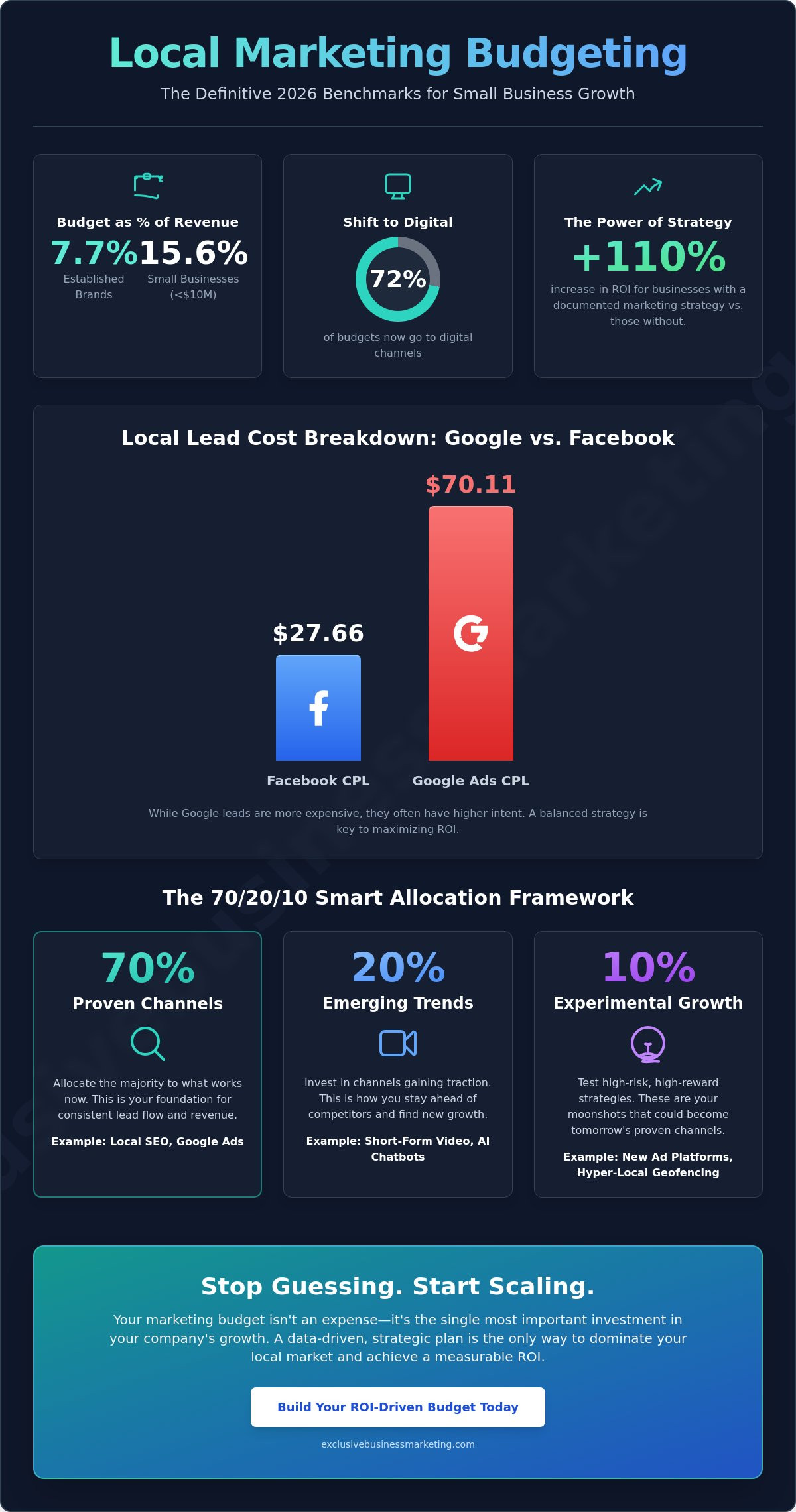
We understand that you want more than just brand awareness; you want tangible outcomes like more leads and higher revenue. This guide provides the exact math and strategy you need to stop guessing and start scaling. We will preview the latest 2026 benchmarks, including the 7.7% average revenue spend and the reason 72% of budgets now go to digital channels. You will learn how to balance the $27.66 cost per lead on Facebook with the $70.11 average on Google to ensure your spend drives a measurable ROI for your specific service area.
Key Takeaways
- Stop viewing your marketing spend as an expense and adopt an investment mindset to prevent your business from being left behind in high-competition areas.
- Learn the specific 2026 formulas for how to set a local marketing budget, whether you are an established brand or a startup in Huntington Beach.
- Balance your allocation between long-term organic growth through SEO and the fast-track lead generation of paid search to dominate your territory.
- Follow a methodical plan to audit your current spending, remove technical jargon, and identify the hidden drains that are currently wasting your capital.
- Boost your ROI by integrating custom AI tools that act as a 24/7 sales team, ensuring no lead generated by your budget goes unanswered.
Why Local Marketing Budgets Fail (And How to Fix Yours)
Viewing marketing as a line-item expense rather than a revenue generator is the fastest way to kill your growth. When business owners treat their spend as a cost to be minimized, they inadvertently stifle their ability to scale. Understanding how to set a local marketing budget requires a fundamental shift in perspective. You are not just paying for ads; you are purchasing future customers and market share. This is especially true as of May 2026, where nearly 40% of small businesses have already committed to increasing their marketing investments to stay ahead of the curve. If you are still looking for ways to “save” on marketing, you are likely handing your customers to the competition.
A generic, one-size-fits-all approach fails in high-competition zones like Orange County. In these markets, digital real estate is expensive and crowded. Relying on an arbitrary allocation or “whatever is left over” at the end of the month ensures your brand remains invisible. Successful Local store marketing requires precision. If your competitors are aggressively bidding for the top spot on Google while you are spending a random amount without data, they will capture the high-intent leads every single time. We have seen that businesses with a documented strategy are far more likely to see a 110% increase in their investment returns compared to those who wing it.
Another silent killer is the “Attribution Lag.” In local service industries, the path from first impression to a booked appointment isn’t always instant. It can take days or weeks for a lead to convert. If you cut your budget because you don’t see a return in 48 hours, you’ve essentially thrown your money away. You must account for this delay to see the true ROI of your efforts. Consistency is the only way to build the trust necessary for local dominance.
The High Cost of Local Invisibility
Being on page two of search results is effectively the same as not existing. Data from 2026 shows that 72% of marketing budgets are now funnelled into digital channels because that is where the physical foot traffic begins. If your business doesn’t appear when a local customer searches for your service, you lose that revenue to a competitor who was willing to invest. A “set it and forget it” budget doesn’t work in a market that changes daily; you need a proactive approach to adjust your spend in real time based on local search trends and competitor behavior.
Moving from Guesswork to Strategy
Your strategy must dictate your budget, not the other way around. Start by defining your core goals. Do you need 50 new leads this month, or are you focused on long-term brand retention? When you know the outcome you want, learning how to set a local marketing budget becomes a mathematical exercise rather than a guessing game. A full-service agency helps you identify budget leaks, such as overlapping software tools or ads targeting the wrong zip codes. We ensure every dollar is focused on generating tangible revenue and measurable success.
Calculating Your Total Investment: 2026 Benchmarks
The average marketing budget in 2026 currently sits at 7.7% of total revenue. This figure provides a solid baseline for established local brands, but it’s only a starting point when you’re learning how to set a local marketing budget that actually generates growth. If you want to maximize your marketing budget, you must adjust this percentage based on your current market position. For example, small businesses with less than $10 million in revenue are currently allocating an average of 15.6% to their marketing efforts to stay competitive against larger national players.
Newer businesses in Huntington Beach often face steeper challenges than established players. If you’re a startup trying to gain traction in a crowded California market, you might need to push that investment to 15% or even 20% of your projected revenue. This aggressive stance is necessary to overcome the high advertising bid prices common in our region. To manage this spend effectively, we recommend the 70/20/10 framework. You should allocate 70% of your funds to proven channels like local SEO, 20% to emerging trends like video content, and 10% to experimental growth strategies that could become tomorrow’s winners.
Industry-Specific Budget Percentages
B2C service providers like HVAC companies, dentists, and lawyers often require a higher percentage of spend because they operate in high-intent, high-competition environments. While B2B local services might focus on a leaner 9.4% spend for targeted lead generation, B2C brands frequently need to be more visible to capture customers at the exact moment of need. Retail and hospitality businesses must balance their digital presence with local event marketing to drive immediate foot traffic. If you’re unsure where your industry falls, you can contact our team for a free quote and a custom analysis of your local market.
Factoring in Fixed vs. Variable Costs
Your total investment includes both fixed and variable expenses. Fixed costs cover your agency retainers, software subscriptions, and website maintenance. These are the foundations that keep your digital storefront open and functional. Variable costs are more fluid, such as your PPC ad spend or social media boosts. For instance, the average cost per lead for Google Ads in 2026 is $70.11, while Facebook Lead Ads average around $27.66. When deciding how to set a local marketing budget, you should also reserve 10% to 15% of your total funds for seasonal opportunities. This allows you to capitalize on sudden spikes in consumer interest during holidays or local festivals without draining your primary campaigns.
Allocating Spend Across Local Channels
Deciding how to distribute your funds is just as critical as deciding how to set a local marketing budget in the first place. You can’t simply throw money at every platform and hope for the best. Instead, you should prioritize SEO services in Orange County to build a sustainable lead generation engine. While SEO provides long term organic growth, PPC acts as the fast track to leads when your local market is saturated. By 2026, 56% of small businesses are using social media ads to bridge the gap between discovery and conversion. However, your digital presence is incomplete without a focus on legal safety. Budgeting for ADA compliant website design is a non negotiable requirement in California to avoid the rising tide of accessibility lawsuits.
Effective local marketing strategies involve a mix of community trust and high intent search capture. Social media management should focus on building that trust rather than just direct lead generation. You want your Huntington Beach or OC neighbors to see you as a reliable fixture in the community. This organic engagement creates a feedback loop that improves your search rankings and lowers your overall acquisition costs. We’ve seen that consistent engagement can significantly improve lead quality without increasing your monthly ad spend.
SEO vs. PPC: Finding the Right Balance
SEO is a compounding asset. Every dollar you spend today reduces your Customer Acquisition Cost (CAC) six months from now. We recommend using PPC to capture immediate demand while your organic presence matures. As your rankings improve, you can slowly transition a portion of your paid budget into more aggressive content creation. This methodical shift ensures you never lose momentum while maximizing your long term ROI. It’s about being smart with your cash flow while building an unbeatable local presence.
Content and Video: The Trust Builders
Over half of small businesses plan to invest more in video marketing in 2026. Professional video production is no longer a luxury; it is a requirement for local social proof. Residents in Orange County expect high quality visuals that reflect the professionalism of your brand. Localized content that speaks directly to the needs of OC residents will always outperform generic, stock heavy campaigns. Investing in high quality branding and logo design ensures your business looks as capable as it truly is. This builds the immediate trust necessary to turn a casual browser into a loyal customer.
Step-by-Step: Creating Your Local Budget Plan
Creating a budget is not a one-time event; it’s a methodical process that ensures your capital is always working for you. If you want to know how to set a local marketing budget that scales, you must start by looking inward. Begin with a thorough audit of your current tech stack. Many businesses unknowingly pay for overlapping software tools or subscriptions they no longer use. Streamlining these “hidden drains” often recovers 5% to 10% of your budget before you even launch a new campaign. This recovered capital can then be redirected toward high-impact channels that drive actual revenue.
Once your internal audit is complete, look at the local landscape. Research your competitors’ visibility using local SEO company near me benchmarks to see where you are being outpaced. If your rivals are dominating the Google Map Pack, that is a clear signal of where your investment needs to go. You must also map your budget to the local customer journey. Don’t make the mistake of spending 100% of your funds on “bottom of the funnel” conversion ads. You need to allocate portions for awareness and consideration to ensure a steady stream of new prospects is always entering your ecosystem.
Phase 1: The Audit and Goal Setting
Calculate your current Customer Acquisition Cost (CAC) by dividing your total marketing spend by the number of new customers acquired over the last 30 days. This number is your most important benchmark. Next, set SMART goals for the next 6 to 12 months. Whether you want to decrease CAC by 15% or increase lead volume by 20%, having a specific target makes it easier to justify your spend. Focus your investment on local keywords with high intent. Instead of chasing broad, expensive terms, target “service + city” combinations that bring local residents to your door.
Phase 2: Execution and Tracking
Precision tracking is non-negotiable in 2026. You must implement tracking pixels and utilize custom AI chatbots to capture and measure every lead. These tools act as your 24/7 sales assistants, ensuring that the leads your budget generates are never lost to a missed phone call. Schedule a monthly budget review with your marketing partner to analyze performance data. If a specific channel hits a “Trigger Threshold” of underperformance, move those funds to a more profitable area. Never cut your budget during a slow month; that is precisely when you need to maintain visibility to capture the limited demand available in the market.
Ready to stop guessing and start growing? Contact us today for a free quote and let our team build a high-performance plan for your business.
Maximize Your Local ROI with Exclusive Business Marketing
Setting the strategy is only half the battle. Executing it with precision is where most local businesses struggle. At Exclusive Business Marketing, we take the burden off your shoulders. We provide a full service solution that covers everything from high end video production to data driven lead generation. Our results first approach has helped our clients see up to a 110% increase in their investment returns. We don’t just tell you how to set a local marketing budget; we prove its value through transparent reporting and tangible revenue growth. You deserve a partner that cares as much about your bottom line as you do.
One of the biggest budget drains is a missed lead. If you’re spending $70.11 per lead on Google Ads but failing to answer the phone, you’re throwing money away. We solve this through custom AI chatbot installation. These digital agents act as your 24/7 sales assistants. They handle customer interactions, book appointments, and ensure your website is agent ready for the AI driven search environment of 2026. This technology allows you to maximize your existing traffic and capture revenue without constantly increasing your ad spend.
Expert PPC and SEO Management
Our team specializes in pay per click management services that focus on high intent conversion. We know how to set a local marketing budget that balances the immediate needs of PPC with the long term dominance of Orange County SEO. By dominating the first page of Google, we ensure your business is the first choice for local residents. We manage every dollar with an owner’s mindset, cutting waste and doubling down on what works. Contact us today for a free quote and a customized budget audit to see where you can improve.
Your Partner in Local Growth
We are more than just an agency; we’re your partner in growth. Our Huntington Beach team builds ADA compliant websites that protect your budget from predatory legal fees. We understand the urgency of local business. That is why we commit to returning every call and email within one hour. We are available seven days a week to ensure your campaigns never skip a beat. We remove the technical jargon and provide clear, actionable insights. Ready to grow? Schedule a call with our Huntington Beach team now and let us prove what we can do for you.
Take Command of Your Local Growth
Mastering the math of your marketing spend is the difference between a thriving business and a stagnant one. You now have the framework to shift from an expense mindset to an investment strategy that actually drives revenue. Remember that while the 7.7% revenue benchmark is a standard, small businesses often need to push toward 15.6% to truly dominate a competitive market like Orange County. Balancing long-term SEO with immediate PPC ensures your brand stays visible while your organic authority grows.
Knowing how to set a local marketing budget is just the first step. Execution requires a partner who understands the local landscape and the technical requirements of 2026. Based in Huntington Beach, we help businesses across Orange County achieve an average 110% increase in client investment returns. As certified ADA and WCAG compliance experts, we also protect your business from legal risks while maximizing your reach. Don’t let another month of guesswork drain your resources. Contact us today for a free quote and budget audit. We are ready to prove that your marketing can be your most powerful tool for success.
Frequently Asked Questions
How much should a small local business spend on marketing?
Most small local businesses should invest between 7% and 10% of their gross revenue into marketing. This range allows you to maintain a consistent presence on search engines and social media while funding lead generation. If you are in a high growth phase or launching a new location, you may need to increase this to 15% to capture market share from established competitors. This investment covers your essential digital footprint and customer acquisition costs.
What is a typical local marketing budget percentage for 2026?
The current benchmark for an established brand is 7.7% of total revenue. However, B2B companies have seen a shift in 2026, with average allocations rising to 9.4% to combat increased digital competition. When you are learning how to set a local marketing budget, you must look at your specific sector. While the average is steady, industries like consumer packaged goods often spend over 25% to maintain brand dominance in local retail environments.
Is SEO or PPC better for a limited local budget?
SEO is the superior choice for a limited budget because it builds a compounding asset that you own. While PPC provides immediate traffic, that traffic disappears the moment you stop paying for ads. SEO continues to generate leads and visibility even during months when your cash flow is tight. For businesses with restricted funds, prioritizing organic search visibility ensures a higher long term ROI and a lower cost per acquisition over time.
How do I calculate marketing ROI for my local business?
You calculate ROI by subtracting your total marketing expenses from your sales growth and then dividing that result by your marketing cost. For instance, if a campaign costs $2,000 and generates $10,000 in new revenue, your ROI is 400%. Utilizing AI chatbots and advanced CRM tracking is essential for accuracy in 2026. These tools help you attribute every phone call and form fill to the specific channel that generated the lead.
Should I budget for ADA compliance in California?
Budgeting for ADA compliance is mandatory for California businesses to avoid predatory lawsuits. Accessibility is no longer optional; it is a core requirement for any digital storefront. Beyond the legal protections, an accessible website ensures that the 25% of adults living with a disability can easily interact with your brand. It is a proactive investment that protects your marketing capital from being diverted into expensive legal settlements or court fees.
What are the hidden costs in a local marketing budget?
Hidden costs typically include software subscriptions, website hosting, and content production fees. Many business owners overlook the cost of professional photography or video production, which are now required for effective social proof. You should also account for the management fees associated with running complex ad campaigns. These “minor” expenses can easily consume 12% of your total budget if they aren’t explicitly tracked during your initial planning phase.
Can I do my own local marketing to save money?
You can manage basic tasks like social media posting, but professional management generally produces a much higher return. Most owners find that the hours spent on DIY marketing are better used for business operations. Experts use specialized data to optimize how to set a local marketing budget, often saving more in ad waste than the cost of their services. Professional management ensures your campaigns are technically sound and legally compliant.
How often should I re-evaluate my marketing budget?
You should perform a formal budget audit every 90 days to ensure your capital is allocated to the most profitable channels. This quarterly review allows you to pivot away from underperforming tactics and reinvest in strategies that are driving the most revenue. Monthly reviews are also beneficial for monitoring your daily ad spend and lead quality. Staying agile allows you to respond to sudden shifts in local competition or consumer behavior in real time.