

How to Get Buy-In for a Website Redesign: The 2026 Executive Guide
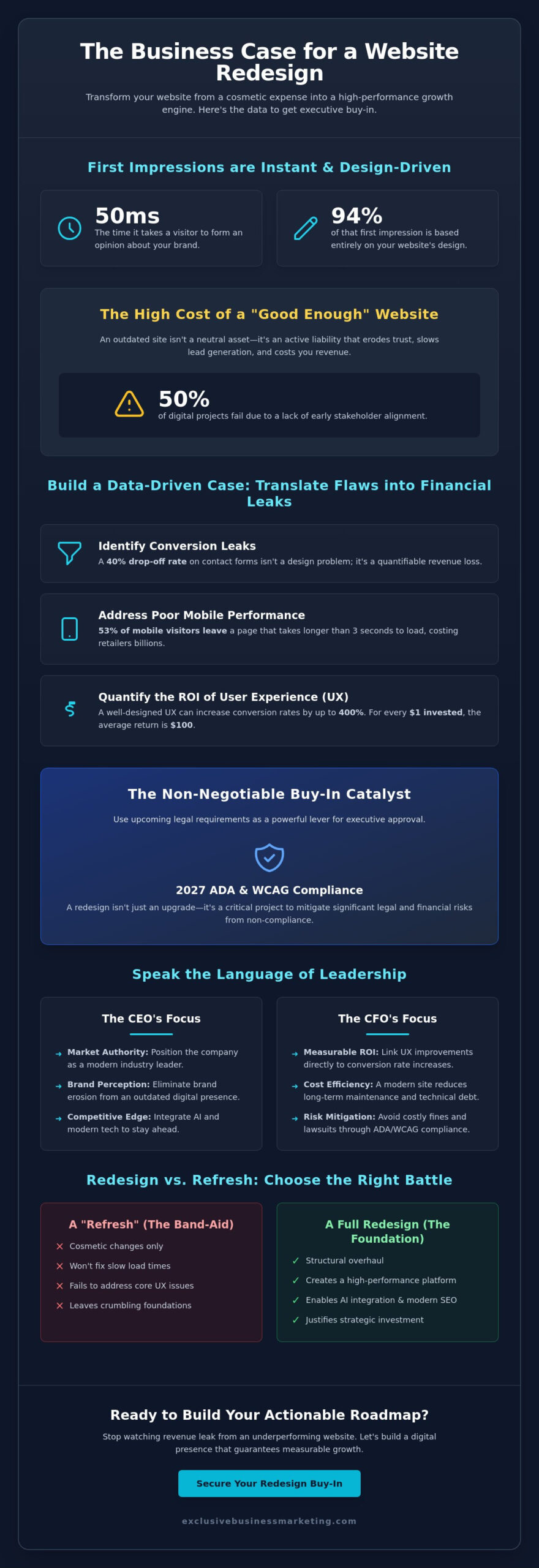
Did you know it takes just 50 milliseconds for a visitor to form an opinion about your brand, and 94% of that impression is based entirely on design? If your leadership team still thinks your current site is “good enough,” they are likely overlooking a massive leak in your revenue funnel. Learning how to get buy-in for a website redesign is no longer about picking prettier colors. It is about presenting a bulletproof business case that treats your digital presence as a high-performance growth engine rather than a cosmetic expense.
We know how exhausting it is to watch a critical project stall because of budget rejection or fears of scope creep. You need a way to bridge the gap between creative vision and executive ROI. This guide provides the data-driven strategies and risk-mitigation frameworks you need to secure a signed-off budget and align your stakeholders. We’ll show you how to quantify the impact of user experience, navigate upcoming 2027 WCAG compliance deadlines, and build a roadmap that guarantees measurable growth.
Key Takeaways
- Stop treating redesigns as creative projects and learn why early stakeholder alignment is the critical factor that prevents 50% of digital projects from failing.
- Master how to get buy-in for a website redesign by identifying specific conversion leaks and SEO gaps that prove your current site is actively losing revenue.
- Leverage upcoming 2027 ADA and WCAG compliance deadlines as a non-negotiable catalyst for executive approval to mitigate significant legal and financial risks.
- Speak the language of leadership by tailoring your pitch to address the CEO’s focus on market authority and the CFO’s demand for measurable ROI.
- Transform your proposal into an actionable roadmap by utilizing a discovery phase to finalize your business case and align goals with a strategic partner.
Why Stakeholder Buy-In is the Foundation of a Successful Redesign
Real buy-in isn’t just a signature on a budget proposal. It is an active, ongoing commitment of resources, time, and organizational will. When you are investigating how to get buy-in for a website redesign, you are essentially building a coalition. Without this foundation, even the most beautiful projects often crumble. Industry experts suggest that up to 50% of redesigns fail specifically because of a lack of early stakeholder alignment. It isn’t usually a technical glitch that kills the project; it is a “no” from a department head six months into development.
You must also account for “Invisible Stakeholders.” These are the individuals in Legal, IT, or Sales who might not attend your weekly meetings but possess the power to veto your progress late in the game. In 2026, a “good enough” website is no longer a neutral asset; it is an active liability. An outdated site erodes trust and slows down your lead generation. If your leadership team views the website as a digital brochure rather than a high-performance growth engine, they will treat it as a cost center to be minimized.
The High Cost of Executive Disconnect
Misaligned goals lead to friction, endless revision cycles, and wasted budget. If the CEO wants brand authority while the CFO only cares about immediate cost-reduction, your project will stall. This disconnect happens because many executives still view websites through an outdated lens. You have to pivot the narrative. Stop saying “the site looks old.” Start demonstrating that “the current site is costing us market share.” This shift is the most effective way to secure how to get buy-in for a website redesign from those who control the purse strings. When goals are clear from day one, you eliminate the psychological barriers that lead to project rejection.
Redesign vs. Refresh: Choosing the Right Battle
Non-technical stakeholders often confuse a visual refresh with a comprehensive redesign. It’s your job to clarify the difference. A refresh is a band-aid; it is a fresh coat of paint on a foundation that might be crumbling. It won’t fix slow load times or poor mobile performance. A full redesign is a structural overhaul that prepares your business for the challenges of a major redesign. By rebuilding the foundation, you create a platform ready for AI integration and modern SEO growth. Positioning the project as a strategic upgrade rather than a cosmetic fix makes the investment much easier to justify to a results-oriented executive team.
Building a Data-Driven Business Case: Beyond Aesthetics
Executives rarely care about the subjective “feel” of a website. They care about the bottom line. To master how to get buy-in for a website redesign, you must translate design flaws into financial leaks. Start by auditing your current conversion leaks using heatmaps and drop-off data. If 40% of your users are abandoning your contact forms or checkout pages, you aren’t just looking at a design problem. You are looking at a quantifiable loss in revenue. In 2026, mobile performance is a primary driver of this loss. 53% of mobile site visitors will leave a page that takes longer than three seconds to load. These slow speeds cost U.S. retailers an estimated $2.6 billion in lost sales annually. Presenting these numbers shifts the conversation from “wanting a new look” to “stopping a revenue leak.”
You should also highlight the revenue potential of modern technology. Integrating 24/7 AI lead generation assistants can capture prospects while your sales team is offline. Since nearly 93% of web designers now use AI tools, failing to upgrade your architecture to support these features puts your brand at a competitive disadvantage. Beyond revenue, emphasize risk mitigation. Following official ADA web accessibility guidance ensures you aren’t just building a pretty site, but a legally compliant one that avoids costly litigation.
Connecting UX Improvements to Tangible Revenue
A well-designed user experience can increase conversion rates by up to 400%. For every $1 invested in UX, businesses can expect a return of $100. Calculate the potential ROI of even a modest 1% increase in your conversion rate. That figure usually justifies the entire project cost within months. If you are currently investing in digital advertising, review your pay per click management services data. A poor landing page experience doesn’t just lose customers. It actively wastes your budget by inflating your cost-per-acquisition. Improving the UX directly increases the efficiency of every marketing dollar you spend.
The SEO Argument: Why Your Foundation is Cracking
Your site’s architecture might be the very thing holding you back from high-value rankings. In the age of AI search, technical SEO is mandatory. Search engines require clear, logical structures to index your content effectively. If your foundation is outdated, you simply won’t rank for the keywords that drive the most profitable traffic. Take a look at our Orange County SEO guide to see how local competitors are using modern site structures to dominate search results. If you want to see how your current site stacks up against the competition, request a performance audit to identify your biggest opportunities for growth.
Leveraging ADA Compliance as a Non-Negotiable Buy-In Catalyst
If you want to know how to get buy-in for a website redesign, you must move beyond aesthetics and talk about legal liability. In 2026, accessibility is no longer a “nice-to-have” feature. The U.S. Department of Justice (DOJ) has finalized rules under ADA Title II requiring state and local government entities to conform with WCAG 2.1 Level AA standards. For entities with a population over 50,000, the deadline is April 26, 2027. Healthcare organizations receiving federal funding face a similar mandate from the Department of Health and Human Services (HHS), with a compliance deadline of May 11, 2027. These aren’t suggestions; they are strict legal requirements with fixed dates. For a CFO or a legal team, the threat of a lawsuit is a far more powerful motivator than a slightly higher bounce rate.
Positioning accessibility as a core requirement reduces long-term maintenance and legal overhead. A compliant site is technically superior, featuring cleaner code and better structure. This foundation naturally boosts your SEO and expands your market reach by ensuring every visitor can interact with your brand. Integrating these requirements into a data-driven redesign strategy transforms the project from a creative wish list into a vital risk-mitigation initiative.
Risk Management: Protecting the Brand from Litigation
Web accessibility lawsuits are surging, particularly in states like California and New York. Many businesses try to take a shortcut by using automated “accessibility overlays.” These tools are not a substitute for a redesigned, compliant core. In fact, overlays often interfere with screen readers and can actually increase your litigation risk. A truly compliant site requires a comprehensive ADA compliant website design guide to ensure every element is accessible from the ground up. Doing it right the first time protects your company from five-figure settlements and catastrophic brand damage.
The Ethical and Business Case for Inclusive Design
Accessible design is simply good design. This is known as the “Curb Cut Effect.” Just as sidewalk ramps help parents with strollers and travelers with luggage, an accessible website improves the experience for all users. It simplifies navigation and makes content easier to consume on mobile devices. There is a massive market-reach advantage here. Over 25% of adults in the U.S. live with some form of disability. If your site isn’t accessible, you are locking out a quarter of your potential audience. Mastering how to get buy-in for a website redesign means showing leadership that inclusion equals profit. Additionally, many government and enterprise contracts now require verified accessibility standards. If you can’t prove compliance, you can’t win the bid.
Tailoring Your Pitch to Different Executive Mindsets
Successful internal advocacy requires more than a polished slide deck. You must speak the specific language of each seat at the decision-making table. When you are determining how to get buy-in for a website redesign, a “one size fits all” approach usually leads to a quick “no.” Your CEO doesn’t look at the site the same way your CFO does. You have to pivot your narrative to match their unique priorities and professional anxieties. By addressing their specific departmental goals, you transform the redesign from a marketing request into a cross-functional business solution.
- The CEO Pitch: Focus on brand authority and market leadership. Show them how a modern, high-performance site positions the company as a dominant force and provides a clear competitive edge over lagging rivals.
- The CFO Pitch: This is about the bottom line. Emphasize ROI, reduced operational costs through automation, and the mitigation of legal risks associated with non-compliance.
- The CTO Pitch: Highlight the elimination of technical debt. Focus on improved security protocols, faster load times, and the ability to integrate seamlessly with your existing CRM and tech stack.
- The Sales Leader Pitch: Focus on lead quality. Demonstrate how AI chatbots and better user journeys deliver warmer, more qualified prospects directly into their pipeline 24/7.
The “Cost of Doing Nothing” Framework
An outdated website acts as a silent drain on your annual growth by leaking high-intent traffic to more modern competitors. If you maintain the status quo, you aren’t just staying still; you are actively losing market share. Projecting your current conversion decline over the next 24 months creates a sense of urgency. When you visualize the “Gap” between your current performance and the 2026 market standard, the decision to reinvest becomes the only logical path forward.
Handling Common Objections with Confidence
Expect resistance, but be prepared to counter it with data. If leadership claims the project is too expensive, point to the efficiency gains. Automating customer service through AI chatbots can significantly reduce manual overhead. When they say “now isn’t a good time,” remind them of seasonal market trends and the risk of falling behind before your peak sales period. You can also prove that leveraging orange county web design expertise can shorten the project timeline by using proven, results-oriented frameworks. Don’t let a temporary delay turn into a long-term revenue loss. Schedule a strategy session today to build a pitch that your board cannot ignore.
Turning Your Proposal into a Roadmap with a Strategic Partner
Securing executive approval is only half the battle. To maintain the momentum you’ve built, you must transition from a conceptual pitch to a concrete execution plan. Leadership needs to see that you aren’t just asking for money; you are proposing a managed, low-risk investment. This is where your choice of partner becomes critical. You need an agency that prioritizes business outcomes over mere aesthetics. When you’re finalizing how to get buy-in for a website redesign, your roadmap should include a rigorous “Discovery Phase.” This stage allows you to validate your initial data, refine your revenue projections, and ensure every stakeholder’s concerns are addressed before a single line of code is written.
To manage budget concerns and stakeholder anxiety, consider a phased rollout. You don’t have to launch a 100-page site all at once. By prioritizing high-impact pages first, such as your primary lead generation funnels, you can start seeing ROI while the rest of the site is still in development. This approach keeps the board happy and provides early data points that prove the redesign was the right move. Establishing clear KPIs for the post-launch phase is essential. Track metrics like conversion rate, site speed, and organic traffic growth to demonstrate exactly how the new site is outperforming the old one.
Why a Full-Service Agency is a Safer Investment
Managing multiple vendors for SEO, design, and compliance is a recipe for project delays and misaligned goals. A full-service agency provides a unified strategy where every element works together. Exclusive Business Marketing bridges the gap between vision and execution by keeping your technical SEO, WCAG compliance, and branding under one roof. This integrated approach ensures that your site isn’t just pretty; it’s a high-performance machine. We also specialize in future-proofing your assets through AI chatbot installation and custom mobile app development, ensuring your brand stays ahead of the technological curve.
Finalizing the Pitch Deck: Your Next Steps
You’ve done the research and identified the leaks. Now, it’s time to package your case. Your final presentation should be concise, data-heavy, and focused on the future. Use a professional audit to validate your claims and remove any suspicion of bias. Your final pitch deck should include:
- The Financial Leak: A summary of current revenue lost to poor UX and slow mobile speeds.
- The Legal Deadline: A reminder of the 2027 ADA and WCAG compliance requirements.
- The Competitive Gap: Evidence of how rivals are currently outperforming you in search.
- The Execution Plan: A clear, phased timeline with a trusted strategic partner.
Don’t leave your project’s success to chance. A professional audit provides the objective proof you need to silence skeptics and win over the board. Schedule a strategy session with us today to build a bulletproof business case and transform your website into your most powerful sales tool.
Take the Lead on Your Digital Transformation
Mastering how to get buy-in for a website redesign requires moving beyond visual preferences to focus on strategic growth and risk mitigation. You’ve seen how conversion data, SEO gaps, and the looming 2027 ADA compliance deadlines provide the leverage you need to align your leadership team. By tailoring your pitch to the specific goals of each executive, you transform a creative request into an essential business initiative that protects your brand and drives measurable revenue.
Don’t let technical debt or outdated design hold your company back from its full potential. With over 15 years of Orange County marketing expertise, our team specializes in WCAG and ADA compliance while delivering a proven track record of ROI for B2B brands. We handle the complex details so you can focus on leading your market. Get a Free Website & Compliance Audit to Build Your Business Case today. You have the roadmap; now it’s time to execute with confidence and secure the growth your business deserves.
Frequently Asked Questions
How long does it typically take to get buy-in for a website redesign?
Getting buy-in typically takes between three to six months in a mid-sized to enterprise organization. This timeline depends on how well you’ve mapped out your stakeholder needs. Providing a data-driven audit early in the process is the best way to speed up the decision-making cycle and ensure everyone is aligned on the project’s scope.
What is the most important metric to show a CFO when asking for a redesign budget?
The most critical metric for a CFO is the projected Return on Investment (ROI) based on conversion rate improvements. You need to demonstrate how to get buy-in for a website redesign by showing the financial gap between your current performance and 2026 market standards. Linking design directly to revenue growth makes the budget much easier to justify during quarterly planning.
Can we do a website refresh instead of a full redesign to save money?
A refresh is often just a cosmetic band-aid on a broken foundation. It might cost less upfront, but it won’t fix slow load times or poor mobile responsiveness. If your goal is long-term growth, a full redesign ensures your site architecture supports modern SEO and AI integrations. It’s usually more cost-effective to build it right than to pay for constant repairs.
How does ADA compliance affect the cost of a website redesign?
ADA compliance adds specific technical requirements to the development phase, which may increase the initial investment. However, this cost is a fraction of the price of a legal settlement or a brand-damaging lawsuit. Designing for WCAG 2.1 AA standards from the start ensures your site is accessible to the 25% of U.S. adults living with disabilities.
What are the risks of using a DIY website builder for a professional redesign?
DIY builders often compromise your site’s performance and security. These platforms frequently suffer from code bloat, which slows down your page speed and hurts your search rankings. They also rarely provide the deep customization required to meet strict legal accessibility mandates. You’ll likely end up spending more in the long run to fix these structural issues.
How often should a business realistically redesign their website?
Most B2B companies should consider a redesign every two to four years to stay competitive. Technology and user expectations evolve rapidly. If your current site lacks mobile-first performance or AI-driven features, you’re likely losing prospects to more modern competitors. Don’t wait until your site is obsolete before you start planning your next move.
What role does AI play in a 2026 website redesign?
AI is a foundational tool in 2026, powering everything from 24/7 lead generation assistants to automated layout testing. It allows for a level of personalization that helps you understand how to get buy-in for a website redesign by proving the site will work harder for your sales team. Nearly 93% of designers now use AI to enhance the human-centered design process.
How do I choose the right agency for a complex B2B website redesign?
Choose an agency that prioritizes measurable results over visual flair. They should have deep expertise in technical SEO, ADA compliance, and business strategy. Look for a partner that offers a thorough discovery phase to ensure their goals align with your organizational needs. Check their case studies for proof of tangible growth and performance improvements.