

How to Avoid Getting Locked Into a Marketing Contract: A 2026 Business Guide
What if your marketing agency had to re-earn your business every single month instead of hiding behind a twelve-month legal shield? Most business owners have experienced the frustration of feeling trapped in a low-performance agreement, paying thousands for vague monthly reports while losing control over their own digital assets. You deserve a partner that focuses on generating tangible growth rather than enforcing fine print. Learning how to avoid getting locked into a marketing contract is the first step toward reclaiming your brand’s agility and ensuring your budget drives measurable outcomes.
This guide provides the exact roadmap you need to spot contract traps before you sign. We’ll show you which clauses to strike from an agreement to maintain total ownership of your marketing data and how to negotiate for month-to-month or performance-based terms. With the FTC increasing scrutiny on transparency and subscription cancellations in 2026, there’s no reason to settle for a rigid, one-sided deal. You’ll learn how to transition to the new industry standard of 90-day initial commitments that prioritize results over legal handcuffs.
Key Takeaways
- Identify the warning signs of agencies that prioritize their recurring revenue over your actual business growth.
- Discover how to avoid getting locked into a marketing contract by identifying and striking predatory auto-renewal and long-notice clauses.
- Implement a 30-60-90 day framework with clear KPIs to ensure your agency delivers measurable results from the very start.
- Secure your right to audit ad spend and maintain full ownership of all digital assets, accounts, and marketing data.
- Shift toward flexible month-to-month terms that force agencies to re-earn your business every single month through high performance.
The Reality of Marketing Contracts: Why Agencies Want You Locked In
Most marketing agencies operate on a recurring revenue model. This means their primary goal is keeping you on the books as long as possible to ensure their own cash flow stability. While this provides security for their business, it often shifts the focus away from your actual success. Understanding marketing contract basics reveals that these agreements are often designed to protect the provider’s interest over the client’s flexibility. You deserve better than a legal trap. Performance is the only real security in a business partnership.
To protect your budget, you must distinguish between a Master Service Agreement (MSA) and a Statement of Work (SOW). The MSA covers the broad legal relationship, while the SOW defines specific deliverables and timelines. If you want to know how to avoid getting locked into a marketing contract, start by insisting that the SOW has a shorter duration than the MSA. This allows you to maintain the legal framework of the partnership while giving you the freedom to pause or pivot specific services if they aren’t generating a return on investment.
Common High-Pressure Red Flags to Watch For
High-pressure sales tactics are designed to bypass your logic and secure a signature before you’ve done your due diligence. Watch out for “limited-time discounts” that vanish unless you sign a 12-month deal immediately. These are often traps to secure long-term revenue before an agency has proven its worth. Vague deliverables are another major warning sign. If a contract focuses on “activity” like the number of posts or hours worked rather than “outcomes” like lead volume or conversion rates, you’re likely entering a low-performance agreement. If an agency refuses to offer a trial period or a 30-day out clause, they’re showing you they don’t trust their own ability to keep you through performance alone.
Why ‘SEO Takes Time’ is Not a Valid Reason for a Lock-In
The common “SEO takes time” excuse is frequently used to justify rigid, multi-year contracts. Although SEO results take months to fully mature, agency accountability should be a monthly standard. You should see progress through project milestones like technical audits, content creation, and backlink acquisition long before you hit the first page of Google. Monthly reporting must prove they’re doing the work even if the final rankings are still climbing. Do not confuse the time required for Search Engine Optimization with the duration of your legal obligation. If an agency is doing its job, they won’t need a 12-month handcuffs clause to keep you as a client. They’ll keep you because the data shows they are growing your business.
The Anatomy of a ‘Trap’ Contract: Clauses to Strike or Rewrite
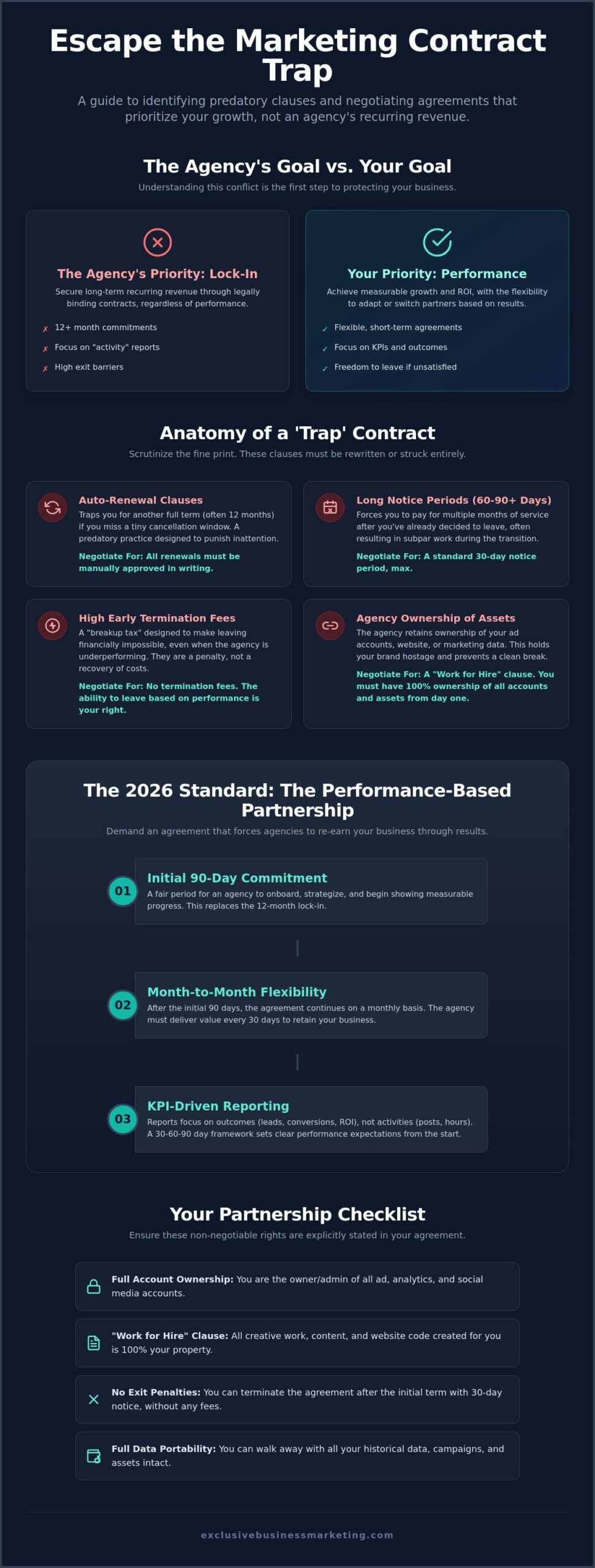
Marketing contracts often contain subtle traps that turn a partnership into a cage. If you want to know how to avoid getting locked into a marketing contract, you must look beyond the monthly fee and scrutinize the legal fine print. Many agencies use auto-renewal clauses to keep you paying long after the initial term ends. These passive signatures mean that if you don’t cancel within a very specific window, you’re on the hook for another year. It’s a predatory practice that prioritizes agency revenue over client satisfaction.
Notice periods are another common trap. While some agencies demand a 90-day notice, this is often just a final revenue grab. It forces you to pay for three months of service while the agency knows you’re leaving, which usually leads to poor performance during the transition. Fair partnerships thrive on shorter windows. Early termination fees are essentially a “breakup tax.” Agencies claim these cover their onboarding costs, but in reality, they are designed to make leaving too expensive to consider. Always calculate the real cost before signing. If the exit fee equals several months of service, you aren’t really free to leave.
Ownership and Data Portability: Your Most Important Protection
Account ownership is non-negotiable. You must own your Google Ads, Meta, and GA4 accounts from day one. If an agency builds your ADA compliant website design, ensure the contract includes a “Work for Hire” clause. Without this, you might find yourself legally barred from using your own website content or creative assets if you decide to switch providers. True data portability means you can walk away with your history and assets intact. If you feel your current agreement is holding your growth back, it might be time to find a marketing agency that values your freedom as much as your results.
Notice Periods and Exit Fees: What is Fair?
A 30-day notice period is the industry gold standard for fair play. It provides enough time for a professional handoff without dragging out an unproductive relationship. When discussing these terms, use effective negotiation tactics for marketers to remove “liquidated damages” or steep exit penalties. You should also clearly define “Termination for Cause” versus “Termination for Convenience.” Termination for cause allows you to exit immediately if the agency fails to meet specific KPIs, while termination for convenience lets you end the partnership for any reason with proper notice. Striking these predatory clauses ensures your agency stays focused on your growth, not just your signature.
Performance-Based Agreements: The 2026 Standard for ROI
Stopping a bad contract is defensive. Structuring a great one from day one is offensive. In 2026, the most successful business partnerships aren’t built on legal threats; they’re built on shared goals and measurable growth. Agencies that produce results don’t need to trap you with fine print. They keep you because your revenue is climbing. Structuring your partnership around performance is the most effective strategy for how to avoid getting locked into a marketing contract that underperforms. When an agency’s compensation is tied to your success, their motivation stays high every single month.
The industry standard in 2026 has shifted toward a 90-day initial commitment followed by a flexible month-to-month arrangement. This 30-60-90 day framework allows for proper setup and early optimization while maintaining your right to pivot. Many forward-thinking agencies now offer hybrid models, where a modest base fee covers operational costs and performance bonuses are triggered by specific lead generation targets. This alignment of interests ensures you’re never just a line item on a spreadsheet. Transparent, real-time reporting acts as the ultimate contract. If the data shows growth, the partnership continues naturally.
Defining Meaningful KPIs (Key Performance Indicators)
You can’t manage what you don’t measure. Stop settling for vanity metrics like “impressions” or “reach” that don’t pay the bills. Your contract should focus on search engine optimization Orange County results that actually drive phone calls and booked appointments. We recommend setting “Stop-Loss” triggers in your agreement. These clauses specify exactly what happens if your primary KPIs aren’t met for two consecutive months. It gives the agency a chance to course-correct while protecting you from paying for continued failure.
The Power of the ‘Trial Project’
Don’t commit to a full-service retainer without a test run. Start with a standalone audit or a single PPC campaign to evaluate the agency’s communication and technical skill. A low-risk AI chatbot installation is another excellent way to test how quickly a team responds to your needs and how they handle technical integration. Use this 90-day probationary period to evaluate more than just numbers. You’re looking for a cultural fit and a proactive partner who treats your business like their own. If the trial project doesn’t exceed expectations, you can walk away without a legal battle or exit fees.
Negotiation Tactics: How to Protect Your Business Interests
Treat the first draft of any marketing contract as a starting point, not a final decree. Most agencies use standardized templates that protect their interests. You have the power to change them. Learning how to avoid getting locked into a marketing contract starts with the realization that every single clause is negotiable. If a term feels restrictive or vague, demand a rewrite. A confident agency will have no problem adjusting their terms to ensure you feel secure in the partnership.
Insist on a “Right to Audit” clause. This is vital for PPC Ad Management services. It ensures that every dollar of your ad spend is actually going to platforms like Google or Meta rather than being padded by hidden agency fees. Transparency is the foundation of trust. You should also demand direct, administrative access to all third-party platforms and login credentials from day one. You shouldn’t have to ask for permission to see your own data. If an agency refuses to grant you login credentials for your own accounts, walk away. This is a massive red flag that they intend to use your data as leverage later.
Use competitor quotes to leverage better contract terms. If another provider offers a 30-day out clause while your current prospect demands 90 days, bring it up. Competitive pressure often forces agencies to be more flexible with their terms. If you’re ready for a partnership built on transparency rather than legal traps, contact a marketing agency that puts your results first.
Crucial Questions to Ask Before Signing Anything
Before you put pen to paper, get specific answers to these three questions. First, ask who your daily point of contact will be and what their guaranteed response time is. You don’t want to be passed off to a junior account manager after signing. Second, clarify exactly what happens if you cancel today. Which assets do you take with you, and what does the agency keep? Finally, ask to see a live dashboard of how they track ROI in real-time. If they can’t show you how they measure success, they can’t guarantee it.
Redlining the Agreement: A Checklist for Your Attorney
When you send the contract to your legal team, tell them to look for three specific red flags. Remove any “automatic price increases” tied to inflation or performance. These allow agencies to hike your rates without your consent. Ensure “non-compete” clauses are struck out or heavily limited. These shouldn’t stop you from hiring another agency or bringing your marketing in-house later. Finally, clarify the scope of work in granular detail. Vague language leads to “scope creep” and hidden fees that can blow your budget. Clear boundaries protect both parties and keep the focus on growth.
The Exclusive Business Marketing Approach: Results Over Restraint
At Exclusive Business Marketing, we’ve built our entire model on the belief that a marketing agency should earn your business every single month. We don’t hide behind legal fine print or multi-year obligations. Instead, we rely on the measurable growth we generate for our clients. If you want to know how to avoid getting locked into a marketing contract, the simplest answer is to choose a partner that doesn’t require one. Our no-hassle philosophy means we focus on your scaling strategy rather than your signature.
Total transparency isn’t just a buzzword for us; it’s a core operational standard. You receive 24/7 access to your data through real-time reporting dashboards. You’ll never have to wait for a monthly PDF to see how your campaigns are performing. We integrate Search Engine Optimization, PPC, and compliant web design into a cohesive, flexible strategy that pivots as your market changes. This agility ensures your marketing budget is always allocated to the channels producing the highest ROI at any given moment.
Our Commitment to Client Ownership
We maintain a strict ‘no exceptions’ policy regarding your digital assets. You own the accounts, the data, and the code. If we build it for you, it belongs to you. Our pay per click management services are designed to provide immediate lead generation without the long-term traps commonly found in the industry. We take a guided, step-by-step approach to scaling your marketing. This allows you to increase your investment based on proven success rather than speculative promises. This is how to avoid getting locked into a marketing contract that drains your resources without delivering value.
Ready for a Different Kind of Agency Experience?
We invite you to experience a marketing partnership built on mutual trust and consistent performance. Our roots in Huntington Beach give us a deep understanding of the competitive California market, allowing us to provide local expertise with a global reach. We’re ready to prove our value from day one. Request a transparent, no-obligation marketing audit today and see how we can drive tangible growth for your business without the legal handcuffs.
Secure Your Growth Without Legal Handcuffs
Your business deserves a marketing partner that earns its place on your payroll every single month through performance, not fine print. You now have the roadmap for how to avoid getting locked into a marketing contract by demanding transparency, account ownership, and flexible terms. By striking predatory clauses and focusing on 30-60-90 day KPI frameworks, you maintain the agility needed to thrive in the competitive 2026 landscape. Accountability is the only foundation for a successful long-term partnership.
Exclusive Business Marketing operates on a results-first philosophy. We offer the month-to-month flexibility you need to stay in total control of your budget. As Orange County’s leading experts in ROI-driven SEO and PPC, we guarantee 100% client ownership of all accounts and data. You keep your assets, your history, and your peace of mind while we drive the tangible growth your brand expects. Don’t let a restrictive agreement slow your momentum.
You’re ready to build a partnership that prioritizes your success above everything else. Let’s start growing your business on your terms.
Frequently Asked Questions
What is a standard notice period for a marketing agency contract?
A 30-day notice period is the current industry standard for fair marketing agreements. While some agencies push for 60 or 90 days, these longer windows often act as a final revenue grab. Insist on a 30-day window to ensure you can pivot quickly if your business needs change. This timeframe allows for a professional transition of assets without dragging out an unproductive relationship.
Can I get out of a marketing contract if the agency isn’t delivering results?
You can exit a contract for poor performance if you have a “Termination for Cause” clause tied to specific KPIs. If the agency fails to meet agreed lead volumes or ranking milestones for two consecutive months, this clause should allow for immediate cancellation. Learning how to avoid getting locked into a marketing contract involves defining these success metrics clearly in the initial agreement to protect your budget.
Who typically owns the website content and ad accounts in a marketing agreement?
The client should maintain 100% ownership of all website content, creative assets, and ad accounts from day one. Your contract must include a “Work for Hire” provision to ensure everything the agency produces belongs to you legally. Never allow an agency to run ads through their own business manager account. If they do, you’ll lose your historical data and campaign progress if you ever decide to leave.
Why do marketing agencies insist on 6 or 12-month contracts?
Agencies prefer long-term contracts to stabilize their own monthly recurring revenue and offset initial onboarding costs. They often claim that results take time, which is true for Search Engine Optimization, but that shouldn’t require a legal handcuff. A confident agency will rely on their performance to keep you as a client rather than a 12-month signature. If they provide value, they don’t need a trap.
What should I do if an agency refuses to remove an auto-renewal clause?
If an agency refuses to remove an auto-renewal clause, it’s a sign they prioritize their cash flow over your flexibility. You should consider this a major red flag and look for another provider. If you must sign, demand that the cancellation window be clearly defined and that the agency provides a written reminder 30 days before the renewal date. Don’t let a passive signature commit your budget.
Is a month-to-month marketing contract more expensive than a long-term one?
Some agencies might charge a small premium for month-to-month terms, but the flexibility often saves you thousands in the long run. Paying a slightly higher monthly rate is a small price for the ability to cancel an underperforming campaign instantly. Long-term contracts might look cheaper on paper, but they become incredibly expensive if you’re stuck paying for a strategy that isn’t driving ROI. Flexibility is your best insurance.
How can I verify if an agency is actually spending my ad budget correctly?
You can verify ad spend by demanding direct, administrative access to your Google Ads and Meta Business Suite accounts. This allows you to see exactly how much is being paid to the platform versus how much the agency is charging for management. Always check the billing section of your ad accounts personally. If an agency hides these details, they might be padding their margins with your ad budget.
What are the most common hidden fees in digital marketing contracts?
Common hidden fees include setup charges, reporting fees, and technical overage costs. Some agencies also bury automatic price increases in the fine print that kick in after the first six months. Scrutinize the scope of work to ensure tasks like AI chatbot installation or basic updates are included in your retainer. Clarifying these details is a key part of how to avoid getting locked into a marketing contract with unexpected expenses.