

California Website Accessibility Laws: The 2026 Business Compliance Guide
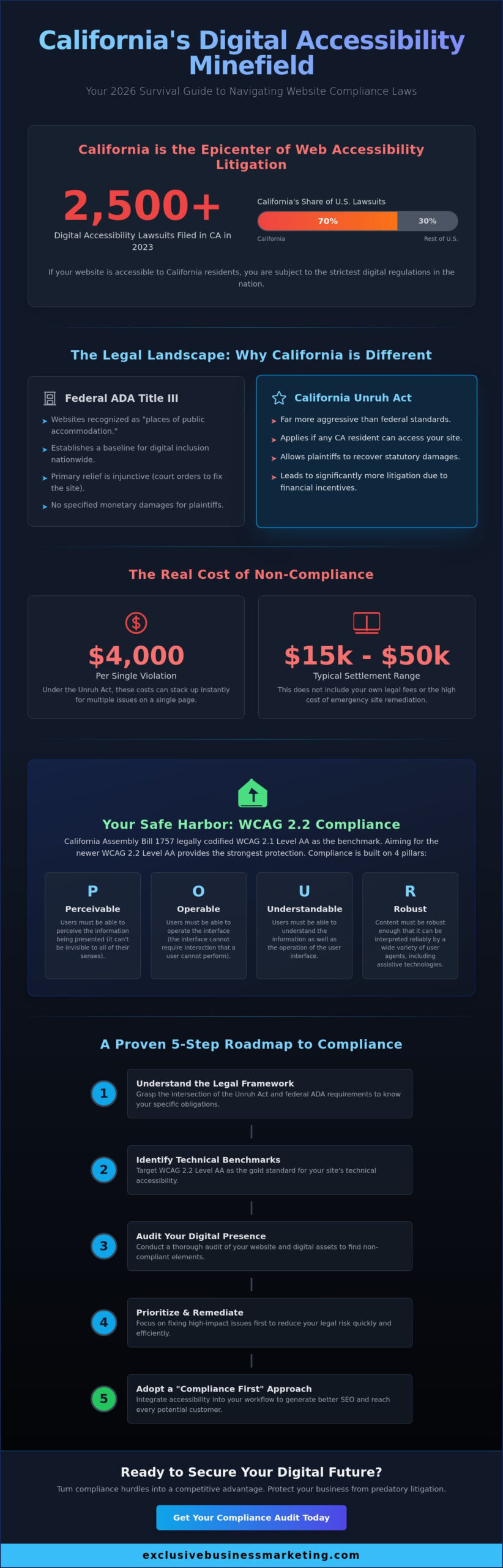
In 2023, California courts handled over 2,500 digital accessibility lawsuits, accounting for a massive share of the nation’s total litigation. You likely feel like you’re walking through a legal minefield every time you update your site. It’s frustrating when you’re trying to grow a business but have to worry about predatory “drive-by” lawsuits that target small technical errors. We understand the stress of trying to distinguish between federal ADA rules and the specific california website accessibility laws that apply to your local operations.
We’ve designed this 2026 guide to cut through the noise and show you exactly how to protect your assets. You’ll learn how to master the latest WCAG 2.2 standards and use the safe harbor provisions in AB 1757 to shield your business from high remediation costs. We’ll break down the legal differences between the Unruh Act and federal mandates while providing a clear roadmap to total digital inclusivity. By the end of this article, you’ll know how to choose a local partner who can turn these compliance hurdles into a competitive advantage for your digital reach.
Key Takeaways
- Understand the critical intersection of the Unruh Civil Rights Act and federal requirements to protect your business from becoming a litigation target.
- Identify the specific WCAG 2.2 technical benchmarks required to meet the global gold standard for digital accessibility and user experience.
- Learn how to navigate california website accessibility laws to avoid expensive legal fees and the stress of mandatory remediation.
- Follow a proven 5-step roadmap to audit your digital presence and prioritize the high-impact fixes that matter most for compliance.
- Explore how a “Compliance First” approach generates better SEO results and ensures your business reaches every potential customer.
Understanding the California Website Accessibility Legal Landscape
Federal law establishes a baseline for digital inclusion, but California builds a much higher ceiling. Under the Americans with Disabilities Act (ADA) Title III, websites are recognized as places of public accommodation. This means your digital presence must be accessible to everyone. However, california website accessibility laws are significantly more aggressive than federal standards. If your business interacts with California residents, you’re operating under the strictest digital regulations in the United States. Ignoring these requirements isn’t just a technical oversight; it’s a massive financial risk.
The Unruh Civil Rights Act Explained
The Unruh Civil Rights Act is the primary reason California sees more digital accessibility litigation than any other state. You don’t need a physical storefront in California to be sued. If a person in California can access your website, you’re subject to the law. Unlike federal law, which primarily seeks injunctive relief, the Unruh Act allows plaintiffs to recover $4,000 in statutory damages for every single instance of discrimination. These costs pile up instantly. In 2023, California courts handled over 70% of all web-related accessibility lawsuits in the country. Judges in this jurisdiction frequently favor plaintiffs, making a “wait and see” approach a dangerous gamble for your bottom line.
AB 1757: The Game Changer for Web Developers
Assembly Bill 1757 (AB 1757) shifted the landscape in October 2023 by codifying WCAG 2.1 Level AA as the official legal benchmark. This bill introduced a “presumption of accessibility.” If your site fails to meet these specific technical criteria, it’s legally deemed discriminatory. The law also created a significant liability shift. Web developers and third-party resource providers are now in the legal crosshairs if they provide non-compliant products. Waiting for a formal demand letter is the costliest mistake a business owner can make. Most settlements for these cases now range between $15,000 and $50,000, not including the cost of emergency site remediation.
Beyond general business operations, specific codes impact those working with the public sector. California Government Code Sections 7405 and 11135 require any private entity receiving state funding or contracting with state agencies to meet Section 508 standards. This means your california website accessibility laws compliance is often a prerequisite for securing or maintaining lucrative state contracts. We help you navigate these complexities so you can stay focused on generating revenue. Our team ensures your site meets every 2026 standard, protecting you from predatory litigation and opening your doors to every potential customer.
- Statutory Damages: $4,000 per violation under the Unruh Act.
- Standard: WCAG 2.1 Level AA is the codified requirement as of 2023.
- Reach: Applies to any business accessible to California residents, regardless of business location.
- State Contracts: Compliance is mandatory under Government Code 7405 for all state vendors.
WCAG 2.2: The Technical Benchmarks Your Site Must Meet
The Web Content Accessibility Guidelines (WCAG) version 2.2, released on October 5, 2023, represents the definitive roadmap for digital inclusion. These guidelines aren’t just suggestions; they’re the technical foundation for Assembly Bill 434 (2017), which set the precedent for state agencies and now influences broader california website accessibility laws. To stay safe in 2026, you need to understand the three tiers of compliance. Level A provides minimal accessibility, Level AA is the global legal standard, and Level AAA offers specialized support for specific audiences. For 95% of California businesses, hitting Level AA is the non-negotiable target.
Compliance rests on four pillars known as POUR. Content must be Perceivable so users can see or hear it. It must be Operable so everyone can navigate your site. It must be Understandable so the interface makes sense to all users. Finally, it must be Robust enough to work with assistive technologies like screen readers. Aiming for WCAG 2.2 Level AA covers the most common legal triggers and ensures your site remains accessible to the widest possible audience.
Key Requirements for WCAG 2.2 Level AA
Achieving Level AA requires focusing on high-impact elements that drive both usability and visibility. Text alternatives (Alt-text) for images are mandatory. This doesn’t just help visually impaired users; it significantly improves your SEO by giving search engines context about your visual content. Keyboard navigability is another critical area. If a user can’t browse your entire site using only the “Tab” key, your risk of a lawsuit increases. You also need to maintain a contrast ratio of at least 4.5:1 for standard text. This ensures readability for the 8% of men with color vision deficiency. If you aren’t sure where you stand, you can request a professional accessibility audit to identify these gaps today.
New Criteria in WCAG 2.2 You Can’t Ignore
The 2.2 update added nine new success criteria that specifically target modern mobile usage and cognitive disabilities. “Focus Not Obscured” ensures that when a user tabs through your site, the active element isn’t hidden by sticky headers or pop-ups. “Target Size” is equally vital for mobile users. Buttons must be at least 24 by 24 CSS pixels to prevent navigation errors. Lastly, “Redundant Entry” requires your site to remember information the user already entered in the same session. This reduces the cognitive burden for users and streamlines the conversion process. Staying ahead of these california website accessibility laws protects your revenue and your reputation.
The Real Cost of Inaccessibility: Lawsuits and Beyond
Ignoring california website accessibility laws isn’t just a technical oversight; it’s a massive financial liability. In 2023, data from UsableNet showed that over 4,600 website accessibility lawsuits were filed in the United States. California remains the primary battleground for these legal actions due to the Unruh Civil Rights Act, which allows plaintiffs to claim statutory damages of $4,000 per violation. For a small business, a single lawsuit often results in a settlement between $15,000 and $50,000. These figures don’t include your own legal defense fees or the mandatory costs to rebuild your digital infrastructure.
- Brand Erosion: Public legal battles damage your reputation and alienate socially conscious consumers.
- High Bounce Rates: If 25% of your traffic can’t navigate your menu, they’ll leave within seconds.
- Remediation Spikes: Fixing a site under a court-ordered deadline is 300% more expensive than proactive development.
Why Accessibility Overlays Are a False Sense of Security
Many owners try to take a shortcut by installing a “one-line-of-code” overlay or widget. These tools are often a magnet for trial lawyers. In the case of Murphy v. Eyebobs, the court highlighted that overlays don’t actually fix the underlying source code. They act as a fragile skin that often breaks screen readers. Using an overlay tells a lawyer that you know your site isn’t compliant but haven’t put in the work to fix it. We don’t use band-aids; we provide permanent, code-level solutions that protect your investment.
The ROI of an Accessible Website
Accessibility is a growth engine, not a tax. People with disabilities and their families represent a $13 trillion global market. When you follow california website accessibility laws, you’re opening your doors to a massive audience that your competitors are likely ignoring. Accessible sites also rank higher in search results because clean code and descriptive tags are exactly what Google’s crawlers look for. You’ll see better conversion rates and lower bounce rates across your entire customer base. Contact us today for a free quote on making your site compliant and profitable.
A 5-Step Roadmap to California Website Compliance
Achieving full alignment with california website accessibility laws requires a methodical approach. You can’t just install a plugin and hope for the best. True compliance demands a deep dive into your site’s architecture. Understanding the nuances of california website accessibility laws is the first step toward long term digital security. Follow this proven roadmap to protect your business and serve every customer effectively.
- Step 1: Conduct a Hybrid Audit. Start with automated scanning to find obvious errors. Pair this with manual testing to catch the nuances that software misses.
- Step 2: Prioritize High-Impact Barriers. Fix the issues that block users entirely. Focus on keyboard navigation, form labels, and screen reader compatibility first.
- Step 3: Execute Technical Remediation. Update your site’s code, design assets, and content. This includes adding descriptive alt text to images and ensuring color contrast ratios meet WCAG 2.1 Level AA standards.
- Step 4: Publish an Accessibility Statement. Draft a formal document that outlines your commitment and provides a clear way for users to report issues. This shows good faith to regulators.
- Step 5: Prevent Compliance Drift. Set up a schedule for ongoing monitoring. Websites change constantly. One bad plugin update can break your compliance overnight.
The Importance of Manual Testing
Relying solely on automated tools is a dangerous gamble. Industry data from WebAIM shows that automated scanners typically catch only 30% to 40% of accessibility errors. These tools can’t tell if your alt text is actually helpful or if a logical reading order exists for a screen reader user. We test your site using actual assistive technologies like JAWS and NVDA. We also involve users with disabilities to ensure the experience is truly functional, not just technically correct. This hands-on approach is the only way to guarantee a frictionless experience for all users.
This commitment to creating a supportive and accessible environment extends beyond the digital world; for an example of how professional mentoring and community access foster independence, you can visit Mighty Mentors WA.
Maintaining Compliance in 2026
Compliance isn’t a one-time project; it’s an ongoing commitment. In 2026, California’s enforcement is expected to be more stringent than ever. You must train your content team on accessible publishing practices so every new blog post or product page stays compliant. We recommend quarterly audits to verify that system updates haven’t introduced new barriers. A 2023 analysis found that 98.1% of homepages had detectable WCAG 2 failures, mostly due to new content updates. If you want to build a foundation that lasts, learn more about our ADA compliant website design services. We handle the technical heavy lifting so you can focus on your revenue.
Ready to secure your digital presence and avoid legal risk? Contact us today for a free quote and let our experts guide you through the complexities of California’s legal requirements.
How Exclusive Business Marketing Secures Your Digital Future
Exclusive Business Marketing doesn’t just build websites; we build digital assets that are legally sound and high-performing. In a state where california website accessibility laws are reaching new levels of enforcement by 2026, you need a partner who understands the local legal landscape. Our Huntington Beach team uses a “Compliance First” framework for every Orange County web design project. We don’t treat accessibility as a final checkmark. We bake it into the code from the very first wireframe.
Our local expertise matters because California businesses face unique risks under the Unruh Civil Rights Act. Industry reports from 2023 showed that nearly 97% of homepages had detectable WCAG 2 failures. We’ve seen a steady increase in digital accessibility lawsuits year-over-year, making it vital to have a team that stays ahead of the curve. We handle the technical complexities so you have less to worry about. Our goal is to generate tangible outcomes like more leads and revenue while shielding you from legal threats.
SEO and Accessibility: Two Sides of the Same Coin
Search engines and screen readers actually look for the same things. When we implement proper heading structures and descriptive alt-text, we’re making your site readable for the visually impaired and crawlable for Google. This synergy boosts your rankings and expands your reach. Mobile responsiveness is another shared requirement. Since Google’s mobile-first indexing became the standard in 2018, having a site that works perfectly on every device is mandatory for both SEO and ADA standards. You can learn more about our SEO services Orange County to see how we drive growth with these strategies.
We also integrate custom AI Chatbots to enhance the user experience. These bots act as 24/7 sales assistants, helping users navigate your site through simple conversational interfaces. This provides an essential layer of accessibility for users who find traditional navigation menus difficult to use. It’s a win-win for your business. Your customers get the help they need, and you capture more leads around the clock without increasing your payroll.
Ready to Protect Your Business?
We walk you through the whole process, from the initial audit to the final launch. Our team is ready and available now to help you meet the latest california website accessibility laws without sacrificing style or speed. We are a one-stop shop that takes the burden off your shoulders so you can focus on running your company.
- Comprehensive accessibility audits that identify every hidden risk on your current site.
- Certified professionals who understand the nuances of WCAG 2.1 and 2.2 standards.
- Proactive maintenance to ensure you stay compliant as digital laws evolve.
Contact us today for a free quote and a comprehensive accessibility report. We are available seven days a week and promise to return your inquiry quickly. Call us now at 1-866-WEB-MKTG to start your journey to compliance. We will prove our value to you from the very first call.
Secure Your Digital Future Before 2026
Navigating california website accessibility laws requires a proactive strategy rather than a reactive one. With 2,387 ADA website lawsuits filed in 2023 according to UsableNet data, the legal landscape is shifting toward much stricter enforcement of WCAG 2.2 AA standards. Businesses that fail to update their digital presence by the 2026 benchmarks risk significant legal fees and lost revenue. You’ve seen the roadmap; now it’s time to execute. Our team of WCAG and ADA compliant design specialists and certified SEO professionals is ready to audit, remediate, and protect your site. We don’t believe in waiting for problems to arise. We’re available 7 days a week and guarantee a response within 1 hour because your compliance can’t wait. We’ll handle the technical complexities so you can stay focused on running your company. Contact us today for a free quote on California website accessibility compliance. It’s time to build a more inclusive, high-performing website that stands the test of time and law.
Frequently Asked Questions
Is my small business website required to be ADA compliant in California?
Yes, your small business must comply with accessibility standards regardless of its size. California law, specifically the Unruh Civil Rights Act, mandates that all business establishments provide equal access to individuals with disabilities. In 2023, digital accessibility lawsuits reached a record high of 4,605 filings, proving that small operations are not exempt from legal scrutiny. Contact us today for a free quote.
What is the difference between WCAG 2.1 and WCAG 2.2 for California law?
WCAG 2.1 is the current baseline, but WCAG 2.2, which was released on October 5, 2023, adds nine new criteria to improve mobile and cognitive accessibility. Adopting the 2.2 standard is the most effective way to future proof your business against evolving california website accessibility laws. Our team ensures your site meets these specific technical requirements to keep you protected. Contact us today for a free quote.
Can I be sued if my business is not located in California but serves CA residents?
You can absolutely face a lawsuit in California even if your physical headquarters is in another state. California courts established this jurisdiction in the landmark 2019 case Robles v. Domino’s Pizza, LLC, which confirmed that websites are places of public accommodation. If a single California resident cannot use your site, you’re at risk. Contact us today for a free quote.
What are the penalties for violating the Unruh Civil Rights Act?
Violations of the Unruh Civil Rights Act carry a mandatory minimum statutory penalty of $4,000 per individual occurrence. Plaintiffs often cite multiple barriers during a single visit, which quickly multiplies the total damages. Beyond these fines, you’ll also be responsible for the plaintiff’s attorney fees and your own legal costs. Contact us today for a free quote.
How much does it cost to make a website ADA compliant?
Costs depend on your site’s complexity, but industry data from 2024 shows that professional manual audits and remediation typically range from $5,000 to $20,000 for mid sized sites. While automated overlays seem cheaper, they fail to catch 70 percent of accessibility issues. Investing in a permanent, code level fix is the only way to ensure long term compliance. Contact us today for a free quote.
Does an accessibility statement protect me from lawsuits?
An accessibility statement does not provide legal immunity or stop a determined plaintiff from filing a claim. It serves as a public commitment to inclusion, but it won’t help you in court if the actual site remains broken for screen reader users. According to the 2024 WebAIM Million report, 95.9 percent of homepages still have detectable WCAG failures. Contact us today for a free quote.
How long does it take to complete a full accessibility remediation?
A comprehensive remediation to align with california website accessibility laws generally takes between 4 and 12 weeks. This timeline includes a manual audit, code adjustments, and final verification testing to ensure every element works for all users. We move quickly to close your window of legal exposure and get your site updated. Contact us today for a free quote.
Will making my site accessible hurt my website design or branding?
Accessibility improves your design by making it cleaner and easier for everyone to navigate. It doesn’t mean your site has to look boring; it just means using proper color contrast and logical layouts. Since 1 in 4 U.S. adults lives with a disability, an accessible site actually expands your brand’s reach to a massive, underserved market. Contact us today for a free quote.