

Accessibility Audit: The Complete 2026 Guide to Website Compliance and SEO
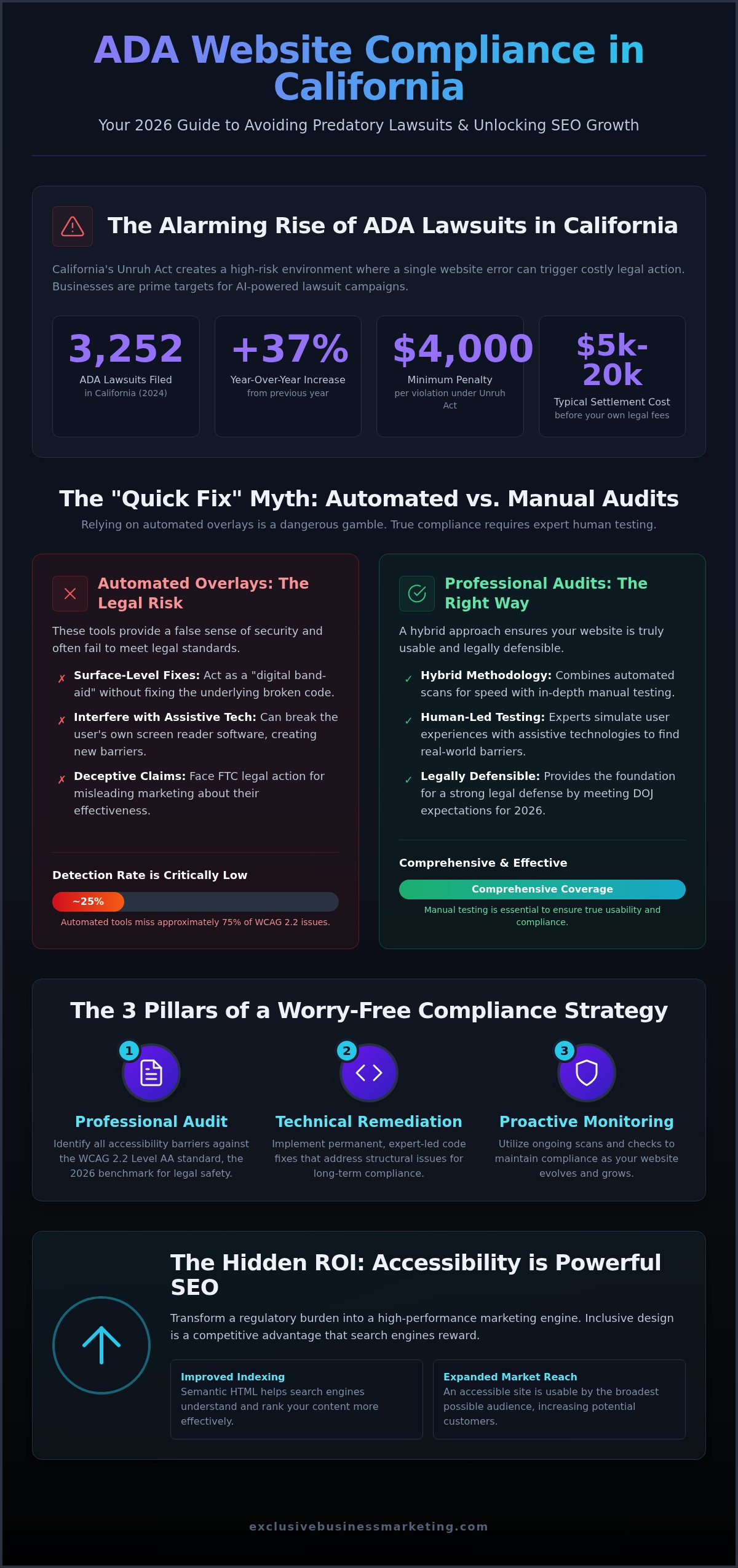
With 3,252 ADA lawsuits filed in California in 2024 alone, a 37% increase from the previous year, your website is no longer just a digital storefront; it’s a potential legal liability. Most business owners feel overwhelmed by the technical jargon of WCAG 2.2 and the unpredictable cost of ADA website compliance California businesses face in a litigious environment. You likely worry that one technical oversight could lead to a minimum $4,000 penalty under the Unruh Act plus skyrocketing attorney fees. It’s a stressful position to be in, but your compliance journey doesn’t have to be a drain on your resources.
This guide shows you how a professional accessibility audit transforms a regulatory burden into a high-performance SEO engine. You’ll learn exactly how to protect your business from predatory litigation while significantly improving your search rankings through inclusive design. We’ll break down the specific WCAG 2.2 requirements for 2026 and provide a clear roadmap for your remediation. By the end of this article, you’ll understand why investing in accessibility is the smartest way to expand your market reach and dominate your local competition.
Key Takeaways
- Understand how the total cost of ADA website compliance California businesses invest in covers the essential trio of professional auditing, technical remediation, and proactive monitoring.
- Learn why relying on automated overlays is a legal risk and how manual testing ensures your site meets the strict WCAG 2.2 standards.
- Discover the hidden SEO advantages of accessible design, where semantic HTML structures help search engines index your content more effectively.
- Follow a proven, phase-based audit roadmap to identify high-risk digital assets and implement permanent, worry-free technical solutions.
- See how local Huntington Beach expertise provides a strategic advantage in navigating California’s unique high-litigation landscape.
What Is the Real Cost of ADA Website Compliance in California for 2026?
Calculating the cost of ADA website compliance California business owners must budget for requires looking beyond a simple software fix. It’s a holistic investment strategy rather than a one-time expense. A complete compliance plan includes the initial professional audit, the technical labor for remediation, and the recurring cost of active monitoring. For a comprehensive Web Accessibility Overview, it’s clear that the 2026 benchmark for legal safety is WCAG 2.2 Level AA. This standard ensures your site is usable by the broadest possible audience while creating a defensible position against litigation. While the upfront costs might seem high, the long-term ROI is found in increased market reach and the avoidance of catastrophic legal settlements.
The Legal Cost of Non-Compliance: California and the Unruh Act
California is unique because of the Unruh Civil Rights Act. This law allows plaintiffs to claim a minimum of $4,000 in statutory damages for every single instance of non-compliance. In 2024, California saw 3,252 ADA lawsuits, which was a 37% jump from the previous year. Orange County and Los Angeles remain high-litigation zones where predatory lawsuits target small to mid-sized businesses with relentless frequency. These plaintiffs often use AI-powered tools to scan thousands of sites per hour. If they find a single keyboard navigation error or a missing alt-tag, they can file a claim. Ignoring these standards in 2026 is effectively an open invitation for a lawsuit that will likely settle for $5,000 to $20,000 before you even pay your own legal fees.
Factors Driving Your ADA Compliance Investment
Several variables influence the total cost of ADA website compliance California entrepreneurs should expect. First, site size is determined by the number of unique templates rather than the total page count. A site with ten thousand blog posts but one layout is often simpler to fix than a ten-page site with ten custom designs. Second, complex features like e-commerce checkout flows and custom AI chatbots require manual testing to ensure screen readers can navigate them. Third, your choice of provider matters. Avoid “cheap” automated overlays or “quick fix” plugins. These tools often fail to catch 75% of issues and have even led to regulatory action for deceptive marketing. Investing in manual, expert-led remediation is the only way to secure a worry-free digital presence and ensure your marketing efforts aren’t derailed by a sudden legal crisis.
Automated vs. Manual Testing: The Anatomy of a Professional Audit
A “quick fix” plugin is often the fastest way to attract a legal claim. Many California business owners believe that adding a single line of code or an AI overlay achieves ada compliant website design instantly. This is a dangerous myth. In January 2025, the FTC took action against major overlay providers for deceptive claims, highlighting that these tools cannot replace expert human review. Automated tools are only capable of detecting approximately 25% of accessibility issues. They miss the nuanced, structural barriers that actually prevent people from using your site. Understanding the real cost of ADA website compliance California requires recognizing that manual labor is the primary driver of value and safety.
To achieve true compliance under the Americans with Disabilities Act (ADA), we utilize a hybrid methodology. We use automated scans for rapid discovery across thousands of pages to find low-hanging fruit like broken links or missing tags. However, the core of our audit is manual testing. This is the only way to satisfy Department of Justice expectations in 2026. Human experts must verify that your site is actually usable for people with disabilities, rather than just passing a machine check. When calculating the cost of ADA website compliance California companies must realize that manual testing is the foundation of a legal defense.
Why Automated Overlays Are a Legal Liability
Overlays often create more problems than they solve. They sit on top of your website like a digital band-aid, but they don’t fix the underlying code. These tools frequently interfere with the assistive technology people already use. A screen reader user has their own software configured to their specific needs. When an overlay tries to override that software, the user experience breaks entirely. This creates a “red flag” for litigants. They specifically search for sites using overlays, knowing they will likely find deep-seated accessibility failures beneath the surface.
The Expert Manual Review Process
Our experts navigate your site using the same tools as your customers. We use screen readers like JAWS, NVDA, and VoiceOver to ensure every element is announced correctly. We also perform keyboard-only navigation tests. This is critical for users with motor disabilities who cannot use a mouse. A machine can’t tell if a “Close” button is logically placed or if a complex form is intuitive to fill out. We verify color contrast ratios and ensure alt-text provides meaningful context. This hands-on approach removes the operational burden from your team. If you want to ensure your site is truly accessible, you can partner with our experts for a manual review.
The Marketing Advantage: How Accessibility Boosts Your SEO Strategy
Google’s search engine bot is essentially a non-visual user. It can’t “see” your beautiful hero image or your sleek video background. Instead, it relies entirely on your site’s underlying code to understand your content and its relevance. This is why the cost of ADA website compliance California companies pay is actually a dual investment in organic visibility. By following the Official DOJ Web Accessibility Guidance, you’re building a site that is technically superior for both humans and search algorithms. Semantic HTML, such as proper <h1> through <h6> tags, creates a clear content hierarchy. This structure tells Google exactly which topics are most important, leading to more accurate indexing and higher rankings.
Technical performance metrics like site speed and mobile usability are also key pillars of accessibility. A site that loads quickly and works perfectly on a smartphone is more accessible to users with limited bandwidth or older devices. Since Google uses mobile-first indexing as a primary ranking signal, these technical improvements directly influence your position on the search results page. You aren’t just checking a compliance box; you’re optimizing your entire digital presence for maximum reach. This level of technical precision is a core part of our seo services orange county, where we prioritize clean, accessible code as the foundation for measurable growth.
Alt-Text, Metadata, and Image Search Visibility
Descriptive alt-text is a primary requirement for WCAG 2.2, but it’s also a powerful tool for image SEO. When you describe an image for a screen reader, you’re giving Google the context it needs to rank that image in search results. This drives additional traffic from users who might never have found your site through traditional text search. Similarly, using descriptive link text instead of generic “click here” buttons helps search engines understand your site’s internal link equity. Implementing these small but vital changes is a key way to improve orange county seo outcomes and outperform competitors who ignore these details.
Inclusive Design as a Hallmark of Quality Web Design
Inclusive design isn’t just about avoiding legal trouble. It’s about providing a better user experience for every visitor. When a site is easy to navigate using only a keyboard, it’s also more intuitive for someone using a mouse or touch screen. This clarity reduces bounce rates and keeps visitors on your page longer, which signals to Google that your site is a high-quality resource. Professional orange county web design relies on this synergy between aesthetics and usability. When users feel comfortable and capable on your site, they’re much more likely to convert into paying customers. The cost of ADA website compliance California businesses face is easily offset by the increased revenue that comes from a frictionless, high-trust user experience.
Step-by-Step: What to Expect During Your Website Accessibility Audit
A professional audit is a methodical process designed to identify and eliminate digital barriers. We don’t just hand you a list of errors and walk away. Instead, we follow a five-phase roadmap that ensures your site meets the 2026 WCAG 2.2 standards while protecting your bottom line. The total cost of ADA website compliance California companies invest in covers more than just a list of errors; it funds a comprehensive remediation roadmap that turns legal risks into marketing assets. By following this structured approach, you can remove the operational burden from your team and focus on growing your business.
- Phase 1: Discovery and Scoping. We identify every digital asset that could trigger a legal complaint. This includes your main website, mobile applications, and third-party integrations like scheduling tools or payment processors.
- Phase 2: The Audit. Our team executes the hybrid methodology discussed earlier. We combine high-speed automated scans with deep-dive manual testing to ensure no barrier goes unnoticed.
- Phase 3: The Report. You receive a prioritized Accessibility Compliance Report (ACR). We categorize every finding as critical, serious, or moderate so you know exactly where to focus your resources.
- Phase 4: Remediation. Our developers fix the underlying code and design elements. We handle everything from alt-text implementation to complex ARIA label adjustments.
- Phase 5: Validation. We perform a final round of manual testing to verify that every issue is resolved. This provides you with the documentation needed to demonstrate a good-faith effort toward compliance.
Understanding the Audit Report and Prioritization
Your Accessibility Compliance Report (ACR) is your most valuable defense tool. It serves as a strategic roadmap for your development team, detailing exactly how to fix each violation. You should always address “Critical” issues first. These are the barriers that completely prevent a user from completing a task, such as being unable to submit a contact form or navigate a menu. Fixing these immediately mitigates your highest legal risks, specifically targeting the vulnerabilities that lead to $4,000 statutory damages under the Unruh Act.
Maintaining Compliance Post-Audit
Accessibility isn’t a one-time “fix”; it’s an ongoing journey. Websites are dynamic, and every new blog post, video, or product page can introduce new accessibility barriers. We recommend setting up a schedule for quarterly reviews to keep your site compliant as technology and content evolve. We also provide training for your internal team on accessible content creation. When your staff knows how to properly tag images and structure videos, you maintain your high-performance SEO rankings and keep your digital presence worry-free for the long term.
Why Partner with Exclusive Business Marketing for Your Audit?
Exclusive Business Marketing isn’t just another agency. We are your local partners based right here in Huntington Beach. We understand the high-stakes legal environment of Orange County and the specific risks California businesses face every day. While national firms offer generic tools, we provide a hands-on, results-oriented approach that prioritizes your growth. We don’t just find errors; we provide a complete, worry-free solution that removes the technical burden from your shoulders. Our deep expertise in the Unruh Civil Rights Act means we build digital experiences that are as legally sound as they are commercially successful.
Our agency merges technical compliance with high-performance marketing. We believe the cost of ADA website compliance California entrepreneurs pay should result in more than just a certificate of completion. It should result in a faster, more accessible site that climbs search rankings and reaches a wider audience. Our reporting is completely jargon-free. We empower you with clear, actionable insights so you can make informed decisions about your digital infrastructure. You won’t get lost in technical acronyms. You’ll get a clear roadmap to success and measurable outcomes.
A Worry-Free Solution for Huntington Beach Businesses
We handle every detail of the technical complexity so you can focus on your core operations. Whether it’s remediation of legacy code or the integration of WCAG-compliant features, our team manages the entire process. Our “accessibility first” philosophy ensures your site is ready for 2026 and whatever regulatory changes come next. You get direct access to local experts who are just a phone call or a short drive away. This responsiveness is what sets us apart from enterprise-level providers who treat you like a ticket number. We take pride in being an all-encompassing provider that manages the complex tasks so you don’t have to.
Ready to Protect and Scale Your Online Presence?
Investing in an accessibility audit is a strategic move to future-proof your business. You gain the dual benefits of legal safety and increased search visibility. Don’t wait for a demand letter to land on your desk before taking action. Reactive compliance is always more expensive and stressful than proactive optimization. Take control of your digital presence now and turn a regulatory requirement into a competitive advantage. Our team is ready to help you scale while keeping your business safe from predatory litigation. We are the reliable partner you need to generate tangible growth in a complex digital landscape.
Secure Your Digital Future with a Professional Audit
Navigating the legal landscape in Orange County requires a proactive strategy that balances risk mitigation with market growth. You’ve seen how manual testing provides a level of legal safety that automated tools simply can’t match. By prioritizing WCAG 2.2 standards, you’re not just avoiding lawsuits; you’re building a technically superior website that Google rewards with higher visibility. The total cost of ADA website compliance California businesses face is a strategic investment in a high-performance, inclusive digital presence. It’s the most effective way to protect your brand while expanding your reach to every potential customer.
Our team at Exclusive Business Marketing combines Huntington Beach local expertise with specialized knowledge in integrated SEO and accessibility strategies. As WCAG 2.2 compliance specialists, we remove the operational burden from your business by handling the complex technical remediation ourselves. This allows you to focus on your core operations while we ensure your brand remains worry-free and ready for 2026. Take the first step toward a more resilient and visible online presence today.
Your business deserves a partner that treats accessibility as a powerful engine for growth. We are ready to help you dominate your market with a site that is truly accessible to everyone.
Frequently Asked Questions
How much does a professional ADA website compliance audit cost in 2026?
Industry data for 2026 shows that a professional manual audit for a small marketing website typically ranges between $1,500 and $5,000. For mid-size sites or complex e-commerce platforms, the investment often falls between $5,000 and $15,000. These figures reflect the technical labor required for expert manual testing and the use of assistive technologies like screen readers.
Is a website accessibility audit legally mandatory for California businesses?
Yes, under the Unruh Civil Rights Act, any business that serves the public in California must ensure their digital presence is accessible. While the law doesn’t use the word “audit” specifically, it mandates that you do not discriminate against users with disabilities. A professional audit is the only documented way to prove a good-faith effort toward compliance and avoid statutory damages.
How long does it take to complete a full WCAG 2.2 audit?
A comprehensive audit typically takes between one and four weeks to finish, depending on the complexity of your site. This timeline includes the initial automated scans, deep-dive manual testing by experts, and the delivery of a prioritized remediation report. Small sites with fewer unique templates move faster, while custom web applications require more extensive human verification.
Can I use an accessibility overlay instead of a professional audit?
No, using an overlay is not a substitute for an audit and often increases your legal risk. In January 2025, the FTC took action against overlay providers for deceptive claims regarding their effectiveness. Overlays typically fail to fix the underlying source code and can interfere with the assistive software that users with disabilities already have configured on their devices.
What is the difference between WCAG 2.1 and WCAG 2.2?
WCAG 2.2 is the most recent update to international standards and adds nine new requirements focused on mobile navigation and cognitive disabilities. While federal guidelines often reference 2.1, California state agencies and high-risk businesses are adopting 2.2 to ensure maximum protection. Meeting this stricter standard is a key factor when calculating the cost of ADA website compliance California businesses should budget for in 2026.
What are the penalties for ADA non-compliance in California?
Non-compliance in California triggers minimum statutory damages of $4,000 per violation plus plaintiff attorney fees under the Unruh Act. Most pre-suit demand letters in the state settle for amounts between $5,000 and $25,000. With 3,252 lawsuits filed in California in 2024, the financial risk of ignoring these standards far outweighs the cost of ADA website compliance California entrepreneurs invest in proactive audits.
Does an accessibility audit include my mobile app and PDFs?
A professional audit should include all digital touchpoints, including mobile applications and downloadable documents. Screen readers must be able to parse the structure of your PDFs and navigate your app interfaces just as they do your website. If these assets are excluded from your compliance strategy, they remain significant vulnerabilities for predatory litigation.
How often should I perform an accessibility audit on my website?
We recommend a full professional audit at least once every two years, supplemented by quarterly monitoring. Websites are dynamic environments where new blog posts, product updates, or third-party plugins can accidentally introduce new barriers. Regular check-ups ensure you maintain your high search rankings and keep your digital presence worry-free as technology and legal standards evolve.