

Website Accessibility Remediation Services: The 2026 Business Guide
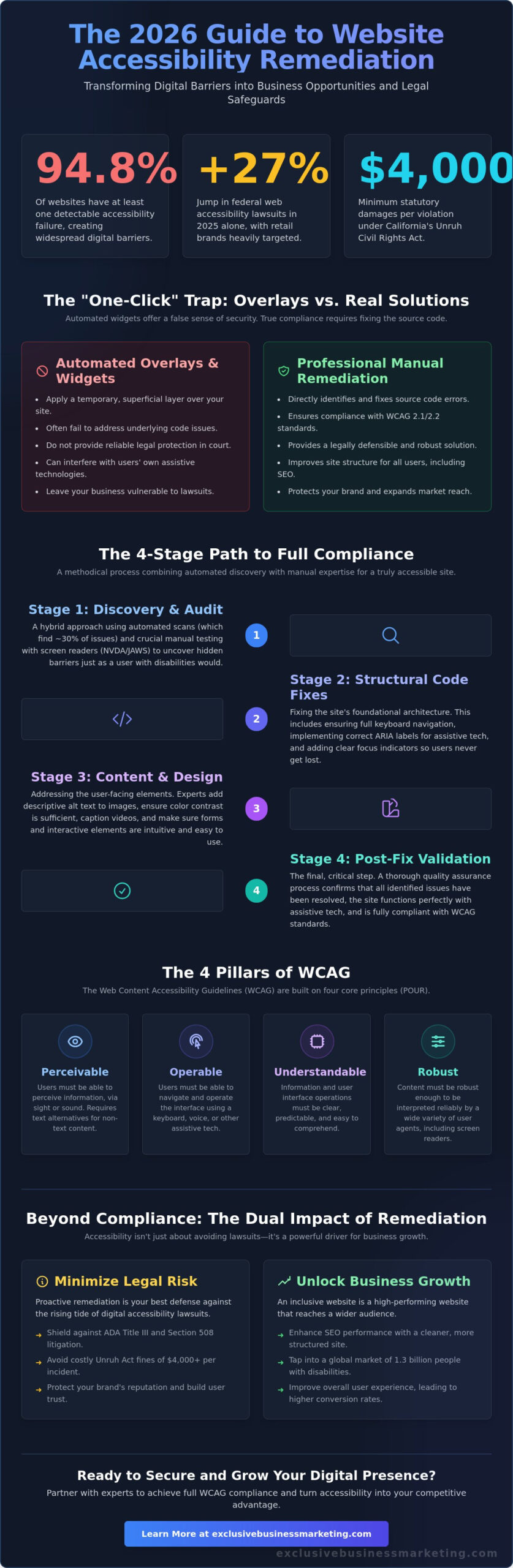
Did you know that 94.8% of websites currently have at least one detectable accessibility failure? In 2025 alone, federal web accessibility lawsuits jumped by 27%, with e-commerce and retail brands bearing the brunt of the litigation. You’re likely feeling the pressure of these rising legal risks and the complexity of the latest WCAG 2.1 Level AA standards. It’s frustrating to realize that “plug and play” overlays often fail to provide real protection, leaving your business vulnerable to the Unruh Civil Rights Act and its minimum $4,000 statutory damages per violation.
We’re here to help you move past the uncertainty. This 2026 guide explains how professional website accessibility remediation services can transform your digital presence into a fully compliant, high-performing asset. You’ll learn how to welcome every user while building a site that’s legally safe and structurally sound. We’ll preview the specific DOJ deadlines for 2026, the essential shift from automated widgets to manual expertise, and how a truly accessible site can significantly enhance your SEO performance and market reach.
Key Takeaways
- Learn the critical difference between identifying digital barriers and performing the actual technical fixes required for full WCAG compliance.
- Discover how professional website accessibility remediation services protect your business by fixing underlying source code instead of relying on temporary, “one-click” overlays.
- Understand the specific legal risks associated with California’s Unruh Civil Rights Act and how to safeguard your brand against the rising tide of digital lawsuits.
- Explore how prioritizing inclusive design improves your site structure, leading to better search engine visibility and higher conversion rates.
- Master a four-stage remediation process that combines automated discovery with manual expertise to ensure your digital assets are truly accessible for every user.
What is Website Accessibility Remediation?
Website accessibility remediation is the intentional process of identifying and removing digital barriers that prevent people with disabilities from using your site. It isn’t a cosmetic update or a quick visual patch. Instead, it’s a structural overhaul that ensures every user, regardless of how they navigate the web, enjoys a seamless experience. For most modern businesses, this involves partnering with professional website accessibility remediation services to align their digital assets with the latest global standards. Legally, this work is essential. Under ADA Title III and Section 508, your website is considered a place of public accommodation. Understanding What is Web Accessibility? is the first step toward avoiding predatory lawsuits and opening your digital doors to the 1.3 billion people globally who live with a disability.
Audit vs. Remediation: Knowing Where You Stand
Think of an accessibility audit as a medical checkup and remediation as the life saving surgery that follows. An audit generates a diagnostic report that lists every failure on your site, from missing alt text to broken keyboard navigation. However, a report alone doesn’t protect you in court or help your users. You need remediation to actually dive into the code and fix those issues. You cannot have a legally defensible site without both phases working in tandem. The Remediation Lifecycle is a continuous process of improvement that ensures your digital environment stays compliant as web technologies and user needs change.
The Core Standards: WCAG 2.2 Explained
The Web Content Accessibility Guidelines (WCAG) are the global gold standards for digital inclusion. They are built on four pillars known as POUR:
- Perceivable: Users must be able to see or hear the content, requiring text alternatives for non-text items.
- Operable: Users must be able to navigate the site via keyboard, voice command, or other assistive tech.
- Understandable: Information and the operation of the user interface must be clear and predictable.
- Robust: The site must work reliably with a wide variety of user agents, including screen readers.
While WCAG 2.1 Level AA is the standard cited in many legal contexts, the transition to WCAG 2.2 in 2026 represents the new best practice for businesses. This version adds stricter requirements for mobile interactions and cognitive accessibility. Expert website accessibility remediation services, such as those provided by 216digital, ensure your images, videos, and complex navigation menus meet these evolving criteria, keeping your brand ahead of both regulators and competitors.
The 4-Stage Website Accessibility Remediation Process
Remediation isn’t a guessing game or a simple cosmetic update. It’s a methodical journey that transforms a legal liability into a high-performing business asset. To achieve true compliance, you need a process that addresses both the visible content and the invisible underlying code. Most professional website accessibility remediation services follow a rigorous four-stage framework to ensure no barrier is left behind. This structured approach moves your site from a state of risk to a state of total inclusivity, providing a robust shield against litigation while improving the experience for every visitor.
Step 1 & 2: Auditing and Structural Code Fixes
The first stage is the discovery phase. While automated scanners are helpful for a quick check, they typically only detect about 30% of accessibility issues. Real protection comes from manual testing. Experts use screen readers like NVDA or JAWS to navigate your site just as a blind or low-vision user would. This reveals hidden obstacles that automated code checks simply cannot find. Once the audit is complete, the focus shifts to technical code remediation. This is the foundation of your site’s architecture. We fix keyboard navigation so users don’t get “stuck” in menus or forms. We also implement clear focus indicators and correct ARIA labels so assistive technologies can interpret your site’s layout accurately. Following the official guidance on the ADA ensures these structural fixes meet federal expectations for digital places of public accommodation.
Step 3 & 4: Content Adjustments and Post-Fix Testing
After the code is secure, we address the user experience through content and design remediation. This phase involves adding descriptive alt text to images, providing accurate video captions, and adjusting color contrast ratios to meet strict WCAG standards. These changes don’t just help users with disabilities; they also improve your overall site structure for better SEO. The final stage is validation. You can’t just assume the fixes worked. A website accessibility consultant performs a “Final Pass” to re-test every element against the original audit findings. This post-fix testing acts as your ultimate defense against future litigation. Ongoing monitoring is equally vital since every new blog post or product page can introduce fresh errors. If you’re ready to secure your digital presence, partnering with an experienced marketing agency ensures your site stays safe, accessible, and high-performing from day one.
Manual Remediation vs. Automated Overlays: The ‘One-Click’ Trap
Many business owners search for a fast, cheap way to handle compliance. They often find accessibility overlays or widgets. These are small JavaScript snippets that you layer over your existing site. On the surface, they promise to fix everything with one click. But there’s a catch. These tools don’t actually modify your underlying source code. They are a temporary mask, not a permanent cure. If you want a site that truly works for everyone, you need professional website accessibility remediation services that address the core foundation of your digital presence. Relying on a script to do the heavy lifting often creates more problems than it solves.
Why Screen Reader Users Hate Overlays
For someone using assistive software, these widgets are often a nightmare. They frequently conflict with the user’s personal settings, creating a “Double Interface” problem. The user has to navigate their own screen reader menu and the website’s overlay menu at the same time. It’s confusing and often breaks the site’s functionality. True accessibility is baked into the code, not slapped on the surface. When you rely on a widget, you’re essentially telling users with disabilities that their experience isn’t worth a real fix. These tools can even block the very assistive technologies they claim to help, leading to a frustrating and exclusionary experience.
Legal Precedents: Lawsuits Against Overlay Users
If you think an overlay protects you from lawyers, think again. In the first half of 2025, 22.64% of web accessibility lawsuits targeted sites that had an accessibility widget or overlay installed. Predatory law firms actually look for these widgets. To them, a visible overlay is a signal that the site’s underlying code is likely broken. The DOJ Guidance on Web Accessibility makes it clear that businesses must provide effective communication and full access. Courts are increasingly finding that these tools are insufficient for ADA compliance. Investing in ADA compliant website design from the start is the only way to ensure your site is legally safe and structurally sound.
California Compliance: Navigating the Unruh Civil Rights Act
California is the primary battleground for digital accessibility. While the federal ADA sets the baseline, the Unruh Civil Rights Act makes the stakes much higher for businesses serving the Golden State. In California, any violation of the ADA is automatically considered a violation of state law. This distinction is critical because the Unruh Act allows plaintiffs to seek statutory damages of a minimum of $4,000 per violation. When you add attorney’s fees to that total, a single non-compliant page becomes an expensive liability. Because of this financial incentive, California consistently ranks as the number one state for website accessibility lawsuits in the country. Proactive website accessibility remediation services are no longer optional for companies that want to avoid these predatory legal costs.
Does Your Website Need to Be ADA Compliant in California?
If your business interacts with California residents, the answer is almost certainly yes. You don’t need a physical office in Los Angeles or San Francisco to be subject to the Unruh Act. If your digital storefront is accessible to CA users, it’s legally classified as a place of public accommodation. By 2026, state-level enforcement has expanded significantly, with small and mid-sized businesses now facing the same level of scrutiny as major corporations. You can find out more about specific triggers in our guide on does my website need to be ada compliant. Staying ahead of these trends requires a structural approach to compliance that goes beyond surface-level fixes.
The Orange County Business Advantage
Local businesses in Huntington Beach and the wider OC area have a unique opportunity to lead in digital inclusion. Partnering with a local SEO agency in Orange County gives you a partner who truly understands the local legal climate. We provide website accessibility remediation services that are tailored to the specific risks OC businesses face. Local experts offer faster response times when you receive a legal demand letter or an audit request. Beyond the legal safety, there’s a massive reputational benefit. When you prioritize accessibility, you signal to the Huntington Beach community that your brand values every customer. It’s a powerful way to build trust and dominate the local market.
Secure your digital future today. Contact our marketing agency for a comprehensive remediation plan that keeps your site legally safe and fully inclusive.
Beyond Compliance: How Remediation Powers Your SEO and Growth
Remediation isn’t just a defensive move to avoid a demand letter. It’s a powerful growth strategy that improves your bottom line. When you invest in website accessibility remediation services, you aren’t just checking a box for your legal team. You’re optimizing your site for a massive, often underserved market. Approximately 1 in 4 Americans live with a disability. If your site isn’t accessible, you’re effectively turning away 25% of your potential customers before they even see your offer. By removing digital barriers, you increase user retention and conversion rates across the board. Inclusive design makes your site easier for everyone to use, which naturally leads to higher revenue and a stronger brand reputation.
The SEO Benefits of an Accessible Site
Google and other search engines prioritize websites that provide a superior user experience. Many of the technical requirements for WCAG compliance directly overlap with SEO best practices. For example, adding descriptive alt text to your images helps screen reader users understand your visuals, but it also tells Google exactly what those images represent. This significantly improves your rankings in image search results. Similarly, using semantic HTML and a clear hierarchy of H-tags helps search engine bots crawl and index your content more efficiently. When your site’s structure is logical and easy to navigate, search engines reward you with better visibility. Mobile-friendliness and accessibility are two sides of the same coin. A site that’s easy to navigate for a user with a motor impairment is also a site that’s easy to use on a smartphone while on the go.
Taking Action with Exclusive Business Marketing
We don’t believe in shortcuts or surface-level patches. Our “No-Stone-Unturned” approach to manual remediation ensures your site is fundamentally sound from the source code up. We integrate these website accessibility remediation services into our broader SEO services in Orange County to give you a competitive edge. This combined strategy protects your brand from predatory lawsuits while simultaneously driving more organic traffic to your pages. We handle the complex technical tasks so you can focus on running your business. You get the peace of mind that comes with full compliance and the tangible growth that comes from a high-performing digital asset.
Don’t wait for a legal challenge to force your hand. Future-proof your business today by making inclusion a core part of your digital strategy. Our team is ready to transform your website into a welcoming, compliant, and high-converting platform. Contact Exclusive Business Marketing now to secure your digital presence and start dominating your local market. We are the reliable partner you need to achieve measurable outcomes and lasting success.
Secure Your Digital Future with Expert Remediation
You’ve seen how relying on automated overlays leaves your brand vulnerable to litigation and alienates your audience. Real protection comes from fixing the underlying code through a methodical, manual process. By prioritizing inclusion, you don’t just dodge legal risks under the Unruh Act; you also unlock significant SEO advantages and reach a wider audience. It is a structural evolution that transforms your website into a high-performing business asset.
As specialists in California Unruh Act compliance, we provide manual testing by accessibility experts to ensure your site is truly safe. Our website accessibility remediation services integrate seamlessly with proven Orange County SEO strategies to drive both legal safety and measurable growth. We manage the complex technical tasks so you can focus on leading your industry with total confidence. Don’t wait for a legal challenge to force your hand when you can proactively build a better experience for every user.
Get Your Free Website Accessibility Audit & Remediation Plan Today
We’re ready to help you build a more inclusive digital world. Let’s start growing your brand together.
Frequently Asked Questions
What is the difference between accessibility auditing and remediation?
Auditing is the diagnostic process of identifying digital barriers, while remediation is the technical work of fixing them. An audit provides a roadmap of failures, but remediation involves the actual coding and content adjustments needed to meet WCAG standards. You need both to transform a report into a legally defensible website.
How long does the website accessibility remediation process typically take?
The timeline depends on the size and complexity of your digital presence. A standard business website might take several weeks to fully update, while large e-commerce platforms with thousands of pages can require several months of structural work. We focus on a methodical approach that ensures every fix is validated without rushing the process.
Are automated accessibility overlays enough to prevent lawsuits in 2026?
No, automated overlays are not a sufficient defense and can actually attract legal scrutiny. Data from 2025 shows that 22.64% of web accessibility lawsuits targeted sites that already had a widget or overlay installed. True compliance requires permanent changes to your source code through professional website accessibility remediation services.
Does the ADA specifically mention websites?
The original text of the ADA does not explicitly mention websites, but the Department of Justice and federal courts interpret Title III to include digital spaces. They view websites as “places of public accommodation” that must be accessible to everyone. This interpretation is the basis for the thousands of digital accessibility lawsuits filed every year.
How much do website accessibility remediation services cost?
Costs are determined by the total number of pages and the technical complexity of your site’s architecture. A site with custom interactive elements or complex forms will require more manual effort than a simple informational layout. We provide customized remediation plans that scale according to the specific needs and risks of your business.
Will remediating my website for accessibility break my current design?
Can I remediate my website myself using free tools?
Free tools are helpful for a basic check, but they only catch approximately 30% of accessibility failures. They cannot simulate the experience of a screen reader user or identify complex logic errors in navigation. Relying on website accessibility remediation services ensures that the other 70% of issues are found and fixed by experts.
What are the most common accessibility issues found during an audit?
The most frequent errors include missing alternative text for images, poor color contrast ratios, and lack of keyboard accessibility. Many sites also fail to provide clear focus indicators or proper heading structures. These barriers make it impossible for users with visual or motor impairments to navigate your content or complete a purchase.