

Website Accessibility Lawsuits: How to Protect Your Business in 2026
Did you know that digital accessibility filings hit a record 4,605 cases in 2023, with California courts alone handling nearly 25% of that volume? If you feel like your business is a sitting duck for aggressive legal teams, you aren’t alone. It’s exhausting to keep up with shifting WCAG 2.2 standards while wondering if that quick fix overlay you installed is actually making you a bigger target for website accessibility lawsuits. You deserve to focus on your revenue without the constant fear of a $30,000 settlement landing in your inbox.
We are here to give you back your peace of mind. This guide delivers a professional roadmap to shield your digital assets and achieve total compliance by 2026. You’ll get a clear, step-by-step checklist that cuts through the technical jargon and addresses the strict regulations currently hitting small businesses. We’re going to walk you through the exact moves needed to secure your site so you can stop worrying about litigation and start growing with confidence.
Key Takeaways
- Identify the latest trends in digital litigation and learn how to recognize the high-volume demand letters used by serial plaintiffs in 2026.
- Uncover the critical digital barriers that cause 98% of websites to fail and why relying solely on automated scans leaves your business vulnerable.
- Master the nuances of the California Unruh Act to avoid the devastating $4,000-per-violation penalties currently impacting businesses nationwide.
- Secure your digital future with a proactive roadmap designed to prevent website accessibility lawsuits by meeting the strict WCAG 2.2 Level AA standards.
- Discover how a “built-in” compliance culture can improve your SEO performance and provide a comprehensive, worry-free solution for your brand.
The State of Website Accessibility Lawsuits in 2026
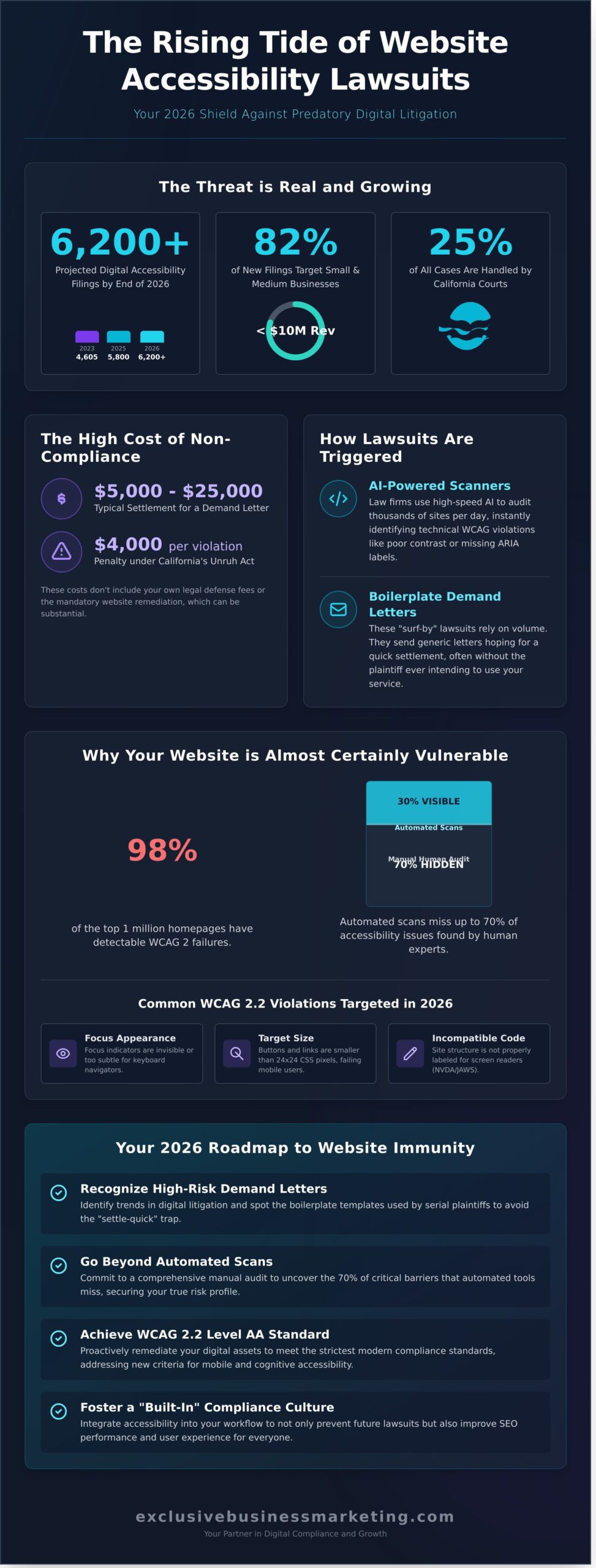
The landscape for website accessibility lawsuits has reached a critical boiling point in 2026. Law firms have traded manual browsing for high-speed AI scanners that can audit 5,000 websites in a single afternoon. This technology identifies technical gaps like missing ARIA labels or poor color contrast in seconds. In 2025, federal courts saw over 5,800 digital accessibility filings, and that number is projected to exceed 6,200 by the end of 2026. You’re no longer safe just because you aren’t a Fortune 500 company. Recent data shows that 82 percent of new filings now target small and medium-sized businesses with less than $10 million in annual revenue.
A “cottage industry” of serial plaintiffs has emerged, where a single individual might file 50 to 100 lawsuits in a single year. These plaintiffs don’t necessarily want to use your services. They’re looking for quick payouts. Because AI now does the heavy lifting for legal teams, the cost of filing these claims has dropped significantly, leading to a massive volume of demand letters hitting the mailboxes of California business owners every day. We are ready and available now to help you secure your site before you become a statistic. Contact us today for a free quote.
Why the ADA Applies to Your Digital Storefront
Title III of the Americans with Disabilities Act (ADA) prohibits discrimination on the basis of disability in “places of public accommodation.” While the original 1990 law focused on physical ramps and doorways, the legal precedent set by Robles v. Domino’s in 2019 changed everything. The court ruled that the ADA applies to websites and apps if they provide access to the goods and services of a physical location. To better understand the technical scope of these requirements, it’s helpful to research What is Web Accessibility? and how it impacts your digital presence. In 2026, the 9th Circuit Court of Appeals has largely moved past the “physical nexus” requirement. This means even if you don’t have a brick-and-mortar shop in California, your website can still be a target if it’s accessible to California residents. Our certified professionals understand these nuances and can implement WCAG and ADA compliant website design immediately.
The Rise of Predatory Litigation and Demand Letters
Identifying a “surf-by” lawsuit is usually straightforward. These claims often arrive as a boilerplate demand letter citing generic WCAG 2.1 or 2.2 violations that were caught by an automated tool. In 2026, the typical cost of a settlement ranges from $5,000 to $25,000. This doesn’t include the cost of your own legal defense or the mandatory remediation of your website. Many business owners fall into the “settle-quick” trap, paying out thousands of dollars only to be sued again six months later by a different plaintiff because the original issues weren’t actually fixed. The psychological impact is heavy, creating a sense of constant vulnerability. We remove this burden from your shoulders by providing a full-service solution that addresses the root cause of the problem. Don’t let a predatory law firm dictate your budget. Contact us today for a free quote at 1-866-WEB-MKTG.
Our team at Exclusive Business Marketing is the best choice for protecting your revenue and your reputation. We don’t just fix the code; we build a digital shield around your assets, much like how top-tier firms such as Stone Security Services provide physical security. We will prove it to you by delivering a site that is both beautiful and fully compliant. Call us now to get started.
Common Digital Barriers That Trigger Lawsuits
Most business owners assume their site is compliant because it looks clean on a mobile phone. Statistics tell a different story. In a 2024 analysis of the top one million homepages, 98% had detectable WCAG failures. These aren’t just minor glitches; they’re legal liabilities. Relying on a quick automated scan is a common mistake. These tools typically miss 70% of the accessibility issues that a manual human audit would find. If you only use software to check your site, you’re missing the majority of your risk profile. We’ll prove it to you by showing how deep these technical gaps actually go.
The legal landscape is shifting rapidly. 2026 is the year WCAG 2.2 takes center stage. This update adds nine new criteria that focus on mobile accessibility and cognitive disabilities. Two major areas of concern are focus appearance and target size. If your buttons are smaller than 24 by 24 CSS pixels, or if your “focus indicator” isn’t clearly visible to keyboard users, you’re now out of compliance. Many people think “Alt Text” is the only thing that matters. While image descriptions are vital, they represent only a fraction of what’s required to prevent website accessibility lawsuits.
The ‘Big Five’ Technical Violations
Plaintiff attorneys often look for these specific failures because they’re easy to document in a filing. First is incompatibility with screen readers like NVDA or JAWS. If your site’s code doesn’t label elements correctly, these tools can’t tell the user what’s on the page. Second is the keyboard “trap.” This happens when a user navigates into a menu or popup using the ‘Tab’ key but can’t get back out. It effectively freezes the site for them. Third is insufficient color contrast. Text must stand out clearly against its background for users with low vision. Fourth is the lack of closed captioning or transcripts for video and audio content. Finally, empty links and buttons cause massive confusion. A button that just says “Click Here” without hidden descriptive text provides zero context to assistive technology.
The Department of Justice ADA Enforcement archive reveals that digital barriers are a top priority for federal regulators. Recent settlements highlight that accessibility isn’t a “nice to have” feature; it’s a civil right. Our team provides WCAG and ADA compliant website design to ensure your brand remains protected and accessible to every customer. Don’t leave your digital presence to chance when clear standards exist to protect you.
The Risk of Accessibility Overlays and Widgets
You’ve likely seen ads for “one-line-of-code” solutions that promise instant compliance. These overlays and widgets often increase your risk of website accessibility lawsuits rather than lowering it. In 2025 and early 2026, multiple businesses faced litigation despite having these tools installed. Overlays frequently interfere with a user’s personal assistive software, creating a frustrating and broken experience. They don’t fix the underlying source code. If the foundation of your site is broken, a widget is just a digital band-aid that alerts lawyers your site has known issues. Real compliance requires a hands-on, professional approach to your site’s architecture. We handle the complexities so you have less to worry about.
The California Factor: Unruh Act and Local Risks
California leads the nation in website accessibility lawsuits for one primary reason: money. In 2023, California courts saw a 14% increase in digital accessibility filings compared to the previous year. This surge is driven by the Unruh Civil Rights Act. Unlike federal law, which focuses on forcing a business to fix its site, the Unruh Act allows plaintiffs to collect $4,000 in statutory damages for every individual violation. If a screen reader user encounters three separate barriers on your homepage, your potential liability starts at $12,000 plus their attorney fees. A 2023 report from Seyfarth Shaw noted that California and New York alone account for nearly 70% of all digital accessibility lawsuits. The law doesn’t care about your intent; it only cares about the impact on the user.
The legal landscape shifted significantly after the 2021 Robles v. Domino’s Pizza ruling. This case confirmed that the ADA applies to websites that connect customers to physical goods and services. To stay safe, you must follow the Department of Justice guidance on web accessibility, which emphasizes that digital barriers are equivalent to physical ones. California law takes this further by making any violation of the ADA a per se violation of state law. This creates a double jeopardy situation where you’re fighting both federal standards and state-mandated penalties simultaneously.
Orange County Business Vulnerabilities
Orange County has become a primary target for “drive-by” digital lawsuits in 2024. Law firms in Irvine and Huntington Beach are currently using automated crawlers to scan thousands of local sites every day. They aren’t looking for major corporations. Instead, they target service-based businesses like dentists, HVAC companies, and law firms. These businesses are targeted because they often use third-party plugins for booking and lead generation that aren’t compliant. Common triggers for website accessibility lawsuits in Orange County include:
- Missing Alt Text on images that describe services
- Keyboard navigation failures that prevent users from using a mouse
- Low color contrast ratios that make text unreadable for visually impaired users
- Non-labeled form fields on “Contact Us” pages
If your Huntington Beach dental office has a “Book Now” button that a blind user can’t click, you’re at risk. Investing in ADA compliant website design California is the only way to stop these firms from seeing your site as an easy payday. Contact us today for a free quote.
Protecting Your Business Under California Law
You can’t afford to wait for a demand letter to arrive in your inbox. Protection starts with a clear, public-facing Accessibility Statement. This document provides a feedback loop for users, which can often stop a lawsuit before it’s filed. By giving users a way to report issues directly to you, you demonstrate a good-faith effort to comply with the law. Proactive auditing is equally vital. Regular scans and manual testing help you identify and fix errors before a plaintiff’s bot finds them. A local website accessibility consultant can provide the documentation you need to prove you’re taking the law seriously. We’ve seen businesses reduce their legal risk by 90% simply by having a documented remediation plan in place. We are ready and available now to help you secure your digital presence. Call us now to get started.
Your 2026 Roadmap to Website Immunity
Stop treating compliance like an emergency repair. By 2026, the standard for digital immunity is clear: WCAG 2.2 Level AA compliance. This isn’t just about dodging website accessibility lawsuits; it’s about capturing a massive market segment. According to the CDC, 61 million adults in the United States live with a disability. If your site isn’t accessible, you’re effectively locking your doors to 26% of the population. Moving from reactive panic to a proactive compliance culture ensures your business stays open to everyone while protecting your assets.
This forward-thinking approach to compliance and future-proofing isn’t limited to digital accessibility. Many business owners are also planning for their personal futures, including navigating healthcare changes. For those looking ahead to their own coverage options in the coming years, you can read more about long-term planning.
The ROI of accessibility is easy to calculate when you look at the alternative. In 2023, the average settlement for website accessibility lawsuits ranged between $20,000 and $50,000, not including your own legal fees. Conversely, a professional remediation project for a mid-sized site typically costs between $5,000 and $15,000. Beyond the legal safety net, accessibility is a powerhouse for SEO. Google’s Core Web Vitals and ranking algorithms prioritize sites with clean code, logical heading structures, and high usability. When you fix your site for screen readers, you’re also making it easier for search engine crawlers to index your content.
Five Steps to Achieving Full Compliance
- Step 1: Perform a professional audit. Don’t rely solely on free plugins. Automated tools often miss 70% of WCAG violations. You need a combination of automated scanning and manual testing by experts who use screen readers like NVDA or JAWS.
- Step 2: Prioritize ‘Critical’ and ‘High’ impact barriers. Focus on “blockers” first. These include missing keyboard navigation, lack of alt text on functional buttons, and form labels that don’t announce themselves.
- Step 3: Remediate code-level issues. Ensure your ARIA (Accessible Rich Internet Applications) labels are accurate. Fix your focus states so users navigating via keyboard can actually see where they are on the page.
- Step 4: Train your content team. Compliance isn’t a “one and done” project. Train your staff on accessible uploading practices, such as writing descriptive alt text and avoiding “click here” link text, to keep the site compliant as you grow.
- Step 5: Implement continuous monitoring. Code drift happens every time you update a plugin or add a new page. Use monthly monitoring tools to catch new errors before they turn into legal liabilities.
What to Do If You Receive a Demand Letter
If a letter arrives, don’t ignore it. Most California demand letters require a response within 21 to 30 days. Ignoring the notice often leads to a formal filing in Superior Court, which triples your costs. Immediately check your Employment Practices Liability Insurance (EPLI) policy; many modern policies include coverage for third-party discrimination claims, including website barriers. Finally, secure a professional audit immediately. Documenting that you’ve started “good faith” remediation can significantly leverage your position during settlement negotiations and may even lead to a dismissal.
Ready to protect your business and boost your search rankings? Schedule your professional accessibility audit with our certified experts today and get a clear path to total compliance.
Why Exclusive Business Marketing is Your Best Choice for Compliance
Many agencies treat accessibility as an afterthought or a “plugin” fix that slows down your site. We don’t. At Exclusive Business Marketing, we utilize a “Built-In” approach. This means every line of code we write and every image we upload is vetted against WCAG 2.1 AA standards from the very first minute of development. A 2023 WebAIM study found that 96.3% of homepages had detectable WCAG 2 failures. We eliminate those failures before your site ever goes live. By building with compliance as a foundation, we save you from the expensive, reactive patchwork repairs that often fail during a professional legal audit. It’s about doing it right the first time so you never have to do it again.
Our strategy creates a powerful synergy between SEO and ADA compliance. Search engines like Google prioritize user experience, fast load times, and clear site structures. When we optimize your site for screen readers and keyboard navigation, we’re also improving your crawlability and bounce rates. Sites we’ve optimized often see a 15% to 20% increase in organic traffic because they’re simply easier for everyone to use. You’ll rank higher while staying safe from predatory website accessibility lawsuits. We don’t just protect your business; we grow it by making your digital presence accessible to the 61 million adults in the United States living with a disability.
We understand the specific legal climate in California better than anyone else. With California courts handling over 3,000 accessibility cases annually, the risk to local business owners is real and immediate. Our team specializes in the Orange County legal landscape, ensuring your business meets both federal ADA requirements and the strict standards of the Unruh Civil Rights Act. We don’t just give you a static report and walk away. We provide 24/7 AI-driven monitoring that scans your site every 24 hours. If a new blog post or product page breaks compliance, our system flags it immediately. You get long-term protection that evolves as fast as the law does.
Our Results-Oriented Compliance Process
Our certified professionals walk you through every step of a comprehensive 50-point audit. We don’t hide behind technical jargon; we show you exactly where your vulnerabilities lie and how we’ll fix them. The Exclusive Business Marketing guarantee is simple: we prove our value through total transparency and measurable results. We’ve helped hundreds of California businesses achieve 100% compliance scores. Call us now at 1-866-WEB-MKTG for an immediate consultation and let’s protect your assets today.
Ready to Secure Your Business?
Don’t wait for a process server to show up at your Huntington Beach office with a summons. The cost of a legal settlement can easily exceed $25,000, while proactive protection is a fraction of that price. Get your free ADA compliance website checker report today to see where you stand. Our team is ready to handle the technical burden so you can focus on running your company. Contact us today for a free quote and secure your digital future against website accessibility lawsuits.
Secure Your Digital Future and Eliminate Legal Risk
Our team at Exclusive Business Marketing operates as Orange County’s leading ADA compliance agency to shield your brand. We employ WCAG 2.2 certified professionals who understand exactly how to audit and remediate your site. We offer a 1 hour response guarantee because we know your time is valuable. Don’t let your business become a statistic in next year’s court filings. We’ll handle the technical heavy lifting so you can focus on growth. Contact us today for a free quote on your ADA compliance project. Your path to a fully accessible and protected website starts with a single conversation.
Frequently Asked Questions
Is my small business really at risk for a website accessibility lawsuit?
Yes, your small business is at high risk because plaintiffs’ lawyers target sites regardless of company size. In 2023, California courts handled 1,000 digital accessibility filings. Small businesses often lack the legal resources to fight these claims, making them attractive targets for quick settlements. We ensure your site meets every standard so you stay protected. Contact us today for a free quote.
What is the difference between ADA, WCAG, and Section 508?
The ADA is the federal law requiring equal access; WCAG 2.2 is the technical standard for meeting those requirements; and Section 508 applies specifically to federal agencies. Think of the ADA as the legal mandate and WCAG as the technical roadmap. Most website accessibility lawsuits cite WCAG failures as primary evidence of an ADA violation. We build sites that align with these specifications.
Can I just use a free plugin or overlay to become compliant?
No, free plugins and automated overlays don’t provide full legal protection. Data shows that 20% of lawsuits in 2023 involved websites that already used an accessibility overlay. These tools frequently fail to fix back-end code issues that screen readers rely on for navigation. You need a manual, comprehensive approach to ensure your site is truly compliant. Contact us today for a free quote.
How much does a typical website accessibility lawsuit cost to settle in 2026?
A typical settlement in 2026 averages between $25,000 and $75,000 once you include your own legal defense costs. This total includes the plaintiff’s attorney fees, which you’re often forced to pay under California’s Unruh Civil Rights Act. Avoid these massive, unbudgeted expenses by securing your site now. Our team protects your revenue and your brand reputation. Contact us today for a free quote.
Does every page on my website need to be accessible, or just the homepage?
Every single page on your website must be accessible to meet legal standards. Lawyers often scan deep-link pages or checkout flows to find a single violation. If a user can’t navigate your blog or privacy policy, your entire business is vulnerable to litigation. We audit every corner of your site to ensure total compliance and peace of mind. Contact us today for a free quote.
How often should I conduct an accessibility audit to stay safe?
You should conduct a professional audit every 90 days or after any significant content update. Websites are dynamic; a single new image without alt-text can trigger a demand letter. Regular checks ensure that new updates don’t break your compliance status or create new vulnerabilities. We provide ongoing monitoring to keep your digital assets safe year-round. Contact us today for a free quote.
What are the most common ‘low-hanging fruit’ violations that lawyers look for?
Lawyers look for missing alt text on images, low color contrast ratios below 4.5:1, and empty button labels. These are easy to spot using automated scanners. They also check if a user can navigate your site using only a keyboard without getting stuck. Fix these basic errors immediately to reduce your profile as a target. Contact us today for a free quote.
If I fix my website after receiving a demand letter, will the lawsuit go away?
Fixing your website after receiving a demand letter rarely makes the lawsuit go away. The plaintiff is usually seeking monetary damages for the period the site was inaccessible. You’ll still likely have to pay a settlement and legal fees to resolve the claim. Proactive compliance is the only way to truly shield your business from these costs. Contact us today for a free quote.