

Does My California Website Need to Be ADA Compliant? The 2026 Business Guide
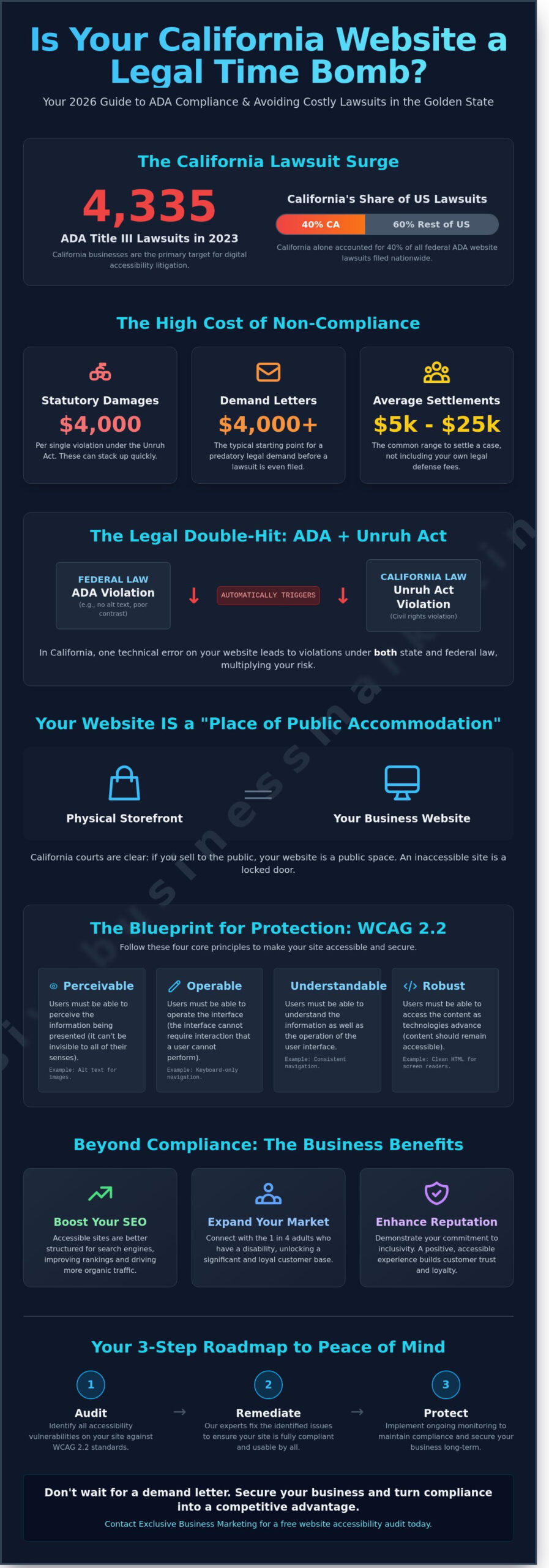
California businesses faced 4,335 ADA Title III lawsuits in 2023 alone, which accounted for 40 percent of all such cases filed in the United States. If you feel like your digital presence is a ticking legal time bomb, you aren’t alone. It’s frustrating to think that a single technical oversight could lead to a $4,000 demand letter or a costly settlement. You want to focus on growing your revenue, not defending your choice of button colors in court. You are likely asking yourself: does my california website need to be ada compliant?
The short answer is yes, but the path to protection is simpler than you think. This 2026 guide reveals the exact legal standards your site must meet to satisfy the Unruh Civil Rights Act and avoid predatory litigation. We promise to show you how to achieve WCAG 2.2 compliance efficiently, ensuring your site is an accessible asset rather than a liability. You will get a step-by-step roadmap to secure your business and gain total peace of mind starting today. We are ready to help you turn these legal requirements into a competitive advantage for your brand.
Key Takeaways
- Understand the critical link between the Unruh Civil Rights Act and federal law to protect your business from the rising wave of predatory accessibility lawsuits.
- Get the definitive answer to “does my california website need to be ada compliant” and learn why the 2026 digital economy defines your site as a place of public accommodation.
- Master the WCAG 2.2 technical blueprint to ensure your website is perceivable, operable, and robust for every potential customer.
- Leverage accessibility as a secret SEO weapon to improve your search rankings and drive more revenue through a more inclusive user experience.
- Implement our high-impact marketing roadmap to audit your digital presence and secure your business against legal and technical vulnerabilities today.
The Legal Reality: Is ADA Compliance Mandatory in California for 2026?
The legal environment for business owners in California has shifted significantly. By 2026, the question isn’t whether you should update your site, but how quickly you can do it to avoid aggressive litigation. If you’re asking, does my california website need to be ada compliant, the answer is an absolute yes. California leads the nation in digital accessibility lawsuits, accounting for 42% of all federal filings in 2023. This isn’t a trend that’s slowing down; it’s the new standard for doing business in the Golden State.
The definition of a “place of public accommodation” has evolved for the 2026 digital economy. It’s no longer limited to physical buildings like a grocery store or a doctor’s office. California courts, specifically through the Unruh Civil Rights Act, view your website as a service of your business. If a user can’t navigate your menu or checkout because of a screen reader error, you’ve effectively locked your front door to them. Federal Title III requirements set the baseline, but California law adds a layer of intense financial risk. Under the Unruh Act, a plaintiff can claim $4,000 in statutory damages for every single instance of discrimination. When you multiply that by a dozen technical errors, the costs skyrocket before you even hire a lawyer.
Doing nothing is a high-risk gamble that rarely pays off. In 2023, 82% of all ADA website lawsuits targeted retail businesses, but service providers are now seeing a surge in demand letters. Whether you’re a small boutique or a large agency, your digital presence is a liability until it meets the Web Content Accessibility Guidelines (WCAG) 2.1 Level AA standards. Settlements for these cases often range between $5,000 and $25,000, excluding your own legal fees. Our team handles the technical heavy lifting so you don’t have to worry about these surprise costs. Contact us today for a free quote to secure your business.
The Shift in DOJ Enforcement
On April 24, 2024, the Department of Justice finalized a new rule under Title II of the ADA. This rule requires state and local governments to ensure their web content and mobile apps are accessible. While Title II technically covers public entities, these standards have immediate consequences for private businesses under Title III. The DOJ’s increased focus means that federal investigators now view digital barriers with the same severity as physical ones. Digital accessibility is a mandatory civil right.
Public vs. Private Sector Requirements
There’s a dangerous misconception that “online only” businesses are exempt from these rules. In California, the courts have been clear. If you sell to the public, you’re a public accommodation. This applies to a surf shop in Huntington Beach just as much as it applies to a national SaaS provider. Even if you don’t have a physical storefront, your website serves the public. California law treats your digital interface as an extension of your business operations. If you haven’t audited your site, you’re leaving yourself open to predatory litigation. We can help you fix this. Call us now to get started.
We understand that the technical side of does my california website need to be ada compliant can feel overwhelming. That’s why we provide a comprehensive solution that brings your site up to 2026 standards quickly. Don’t wait for a process server to show up at your door. Contact us today for a free quote and let our experts protect your revenue and your reputation.
The California Difference: Unruh Act vs. Federal ADA Title III
California business owners face a unique legal environment that sets them apart from the rest of the country. While federal laws apply nationwide, the California Civil Code § 51, known as the Unruh Civil Rights Act, creates a much stricter reality for your digital presence. If you’re asking, “does my california website need to be ada compliant,” the answer is a definitive yes because of how state and federal laws intertwine. The math is simple. Under California law, any violation of the Americans with Disabilities Act (ADA) is considered an automatic violation of the Unruh Act. This means a single technical error on your site isn’t just a federal accessibility issue; it’s a state-level civil rights violation that carries immediate financial weight.
The difference between federal and state enforcement comes down to money. Federal courts typically focus on injunctive relief, which means the court orders you to fix the site. California doesn’t stop there. The state’s legal framework allows plaintiffs to sue for actual damages and, more importantly, statutory damages. This creates a high-stakes environment where a small business can face a lawsuit even if they never intended to exclude anyone. Our team sees these cases daily. We focus on providing a comprehensive solution so you don’t have to worry about these legal technicalities.
Understanding Statutory Damages in CA
In California, the “statutory damages” trap is what makes these lawsuits so expensive. The Unruh Act allows for a $4,000 minimum penalty per occurrence. This isn’t a one-time fine for the whole website. If a user visits your site on three separate occasions and encounters the same barrier, they can argue for $12,000 in damages before legal fees are even calculated. Plaintiffs prefer California courts over federal courts specifically for this reason. In federal court, they can’t get a “payday,” but in California, the cash incentive is built into the law. This creates a massive financial risk for any business with an outdated or non-compliant site.
The Risk of Predatory Litigation
The rise of “surf-by” lawsuits has transformed the legal landscape for local companies. In 2023, California saw more than 2,500 digital accessibility filings, a number that continues to climb as automated scanning tools become more sophisticated. Attorneys in Orange County and Huntington Beach often target small to mid-sized retailers, restaurants, and real estate offices. These firms don’t care about the “spirit of the law” or your commitment to the community. They look for specific technical failures like missing alt-text or keyboard navigation errors. If your site has these flaws, you’re a target. It’s a numbers game for them, but it can be a total financial crisis for you.
This risk is particularly acute in specialized real estate sectors, such as senior care, where the clientele and their families are more likely to rely on accessible technology. For brokerage services that understand the nuances of this industry in California, you can visit Assisted Living Real Estate Group.
You can’t afford to leave your business vulnerable to these predatory tactics. Ensuring your site meets current standards protects your revenue and your reputation. You should check your current compliance status to see where your business stands today and close any gaps before a demand letter arrives. We’ve helped dozens of businesses in Huntington Beach and across the state secure their digital assets. We are ready and available now to help you navigate these complex requirements so you can get back to growing your business.
- $4,000: The minimum statutory damage per violation in California.
- Per Occurrence: Damages can multiply every time a user visits the non-compliant site.
- 2,500+: The number of accessibility lawsuits filed in California in 2023 alone.
- Automatic Violation: Any federal ADA failure is automatically an Unruh Act violation.
WCAG 2.2 Standards: The Technical Blueprint for Compliance
Think of the Web Content Accessibility Guidelines (WCAG) 2.2 as the building code for the internet. Released in October 2023, these standards aren’t just suggestions. They’re the rules that keep your business out of court. If you’re asking, does my california website need to be ada compliant, the answer is found in how well you meet these technical benchmarks. This framework ensures that every user, regardless of their physical or cognitive ability, can access your digital content without barriers.
The system relies on four pillars, often called POUR. Your site must be Perceivable, Operable, Understandable, and Robust. This means users must be able to see or hear your content, navigate your site with ease, follow your instructions, and use the technology of their choice to browse. If any of these pillars crumble, your legal protection disappears. We focus on building a foundation that supports all four pillars so you don’t have to worry about technical gaps.
Level AA is the specific tier you need to hit. It’s widely considered the gold standard for businesses because it covers the most common accessibility barriers without requiring the extreme technical overhauls of Level AAA. You can see how these rules apply to official state resources by reviewing the California Government Accessibility Standards. It’s a high bar, but it’s the only way to truly protect your brand. WCAG 2.2 Level AA is the benchmark used by 99% of legal settlements in 2026. If you fall below this line, you’re essentially inviting a lawsuit.
Don’t fall for the trap of accessibility overlays or quick-fix plugins. These tools are often marketed as a cheap way to achieve compliance, but they fail in practice. Data from 2023 shows that 67% of accessibility lawsuits targeted websites that were already using an overlay. These tools don’t fix your code; they just put a band-aid on a broken leg. Lawyers actually look for these plugins because they signal that a site has known issues that hasn’t been properly addressed. Real compliance happens at the code level, and that’s where we excel.
Perceivable and Operable Content
Perceivability starts with alt-text. Every image on your site needs a description so screen readers can tell a blind user what’s on the page. This matters for the 12 million visually impaired Americans who rely on these tools. Operability means your site must work without a mouse. About 7% of U.S. adults have a motor disability that makes keyboard navigation a necessity. We also ensure a 4.5:1 color contrast ratio so users with low vision can actually read your text against the background.
Understandable and Robust Architecture
Your site’s architecture must be predictable. Navigation shouldn’t change from page to page, and form errors must be clearly identified. If a user misses a field in a contact form, don’t just turn the box red. You need to provide a text-based explanation of the error. A robust site uses clean, valid code that works across all assistive technologies like JAWS and NVDA. We build sites that maintain this compatibility long-term. Contact us today for a free quote to see how we can secure your site’s future.
The Business Case: Why Accessibility Is Your Secret SEO Weapon
Stop viewing digital accessibility as a legal hurdle. It’s actually one of the most effective ways to dominate your local market. When business owners ask, “does my california website need to be ada compliant,” they’re often worried about avoiding a demand letter. While that’s a valid concern, the real story is about growth. According to the CDC, 1 in 4 Americans lives with a disability. That’s 61 million people. If your site isn’t accessible, you’re effectively closing your doors to 26% of the population. No smart business owner ignores a quarter of their potential revenue.
Accessibility and SEO are two sides of the same coin. Google’s search bots are essentially “blind” users. They can’t see your hero image or watch your promotional video. They rely entirely on your code to understand what your page is about. When you use descriptive alt-text for images, you aren’t just helping someone with a screen reader. You’re giving Google specific keywords to index, which improves your performance in image search results. This technical clarity directly correlates with better organic rankings. It’s a win for the user and a win for your bottom line.
Improving your site’s User Experience (UX) for people with disabilities also keeps every visitor on the page longer. A 2023 study showed that sites with superior UX see a 400% increase in conversion rates. Clear navigation, high-contrast text, and logical layouts reduce frustration for every visitor. This lowers your bounce rate and signals to Google that your site is a high-quality destination. The question isn’t just does my california website need to be ada compliant for legal reasons; it’s about whether you can afford to ignore a massive segment of your market.
SEO and Accessibility Synergies
Your site’s structure dictates how both humans and bots perceive your authority. A clean H1-H6 heading hierarchy allows screen readers to jump to specific sections, but it also gives Google a roadmap of your content’s importance. Video content is another huge opportunity. By adding captions and full text transcripts, you allow search engines to index the actual dialogue of your videos. This can increase organic search traffic by 10% because your video content becomes searchable text. Looking ahead, mobile accessibility is set to become an even heavier ranking factor by January 2026. If your buttons are too small for a thumb to click or your site isn’t responsive, your search visibility will suffer.
Brand Loyalty and Social Responsibility
Inclusive design tells the world that your business values every customer. This isn’t just a marketing gimmick; it’s a retention strategy. Data shows that 71% of web users with disabilities will leave a site immediately if it’s difficult to navigate. By making your site easy to use, you capture a loyal audience that your competitors are actively pushing away. Compliance isn’t a one-time cost; it’s a long-term investment. Retrofitting an old, broken site often costs 300% more than doing it right the first time. Contact Exclusive Business Marketing to integrate SEO and ADA compliance into your next build and ensure your site is a lead-generation machine from day one.
Securing Your Digital Presence: The Exclusive Business Marketing Roadmap
You’re probably asking, “does my california website need to be ada compliant” because you’ve seen the 4,605 digital accessibility lawsuits filed in 2023. California remains the primary target for these legal actions. At Exclusive Business Marketing, we’ve developed a foolproof system to shield your business while improving your user experience. We don’t just slap a widget on your site; we rebuild your foundation for long term success.
- Step 1: Professional Accessibility Audit. We conduct a deep dive into your site’s architecture. Automated tools only catch 30% of WCAG failures. Our team performs manual testing to find the other 70% that lawyers look for.
- Step 2: High Impact Remediation. We prioritize fixes that stop users from leaving. This includes fixing broken contact forms, confusing navigation menus, and missing alt text on images. These are the red flags that trigger complaints.
- Step 3: Continuous Monitoring. Websites are living assets. Every time you add a blog post or a new product, you risk falling out of compliance. We implement systems to monitor these changes 24/7.
- Step 4: Accessibility Statement. We help you draft and publish a formal statement. This shows a good faith effort to provide access, which is a critical defense if your site is ever questioned.
A comprehensive digital security plan extends beyond accessibility. It also involves addressing human-related cybersecurity risks, which can lead to equally damaging legal and financial consequences. For businesses looking to build a resilient security culture, training platforms from specialists like AwareGO are an essential component of modern risk management.
Why DIY Compliance Often Fails
Free automated checkers provide a false sense of security. They miss keyboard traps and screen reader errors that only a human can detect. Our Huntington Beach team uses certified professionals to test your site against WCAG 2.1 standards. This manual approach is the only way to build a reliable legal defense. Relying on a cheap plugin often makes your site a bigger target for serial litigants. We do it right the first time so you don’t have to worry about it later. Don’t leave your business’s future to a free tool that misses 7 out of 10 errors. Contact us today for a free quote.
Your Free Compliance Audit Report
When you partner with us, you get more than just a list of errors. Our audit process identifies SEO opportunities hidden within your accessibility gaps. For example, fixing your heading structure helps screen readers and boosts your Google ranking simultaneously. In 2023, 98% of the world’s top one million websites failed basic accessibility tests. We ensure you’re in the elite 2% that get it right. We’ll walk you through the entire process and handle every technical detail. Contact us today for a free quote and compliance audit.
Does my california website need to be ada compliant? Yes, it’s a legal and moral necessity for any business operating in the state. We’re ready to prove our value to you. Our team is available now to start your transformation. Don’t wait for a demand letter to arrive in your inbox. Let us secure your digital presence and drive more revenue to your business starting today. We handle the technical heavy lifting so you can focus on running your company. Contact us today for a free quote.
Secure Your Digital Future Before 2026
California businesses face a unique legal landscape where the Unruh Civil Rights Act makes digital accessibility mandatory. Ignoring these standards puts your company at risk of statutory damages that typically cost between $4,000 and $25,000 per violation. By adopting WCAG 2.2 standards today, you aren’t just avoiding legal fees; you’re opening your doors to the 25% of the U.S. adult population living with a disability. If you’re still wondering, “does my california website need to be ada compliant” as we approach 2026, the answer is a clear yes. Compliance is your secret weapon for better SEO and higher conversion rates.
Our Orange County-based experts specialize in WCAG and ADA compliant design that drives results. We’ve built a proven track record of helping businesses improve visibility while eliminating legal vulnerabilities. As a full-service agency, we manage your entire digital presence, from technical SEO to advanced AI Chatbot installation. Don’t leave your business exposed to unnecessary risk when you can turn accessibility into a competitive advantage. Get Your Free ADA Compliance & SEO Audit Report Today and let’s start building a more inclusive, profitable website together.
Frequently Asked Questions
Is website ADA compliance a legal requirement for small businesses in California?
Yes, California law requires your website to be accessible to all users. Under the Unruh Civil Rights Act, any business operating in the state must provide equal access to its digital services. If you are asking “does my california website need to be ada compliant,” the answer is a firm yes. Courts consistently rule that websites are public accommodations. Contact us today for a free quote to secure your site.
What is the penalty for a non-compliant website in California?
You face a minimum statutory penalty of $4,000 per violation under the Unruh Civil Rights Act. This does not include the plaintiff’s legal fees, which often range from $15,000 to $50,000 per case. In 2023, California saw over 2,500 accessibility lawsuits filed against digital properties. These costs quickly drain your marketing budget and damage your reputation. We help you avoid these expensive legal traps. Call us now to get started.
Can I be sued if my business is only online and has no physical location?
Yes, you can be sued even without a brick and mortar store. California courts clarified in 2020 that web-only businesses must still comply with state civil rights laws. Recent 2024 data shows that 75 percent of digital accessibility lawsuits target companies with under $50 million in annual revenue. Don’t assume your digital-only status protects you from litigation. Contact us today for a free quote on a compliant site.
Do accessibility overlays or plugins make my website ADA compliant?
No, overlays and plugins do not guarantee compliance or legal safety. In 2023, over 600 lawsuits were filed against companies that used these “quick fix” tools. They often interfere with screen readers and fail to address core code issues. You need a custom, manual approach to meet WCAG standards effectively. Our team builds compliance into your site’s foundation to ensure real accessibility. Call 1-866-WEB-MKTG to learn more.
What is the difference between WCAG 2.1 and WCAG 2.2?
WCAG 2.2 is the latest standard released on October 5, 2023. It adds 9 new success criteria that focus on mobile accessibility and users with cognitive disabilities. While WCAG 2.1 is still widely used in legal settlements, moving to 2.2 ensures your site stays ahead of evolving legal requirements. We implement these technical standards to keep your business safe and functional. Contact us today for a free quote.
How much does it cost to make a website ADA compliant in 2026?
In 2026, professional remediation costs typically range from $2,500 to $15,000 depending on your site’s complexity. This investment is significantly lower than the $30,000 average settlement for a single ADA lawsuit. We provide transparent pricing to help you manage your budget while protecting your digital assets. It’s a smart way to drive long term returns for your brand. Call us now for a custom estimate.
Does ADA compliance help my website’s SEO rankings?
Yes, accessibility features directly improve your SEO performance and search visibility. Search engines use over 200 ranking factors, and many overlap with accessibility, such as alt text and clear heading structures. When you ask “does my california website need to be ada compliant,” remember that compliance also boosts your user experience scores. Higher engagement leads to better rankings and more revenue. Contact us today for a free quote.
How often should I audit my website for accessibility issues?
You should perform a comprehensive audit 4 times a year to maintain safety. Website content changes constantly, and new blog posts or products can introduce 10 or more accessibility errors in a single update. Regular quarterly checks ensure you maintain compliance and avoid surprise litigation from aggressive law firms. We offer proactive monitoring to keep your site accessible 365 days a year. Call 1-866-WEB-MKTG to schedule your first audit.