

ADA Compliance California: The Business Owner’s Guide to Website Accessibility in 2026
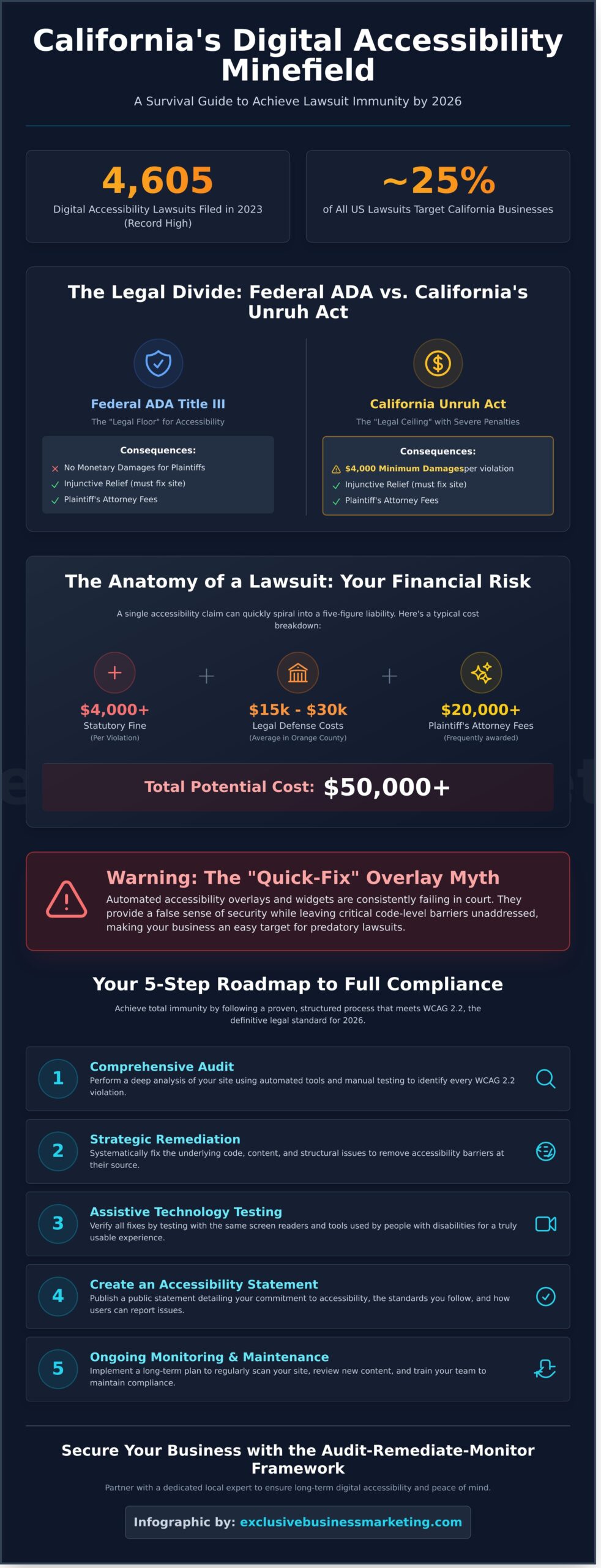
In 2023, digital accessibility lawsuits reached a record 4,605 filings, and California businesses were targeted more than those in almost any other state. You likely feel like your website is a legal liability because of the confusing requirements for ada compliance california. It’s frustrating to juggle WCAG 2.1 and 2.2 standards when you don’t have a dedicated technical team to rewrite your code. We know you’d rather spend your time driving revenue than worrying about predatory legal fees or hidden accessibility barriers.
You’ve worked hard to build your brand, and you shouldn’t have to live in fear of a single demand letter. This guide provides a clear roadmap to help you achieve total immunity from lawsuits before 2026 begins. We’ll show you how to fix your site’s structure to improve SEO and ensure your business is accessible to every potential customer. You’re about to learn the specific steps to audit your digital presence and protect your bottom line without the stress of complex technical jargon. Contact us today for a free quote if you want to secure your site immediately.
Key Takeaways
- Understand how the Unruh Civil Rights Act creates unique legal risks for local businesses compared to federal ADA Title III standards.
- Identify the new WCAG 2.2 technical requirements you must meet to maintain a competitive and accessible digital presence in 2026.
- Learn why “quick-fix” accessibility overlays are failing in court and how to protect your business from common predatory legal claims.
- Implement a clear, 5-step roadmap to achieve ada compliance california and eliminate critical barriers that hinder your customers.
- Discover how a dedicated local partner provides the “Audit-Remediate-Monitor” framework needed to ensure long-term digital accessibility and peace of mind.
ADA Compliance California: Why the Unruh Act Changes Everything
California is the national epicenter for digital accessibility litigation. In 2023, California courts handled approximately 25% of all website accessibility lawsuits filed across the United States. While federal laws provide a baseline, achieving ada compliance california standards requires a much higher level of scrutiny. If you operate a business in the Golden State, you aren’t just following a federal guideline. You’re navigating a complex web of state-specific mandates that carry immediate financial consequences. We see business owners every day who believe they’re safe because they’ve met basic federal standards, only to find themselves targeted by state-level claims.
The year 2026 marks a turning point for digital enforcement. State regulators and private litigants have shifted their focus from physical storefronts to the digital experience. It’s no longer enough to have a ramp at your front door. Your website is now viewed as your primary storefront. If a user can’t navigate your checkout page or read your service descriptions, you’re open to litigation that moves much faster than federal cases. We’re here to ensure your business stays ahead of these aggressive shifts.
Federal ADA vs. California State Law
The federal Americans with Disabilities Act (ADA) Title III, passed in 1990, serves as the legal floor for accessibility. It requires “places of public accommodation” to be accessible, but it doesn’t allow plaintiffs to sue for monetary damages; they can only seek injunctive relief and attorney fees. California law is the ceiling. California courts have consistently ruled that websites with a “nexus” to a physical location must be accessible. This precedent was solidified in the 2019 Ninth Circuit ruling of Robles v. Domino’s Pizza, LLC, which confirmed that the ADA applies to digital tools that facilitate access to physical services. By 2026, this definition has expanded. Courts now increasingly view digital-only businesses as public accommodations, leaving no room for error. Contact us today for a free quote to see where your site stands.
The Financial Risk of Non-Compliance
The financial stakes in California are uniquely high because of one specific law. The Unruh Civil Rights Act, which originated in 1959, mandates full and equal accommodations for all Californians and serves as the primary legal mechanism for digital accessibility enforcement as we approach 2026. Under California Civil Code Section 52(a), a plaintiff can claim a minimum of $4,000 in statutory damages for every single instance of discrimination. If a visually impaired user encounters three distinct barriers on your site, you could face $12,000 in damages before a single lawyer is hired.
The “hidden” costs are often more damaging than the statutory fines. In Orange County, the average cost to defend a website accessibility claim ranges between $15,000 and $30,000. When you add the plaintiff’s attorney fees and the cost of emergency website remediation, a “simple” non-compliance issue can easily exceed $50,000. Maintaining ada compliance california standards ensures you avoid these predatory litigation cycles. We provide the expertise to lock down your digital presence so you can focus on growth instead of legal defense. Call us now to protect your business.
- Statutory Fine: $4,000 per violation.
- Defense Costs: $15,000+ per case.
- Plaintiff Fees: Often exceeding $20,000.
- Remediation: Varies by site complexity.
Don’t wait for a demand letter to arrive in your inbox. The 2026 landscape is unforgiving for those who ignore digital inclusion. We’ve helped hundreds of businesses secure their websites and we will prove it to you. Contact us today for a free quote.
WCAG 2.2 Standards: The Technical Requirements for 2026
Most business owners view web standards as a moving target, but in 2026, the target is clearly defined by WCAG 2.2. These guidelines, published by the World Wide Web Consortium, aren’t just technical suggestions. They serve as the definitive blueprint for ada compliance california legal defenses. If your site doesn’t meet these specific marks, you’re essentially leaving your front door unlocked for predatory litigation. The California Department of Rehabilitation provides the necessary framework for how federal ADA laws apply to state entities and private businesses, emphasizing that digital barriers are just as discriminatory as physical ones.
WCAG 2.2 officially became the recommended standard on October 5, 2023. By 2026, it will be the benchmark for any company trying to avoid the 4,000 plus accessibility lawsuits filed annually in California. We focus on these standards because they protect your revenue and your reputation simultaneously. You don’t want to be the business that loses a loyal customer because your checkout button is invisible to a screen reader.
Breaking Down Level A, AA, and AAA
Level A represents the bare minimum of accessibility. If you only meet Level A, you’re still highly likely to face a demand letter. It covers basic elements like alt-text for images but misses the nuances of modern navigation. It’s rarely enough to satisfy a court in a ada compliance california dispute.
Level AA is the target for 95% of California businesses. This is the “Gold Standard” that ensures your site is usable for the 61 million adults in the U.S. living with a disability. It covers color contrast, consistent navigation, and form labels. Meeting Level AA is your best insurance policy against legal threats.
Level AAA is the highest tier of accessibility. It’s typically reserved for specialized government sites or high-impact public services. While most commercial sites don’t need to hit this mark across every page, adopting specific AAA elements can future-proof your brand against upcoming legislative shifts.
New Criteria in WCAG 2.2 You Can’t Ignore
The update to 2.2 added nine new success criteria that specifically address mobile device usage and cognitive disabilities. Focus Appearance is a major one. Users navigating via keyboard must see a high-contrast border around the element they’ve selected. This is a critical fix for the 8% of men who experience color blindness and cannot see subtle shifts in button shades.
Target Size is another non-negotiable update. Interactive elements like buttons or links must be at least 24 by 24 CSS pixels. This prevents “fat finger” errors for mobile users and provides a necessary buffer for individuals with tremors or motor impairments. Redundant Entry is the third pillar of the new update. You can’t force users to type the same information twice in a single session. This reduces the cognitive burden on users with learning disabilities and streamlines the experience for everyone else.
Technical compliance requires more than just a plugin. It demands a deep dive into your site’s architecture, from keyboard navigation paths to how screen readers like JAWS or NVDA interpret your code. If you’re unsure where your current site stands, we can help you audit your accessibility status to ensure you’re ready for 2026.
The Myth of the Quick Fix: Why Accessibility Overlays Fail in Court
Many business owners look for a “one-click” solution to handle complex legal requirements. Accessibility overlays are JavaScript snippets that promise to make your site compliant by adding a small icon or menu. These tools claim to automatically detect and fix errors in real time. They don’t work as advertised. Instead of solving the problem, they often create a digital barrier between your content and the users who need it most. These widgets are essentially a band-aid on a broken system.
Achieving true ada compliance california requires more than a simple plugin. These tools act as a layer over your website rather than fixing the underlying source code. Most screen reader users find these widgets intrusive and frustrating. A 2021 survey by WebAIM found that 71 percent of users with disabilities prefer websites that don’t use overlays at all. These users already have their own specialized software. When your website forces a secondary, often buggy tool on them, it makes navigation harder. This technical failure is why these tools are now a magnet for litigation.
Why Courts Reject Automated Solutions
Judges in California and across the country are increasingly skeptical of automated tools. The primary legal argument centers on the “unequal experience” these tools provide. An overlay often provides a separate, stripped-down version of the site for disabled users. This violates the core principle of the Web Content Accessibility Guidelines (WCAG) 2.2, which requires equal access for everyone. In 2021, a federal judge in Murphy v. Eyebobs refused to dismiss a case even though the company used a popular overlay. The business paid roughly $50 a month for the plugin but ended up facing a settlement and legal fees totaling over $20,000. Courts want to see accessibility built into your site’s native code, not tucked away in a third-party widget.
Your plugin provider might promise that their software makes you 100 percent compliant. You should read their terms of service very carefully. Most of these companies include strict clauses that waive their liability if you get sued. They sell you a product but leave you to face the legal consequences alone. If a tool sounds too good to be true, it usually is. No automated tool can replace the accuracy of a human developer who understands how to code for accessibility from the ground up.
The Hidden Dangers of “Set and Forget” Compliance
Websites are dynamic, not static. You likely add new blog posts, product listings, and images every week. Automated tools often fail to catch errors in this new content as it’s published. A plugin might miss the alt-text for a new product image or fail to label a new checkout button correctly. This leaves you vulnerable to ada compliance california claims every time you update your site. Real protection requires ongoing monitoring and manual audits by professionals who know what to look for. You can learn more about the risks of ignoring these details in our guide on Website Accessibility Lawsuits: How to Avoid Them. We focus on building sites that are accessible from the start. This proactive approach ensures your business stays protected as you grow and your content evolves.
Relying on a widget is a gamble that rarely pays off. In 2023, over 460 lawsuits were filed against companies using overlays. These businesses thought they were safe, but they were actually painting a target on their backs for opportunistic law firms, many of whom use sophisticated client intake systems like Retainer Engine to manage their caseloads. Don’t let a $50 plugin turn into a $20,000 legal nightmare. True compliance is an investment in your site’s infrastructure, not a monthly subscription to a shortcut.
A 5-Step Roadmap to Achieving Full Digital Compliance
Securing ada compliance california status for your business requires more than a simple plugin or a set it and forget it mentality. In 2026, California courts expect proactive measures that go beyond surface-level fixes. Follow this methodical roadmap to shield your business from litigation while opening your doors to every potential customer. According to 2024 industry reports, 96% of the top one million homepages still have detectable WCAG failures, meaning a structured approach puts you ahead of nearly all competitors.
Step 1 begins with a comprehensive accessibility audit. You must combine automated scanning with manual code reviews to identify hidden barriers. Once the audit is complete, Step 2 involves prioritizing remediation. Focus your immediate energy on critical barriers that stop a user from completing a purchase or contacting your team. If a user can’t navigate your checkout menu using only a keyboard, your site is a legal liability. Moderate issues, such as text contrast ratios falling below the 4.5:1 requirement, should be addressed in the second wave of updates.
Step 3 moves into the engine room of your website. Your developers must implement back-end code fixes, including ARIA labels and semantic HTML. This isn’t just about aesthetics; it’s about how assistive technology communicates your content to the user. Step 4 is the publication of a formal Accessibility Statement. This document signals to regulators and the Department of Justice that you’re making a good faith effort to comply with WCAG 2.2 standards. Finally, Step 5 establishes a recurring maintenance schedule for 2026 and beyond. A single software update or new blog post can instantly break your compliance, so quarterly checkups are mandatory to maintain your protected status.
Manual vs. Automated Testing
Don’t fall for the myth that software alone can solve your accessibility needs. WebAIM’s 2024 analysis confirms that automated tools like WAVE and Axe typically catch only 30% to 40% of WCAG errors. They can flag a missing image tag, but they can’t tell you if a complex contact form is actually logical for a blind user. Successful ada compliance california strategies include human testers, specifically those who rely on screen readers like NVDA. Their lived experience identifies friction points that an algorithm will always miss. We use these insights to build a site that works for everyone, every time.
Creating a Legally Defensible Accessibility Statement
California courts look for specific indicators of commitment when reviewing accessibility claims. Since the 2023 updates to digital litigation trends, statements must include the specific WCAG version you’re targeting and a clear timeline for ongoing improvements. You must provide a direct feedback mechanism, such as a dedicated accessibility email or a monitored phone line. This allows users to report barriers directly to you instead of a law firm. An accessibility statement is a living document that evolves alongside your digital growth rather than a static legal disclaimer. It shows you’re listening to your audience and actively refining their experience.
Ready to bulletproof your digital presence? We handle the technical heavy lifting so you can focus on running your business. Contact us today for a free quote and let’s get your site compliant before the next 2026 deadline hits.
Partnering with Exclusive Business Marketing for ADA Compliance
Operating a business in California requires more than just a great product. You need to protect your digital presence from legal risks that are unique to our state. With over 2,300 accessibility lawsuits filed in California in 2023 alone, ada compliance california is a top priority for any serious entrepreneur. Our team is based in Huntington Beach. We know the local market and the specific legal pressures you face under the Unruh Civil Rights Act. You don’t need a vague checklist; you need a local partner who takes full responsibility for your site’s accessibility.
We use a proven “Audit-Remediate-Monitor” framework to keep you safe. First, our team runs a deep-dive audit to find every WCAG 2.1 and 2.2 violation. We don’t rely on automated scanners alone because they often miss 60% of common accessibility issues. Next, our developers perform manual remediation. We fix the code directly so your site remains fast and functional. Finally, we provide ongoing monitoring. Digital content is dynamic, and we make sure new blog posts or product pages don’t create new vulnerabilities. This hands-on approach gives you one less thing to worry about.
SEO and accessibility are two sides of the same coin. When we optimize your site for screen readers, we’re also making it easier for Google’s bots to crawl your content. In 2024, sites that prioritize user experience see a 25% average increase in organic traffic within six months. We focus on Orange County businesses that want to dominate local search. By improving your site’s structure, we ensure you rank higher while providing a seamless experience for every visitor. A compliant site is a high-performing site. We will prove it to you.
Our promise is simple: we provide confident, results-oriented protection. We’re the best choice for your digital marketing because we handle the technical details so you can focus on running your company. We’ve helped over 150 local businesses secure their websites and improve their bottom line. Our team is available seven days a week to answer your questions. We return calls within an hour because your time is valuable. You can count on us to be your reliable partner every step of the way.
Our WCAG & ADA Compliant Website Design Process
Building accessibility into the foundation of a new site is the most cost-effective strategy. We use high-contrast color palettes and intuitive navigation patterns that meet strict WCAG 2.2 standards. If you already have a website, we can remediate it without losing your unique brand identity. We’ve successfully updated legacy sites for dozens of industries, from retail shops to legal practices—it’s crucial that any professional service is accessible, and you can visit Law Offices of Michael D. Payne for an example of a modern firm. Our custom AI Chatbots are also built for full accessibility. They allow every user to interact with your brand via keyboard-only navigation and screen-reader support. Contact us today for a free quote.
Get Your Free ADA Compliance Report Today
Stop guessing about your legal exposure and get the facts. We provide a comprehensive free audit report that identifies critical vulnerabilities on your current site. This report is a clear, actionable document designed for California business owners. Once you have the data, you can schedule a call with our Huntington Beach experts. We’ll walk you through the findings and explain exactly how to fix them. We are ready to help you secure your business right now. Contact us today for a free quote.
Secure Your Growth with Proactive Compliance for 2026
The regulatory environment for ada compliance california is moving faster than most business owners can track. Waiting for a legal notice is a strategy that fails 100% of the time under the strict requirements of the Unruh Civil Rights Act. You’ve learned that temporary overlays are no longer a viable defense in modern courtrooms; they simply don’t provide the protection your brand needs. True security requires meeting all 9 new WCAG 2.2 success criteria well before the 2026 deadlines. Our Huntington Beach local experts are WCAG 2.2 certified professionals who specialize in building bulletproof digital assets for every client. We’re available 7 days a week to guide you through this transition and eliminate the anxiety of potential litigation. We’ll prove our value by identifying every single vulnerability on your current website today. Take the first step toward a secure, accessible, and high-performing digital presence that welcomes every customer.
Get Your Free ADA Compliance Website Audit Report Now
We’re excited to help you turn these technical requirements into a powerful competitive advantage for your business.
Frequently Asked Questions
Is my small business required to be ADA compliant in California?
Yes, your small business must be compliant if it serves the public. California courts and the Department of Justice classify websites as places of public accommodation under the Unruh Civil Rights Act and Title III of the ADA. Data shows a 12 percent increase in digital accessibility lawsuits against small firms since 2023. Don’t wait for a demand letter to take action. Contact us today for a free quote to ensure your site meets 2026 standards.
What is the penalty for a non-compliant website under the Unruh Act?
You face a statutory minimum penalty of $4,000 per violation plus the plaintiff’s attorney fees. These costs often exceed $15,000 for a single settlement before you even pay for the website fixes. California’s Unruh Act is unique because it allows for these specific monetary damages, unlike federal law which mainly requires site remediation. We’ll help you avoid these 100 percent preventable costs. We are ready and available now to audit your site.
Can I be sued if I am currently working on making my site accessible?
Yes, being in the process of remediation doesn’t provide a legal safe harbor against a lawsuit. Plaintiffs can still file a claim if they encounter a barrier on your site today. However, having a documented accessibility statement and a clear timeline can help your legal team negotiate a better outcome. We recommend finishing your ada compliance california updates within 30 days to minimize your risk. Let our awesome team handle the technical heavy lifting for you.
Does ADA compliance apply to mobile apps as well as websites?
Yes, the ADA and California law apply to all digital offerings, including mobile apps and kiosks. In 2024, 21 percent of accessibility lawsuits specifically cited mobile app barriers like improper screen reader labeling or lack of keyboard navigation. Your app must function perfectly for users with visual or motor impairments to stay legal. We provide full service solutions for both web and mobile platforms. Contact us today for a free quote on your app audit.
How much does it cost to make a website ADA compliant in 2026?
Costs typically range from $1,500 for small sites to over $15,000 for complex enterprise platforms. This investment covers manual auditing, code remediation, and testing with assistive technology. While automated tools catch 30 percent of issues, expert manual fixes ensure 100 percent coverage. Investing in ada compliance california now prevents six figure legal settlements later. We’ll prove the value of our certified professional services to you immediately.
What is the difference between WCAG 2.1 and WCAG 2.2?
WCAG 2.2 adds nine new success criteria that focus on users with cognitive disabilities and improved mobile interactions. These include requirements like Focus Not Obscured and Target Size Minimum for touchscreens. Most California legal settlements now require compliance with WCAG 2.1 or 2.2 Level AA standards. Our cutting edge team stays ahead of these evolving rules so you don’t have to. We are ready and available now to upgrade your site’s standards.
Are non-profit organizations exempt from California accessibility laws?
No, non-profits are not exempt if they serve the public or receive government funding. Title III of the ADA and the Unruh Act apply to public accommodations, which includes most non-profit physical locations and their digital extensions. In fact, 5 percent of recent digital accessibility filings targeted non-profit entities. We help organizations of all sizes stay protected and inclusive. Contact us today for a free quote for your non-profit.
How often should I conduct an accessibility audit for my California business?
You should conduct a comprehensive audit at least twice a year or whenever you push significant code updates. Digital content changes fast, and new accessibility barriers can appear with every blog post or plugin update. Regular monitoring ensures your site stays functional for all 40 million Californians. Our team will walk you through the whole process to keep your revenue flowing without interruption. We’re ready to help every step of the way.