

The Real Cost of a Website Accessibility Lawsuit in 2026: A Financial Breakdown
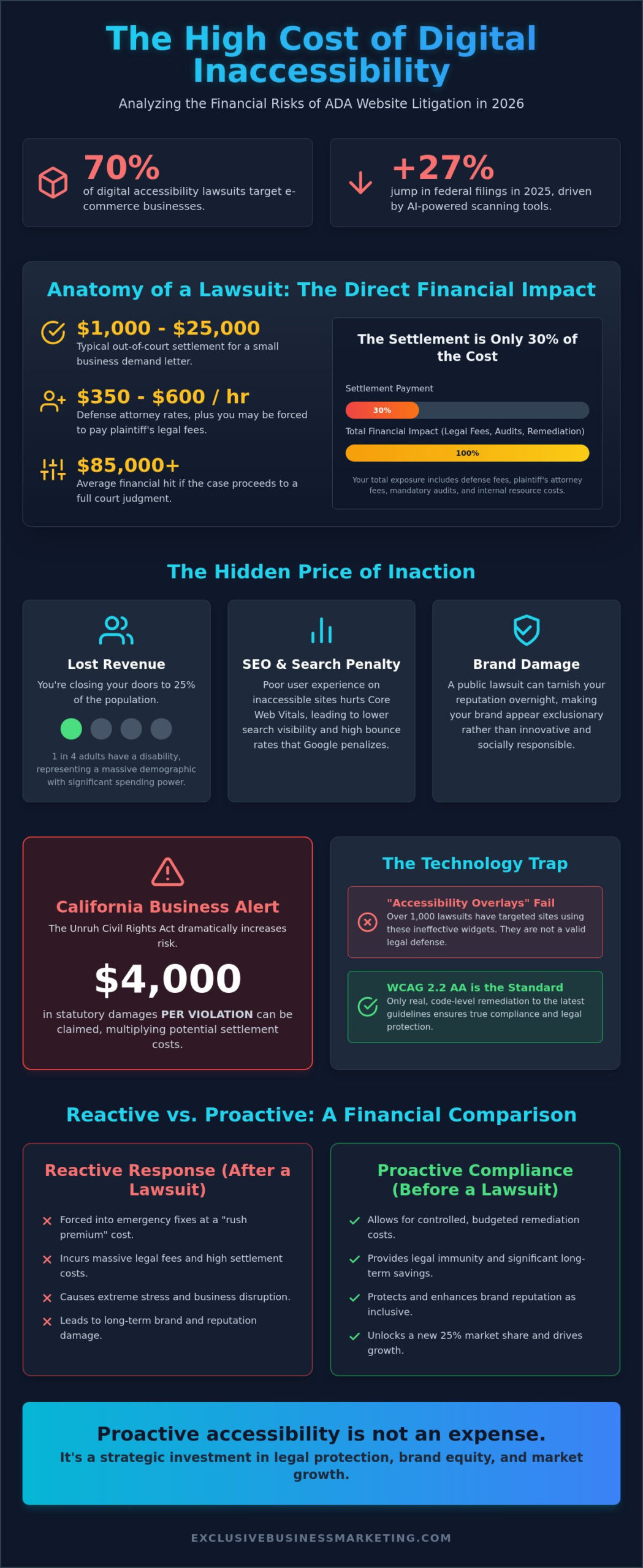
Did you know that 70% of all digital accessibility lawsuits in 2025 targeted e-commerce businesses, with federal filings jumping by 27%? If you’ve just received a notification, you’re likely frantically searching for how to respond to an ADA demand letter while staring at a potential $30,000 settlement. It feels like you’ve been targeted by a serial litigant using AI to scan for minor WCAG errors, and the anxiety of an unpredictable five-figure legal bill is enough to keep any business owner awake at night.
We understand that the technical requirements of WCAG 2.1 AA feel like a moving target, especially when you’re focused on scaling your brand. This article breaks down the direct and hidden expenses of ADA website litigation in 2026, proving why proactive compliance saves your business six figures over the long term. You’ll gain a clear understanding of the financial risks, a solid justification for your remediation budget, and a step-by-step roadmap to achieving legal immunity. It’s time to stop worrying about predatory lawsuits and start building a more accessible, profitable digital presence.
Key Takeaways
- Learn the immediate financial impact of litigation and the essential steps for how to respond to an ADA demand letter to minimize settlement costs.
- Discover how website accessibility failures hurt your bottom line through lost revenue and poor SEO rankings.
- Understand the specific legal risks facing California businesses, including the $4,000 statutory damage rule under the Unruh Civil Rights Act.
- Compare the high “rush premium” of reactive fixes against the long-term savings of a proactive, compliant design strategy.
- Identify how professional audit reports and compliant web design protect your brand while driving tangible business growth.
Breaking Down the Direct Costs of an ADA Website Lawsuit
Receiving a formal legal notice is a high-stress moment for any business owner. It’s usually the first time you’ve had to consider the technical debt of your digital presence. Knowing exactly how to respond to an ADA demand letter is the difference between a controlled resolution and a financial tailspin. In 2026, the initial demand letter phase alone requires immediate capital for legal consultations. You aren’t just paying for a response; you’re paying for a defense strategy to prevent a single letter from turning into a full-scale federal case.
Settlement ranges in 2026 have shifted as litigation becomes more automated. For small businesses, out-of-court settlements typically land between $1,000 and $25,000. Mid-market companies often face much higher demands. If a case proceeds to a court judgment, the financial hit averages $85,000. You must also account for plaintiff attorney fee-shifting. In most ADA cases, the defendant is responsible for paying the legal fees of the person suing them. This creates a lopsided battle where you’re essentially funding both sides of the litigation while your own legal bills continue to climb.
Settlement Fees vs. Total Legal Exposure
Don’t make the mistake of thinking the settlement check is your only expense. Experience shows that the settlement itself is often only 30% of the total financial impact. You’ll face defense attorney rates that typically range from $350 to $600 per hour. These hours add up quickly during discovery and negotiation. Additionally, many settlement agreements now include mandatory monitoring requirements. You may be legally forced to pay for third-party accessibility audits every six months for several years. This ensures you remain compliant, but it adds a recurring line item to your budget that didn’t exist before the lawsuit.
The 2026 WCAG 2.2 Standard Impact
The technical landscape has evolved, making older websites more vulnerable than ever. The Web Content Accessibility Guidelines (WCAG) 2.2 AA is now the recognized legal benchmark for digital accessibility. This update introduced new requirements for focus appearance and dragging movements, expanding the surface area for potential violations. Many businesses previously relied on “accessibility overlays” or widgets as a quick fix. These are no longer a valid legal defense. In fact, over 1,000 lawsuits recently targeted websites specifically because they used these ineffective tools. Real, code-level remediation is the only way to secure your business against AI-driven litigation bots that scan for these specific WCAG 2.2 failures.
The Hidden Price of Inaction: Indirect Costs and Business Disruption
Receiving a legal notice isn’t just a line item on your balance sheet; it’s a total business disruption. While you search for how to respond to an ADA demand letter, your growth strategy often grinds to a halt. The indirect costs are silent but devastating. You lose market share, damage your search engine rankings, and drain internal resources that should be focused on sales. Diversion of your top talent to manage a legal crisis is a massive opportunity cost that few businesses calculate correctly.
Consider the ‘Purple Pound.’ Data from 2026 confirms that 1-in-4 adults live with a disability. If your e-commerce site is inaccessible, you’re effectively closing your doors to 25% of the population. This isn’t just about avoiding a lawsuit. It’s about capturing a massive demographic with significant spending power. An inaccessible site is a leaky bucket for your marketing budget. You’re spending money to drive traffic to a site that refuses to let people buy.
Beyond the immediate legal fees, inaction creates a technical SEO penalty. Google’s algorithms increasingly prioritize user experience and inclusivity. Sites that fail to meet basic accessibility standards often struggle with Core Web Vitals, leading to lower search visibility. To understand how these factors influence your local reach, review our orange county seo guide. High bounce rates are common when users with motor impairments can’t navigate your site via keyboard. This signal tells search engines your content isn’t valuable, pushing you down the rankings.
The brand damage is equally significant. In 2026, consumers are more conscious of corporate social responsibility. A public lawsuit can tarnish your reputation overnight, making you look exclusionary rather than innovative. It’s far more effective to secure a professional accessibility audit before a litigant forces your hand.
The Opportunity Cost of an Inaccessible Site
When a user with visual impairments hits a site with missing alt-text or poorly labeled forms, they leave immediately. This isn’t just a lost click; it’s a lost customer for life. The official DOJ guidance on web accessibility makes it clear that digital spaces must be as open as physical ones. Businesses that ignore this guidance face massive traffic drops that no amount of PPC spending can fix. Keyboard navigation is a critical benchmark. If a user can’t browse your products without a mouse, your conversion rate will suffer.
Impact on Insurance and Financing
Ongoing litigation or a history of demand letters can cause your business liability insurance premiums to skyrocket. Insurers now view digital inaccessibility as a high-risk liability. Additionally, if you’re planning an exit or seeking venture capital, your digital compliance will be scrutinized during due diligence. An unresolved ADA issue can stall a merger or lower your business valuation significantly; firms like Stewart Accounting Services advise business owners to mitigate these risks through proper risk management and documentation. Drive-by lawsuits are designed to exploit these vulnerabilities, often stalling your marketing momentum for months while you scramble to fix code under pressure.
The California Factor: Why Orange County Businesses Face Higher Risks
California isn’t just a beautiful place to do business; it’s the most litigious environment in the country for digital accessibility. While federal law focuses on injunctive relief, the California Unruh Civil Rights Act adds a layer of financial penalty that makes every mistake expensive. If you’re trying to figure out how to respond to an ADA demand letter in Orange County, you’re dealing with a state law that allows plaintiffs to recover $4,000 for each violation. This per-violation rule is why a single inaccessible website often results in a massive settlement demand before you even step into a courtroom.
Huntington Beach and the surrounding coastal cities have become primary targets for serial litigants. These individuals often file hundreds of lawsuits annually, specifically targeting retail and service-based businesses that lack a local website accessibility consultant to verify their code. Being based in a litigation hotspot means your site is likely being scanned by automated tools right now. You need more than just a generic fix. You need a strategy that stands up to the specific scrutiny of California judges who are well-versed in these digital disputes.
Understanding the Unruh Civil Rights Act
The Unruh Act is fundamentally different from federal ADA Title III. Under federal law, a plaintiff typically only wins an order for you to fix the site and payment of their legal fees. In California, however, the law guarantees statutory damages regardless of your intent. You don’t have to mean to exclude someone to be liable for thousands of dollars in damages. This lack of an intent requirement has led to a surge in serial plaintiffs targeting OC businesses. They look for easy wins where technical WCAG failures are obvious, knowing that California law favors the plaintiff in almost every digital encounter. It’s a predatory system, but it’s the reality of the 2026 legal climate.
California-Specific Compliance Requirements
Your compliance strategy must also consider the intersection of accessibility and privacy laws like the CCPA and CPRA. Many ready-made website templates claim to be accessible but fail to meet the rigorous standards required by California legal scrutiny. These templates often lack the deep integration needed for assistive technologies to function correctly across all pages. Don’t leave your business vulnerable to a drive-by lawsuit. You can start protecting your brand today by reviewing our ADA compliant website design guide for a clear path to immunity. We focus on identifying these regional vulnerabilities before they are exploited by opportunistic legal teams.
Reactive vs. Proactive: A Financial Cost-Benefit Analysis
Waiting for a legal notice is the most expensive way to manage your digital infrastructure. When a business is forced to learn how to respond to an ADA demand letter under the pressure of a tight legal deadline, they inevitably pay a “rush premium.” This reactive remediation typically costs 3 to 5 times more than a planned, proactive design. You aren’t just paying for the code; you’re paying for the developer’s overtime and the legal team’s oversight of the fix. Proactive sites are easier and significantly cheaper to update because accessibility is baked into the foundation rather than duct-taped on later.
Legal immunity is a powerful competitive advantage in 2026. While your competitors are distracted by five-figure legal bills and frantic remediation, you can focus on growth and market expansion. The ROI of accessibility is clear: the cost of a professional defense far outweighs the investment in a comprehensive audit. A site that is accessible from day one serves a wider audience and projects a brand image of high quality and modern methodology.
The Math of Proactive Compliance
Contrast the predictable cost of an annual audit with the minimum $15,000 cost of a standard settlement. Investing in ADA compliant website design significantly reduces technical debt, making future updates faster and cheaper. Proactive fixes allow for better UX and higher conversion rates by ensuring every visitor can navigate your sales funnel without friction. It’s a strategic move that transforms a legal necessity into a marketing asset.
The Myth of the Quick Fix Overlay
Accessibility widgets and overlays are a trap. In 2026, these tools actually increase your legal risk because they signal to litigants that you’re aware of accessibility issues but chose a shortcut. When an overlay fails a court-ordered audit, you’re forced to pay for custom development anyway, effectively paying for the work twice. Custom development is the only true once and done solution that provides permanent immunity and a worry-free experience for your users. Stop gambling with your business’s future and contact our expert team for a compliant website design today.
Strategic Protection: Securing Your Business with Exclusive Business Marketing
Receiving a legal notice is a wake-up call, but it doesn’t have to be a disaster. If you’re currently researching how to respond to an ADA demand letter, you need more than just legal counsel; you need a technical partner who can close the gaps litigants exploit. Our Huntington Beach team specializes in identifying these specific vulnerabilities before they turn into costly settlements. We don’t just patch errors. We integrate WCAG compliance into a high-performance marketing strategy that protects your brand and boosts your bottom line. Our goal is to transform your digital presence into a fortress that resists litigation while simultaneously driving growth.
Our approach is methodical and fast-paced. We recognize that every day your site remains non-compliant is a day you’re exposed to risk. We take the operational burden off your shoulders by managing the complex technical tasks required for digital accessibility. This allows you to stay focused on your core business operations while we secure your digital assets. We build websites that don’t just meet a legal checklist; they provide a superior user experience for every visitor, which is the ultimate defense against predatory lawsuits.
Why Local Expertise Matters for Compliance
Operating in a litigation hotspot like Southern California requires a partner who understands the nuances of the regional legal climate. We combine our deep technical expertise with SEO services in Orange County to ensure your accessible site also dominates local search results. This dual focus means your investment in compliance also serves as an investment in your market visibility. We are a hands-on, customer-centric agency that prioritizes rapid communication. When a local business faces a digital crisis, we’re ready to respond with immediate, actionable solutions.
Your Next Steps to Total Digital Immunity
Total digital immunity begins with a comprehensive audit. When you analyze how to respond to an ADA demand letter, your first priority must be obtaining a professional compliance report that identifies every WCAG failure on your site. We don’t leave you guessing about technical jargon. Our reports prioritize critical fixes that remove barriers to entry for users with disabilities, providing you with a clear roadmap to safety. Once the initial remediation is complete, we provide ongoing support to ensure your site stays compliant as new content is added and standards evolve. Don’t wait for a process server to arrive at your door. Contact Exclusive Business Marketing for your compliance audit today.
Take Control of Your Website’s Legal and Financial Future
You now understand that a website lawsuit isn’t just a settlement; it’s a massive disruption to your growth. While knowing how to respond to an ADA demand letter is a critical survival skill for California business owners, the real victory lies in never receiving that letter in the first place. By aligning your digital presence with current WCAG standards, you don’t just dodge legal bullets. You also capture the significant market share you’ve been missing and boost your local search authority.
Our Huntington Beach team specializes in this exact intersection of high-performance SEO and Unruh Act compliance. We take the technical burden off your plate so you can focus on scaling your brand with total confidence. It’s time to stop worrying about serial litigants and start building a more inclusive, profitable business. We have a proven track record of securing digital assets for Orange County businesses through methodical, results-oriented design.
Get Your Professional Website Accessibility Audit and Protect Your Business Today
You’ve got the roadmap to legal immunity. Let’s build a digital foundation that drives results for years to come.
Frequently Asked Questions
What is the average settlement for a website accessibility lawsuit in 2026?
Out-of-court settlements in 2026 average approximately $30,000, though initial demand letter settlements typically range between $1,000 and $25,000. If a case reaches a court judgment, the average cost climbs to $85,000. These figures don’t include your own defense attorney fees, which can quickly double the total financial impact of the litigation.
Can a small business be sued for ADA website compliance issues?
Yes, small businesses are frequent targets because ADA Title III applies to any business open to the public, regardless of company size. In 2025, e-commerce businesses accounted for 70% of all digital accessibility lawsuits. Litigants often target smaller entities specifically because they are less likely to have a dedicated compliance team or proactive legal defense in place.
Does the Unruh Act apply to businesses outside of California?
The Unruh Civil Rights Act applies to any business that serves customers in California, even if the company is headquartered in another state. If a California resident cannot access your website, you can be held liable for statutory damages of $4,000 per violation. This long-arm jurisdiction is why California remains the national litigation capital for digital accessibility.
How long do I have to fix my website after receiving a demand letter?
Most demand letters specify a deadline of 30 to 60 days to remediate the issues, but you should begin the process immediately. Learning how to respond to an ADA demand letter involves showing a good-faith effort toward compliance right away. While the DOJ set new deadlines for state and local governments in 2027 and 2028, private businesses remain under immediate pressure to meet WCAG standards.
Are website accessibility overlays a valid defense against a lawsuit?
No, accessibility overlays or widgets are not considered a valid legal defense and often increase your risk. Over 1,000 lawsuits in 2023 and 2024 specifically targeted websites using these tools. In early 2025, the FTC even fined a major overlay provider for making false compliance claims, reinforcing that custom code-level fixes are the only reliable protection.
What are the most common WCAG violations cited in lawsuits?
The most frequent violations cited in 2025 lawsuits include low-contrast text, missing alternative text for images, and missing form input labels. Research shows that 79.1% of homepages fail contrast requirements, while 55.5% lack proper alt text. These are easily detectable by automated scanners used by serial litigants to find non-compliant targets.
How much does a professional website accessibility audit cost?
The cost of a professional accessibility audit varies based on the size and complexity of your website. While we don’t provide specific pricing here, industry professionals report that the cost is significantly lower than a single legal settlement. Investing in a comprehensive audit is the most effective way to identify vulnerabilities before they are exploited by predatory legal teams.
Can I be sued multiple times for the same website accessibility issue?
You can absolutely be sued multiple times for the same or different accessibility issues if they aren’t fully resolved. In 2025, 45% of all federal accessibility filings were against companies that had been sued before. A settlement does not grant permanent immunity; only achieving and maintaining WCAG standards can protect you from future litigation.